Cost to Build Shed: Wood vs. Metal vs. Resin Comparison
Compare the true cost to build shed structures in wood, metal, and resin. Includes foundation, labor, and upgrade pricing for your next project.

The True Cost to Build Shed Structures: A Material & Size Analysis
Calculating the accurate cost to build shed structures requires looking far beyond the sticker price of a kit or the lumber bill. A basic 8x10 galvanized steel kit might start at $1,200, but once you factor in a proper gravel foundation, anchoring, and labor, the realistic cost to build shed projects of that size jumps to $2,800. Conversely, a custom-built 12x16 timber-frame workshop with architectural roofing and a concrete slab can easily exceed $35,000. According to industry data tracked by Angi, the national average for a professionally built shed sits between $4,500 and $8,500, heavily dependent on material selection and site preparation.
Quick Decision Matrix: Which Material Fits Your Budget?
- Choose Metal if: Your budget is under $3,000, you need basic storage for lawn equipment, and you live in a low-humidity climate to prevent interior condensation.
- Choose Resin if: You want a zero-maintenance, rot-proof structure in the $3,000–$6,000 range and do not plan to hang heavy tools or shelving from the walls.
- Choose Wood if: You need a fully customizable workshop, plan to run electricity, require heavy-duty wall framing for tool storage, and have a budget exceeding $6,000.
Core Material Cost Comparison: Wood vs. Metal vs. Resin
The primary driver of your budget is the shell material. Below is a direct cost comparison for standard shed footprints, assuming mid-grade materials and excluding foundation and labor.
| Material Type | Cost per Sq Ft | 8x10 Total (80 sq ft) | 10x14 Total (140 sq ft) | Expected Lifespan |
|---|---|---|---|---|
| Wood (Stick-Built) | $45 - $85 | $3,600 - $6,800 | $6,300 - $11,900 | 25 - 40+ years |
| Metal (Kit) | $15 - $30 | $1,200 - $2,400 | $2,100 - $4,200 | 15 - 25 years |
| Resin (HDPE Kit) | $25 - $50 | $2,000 - $4,000 | $3,500 - $7,000 | 15 - 20 years |
Wood: The Premium Custom Option
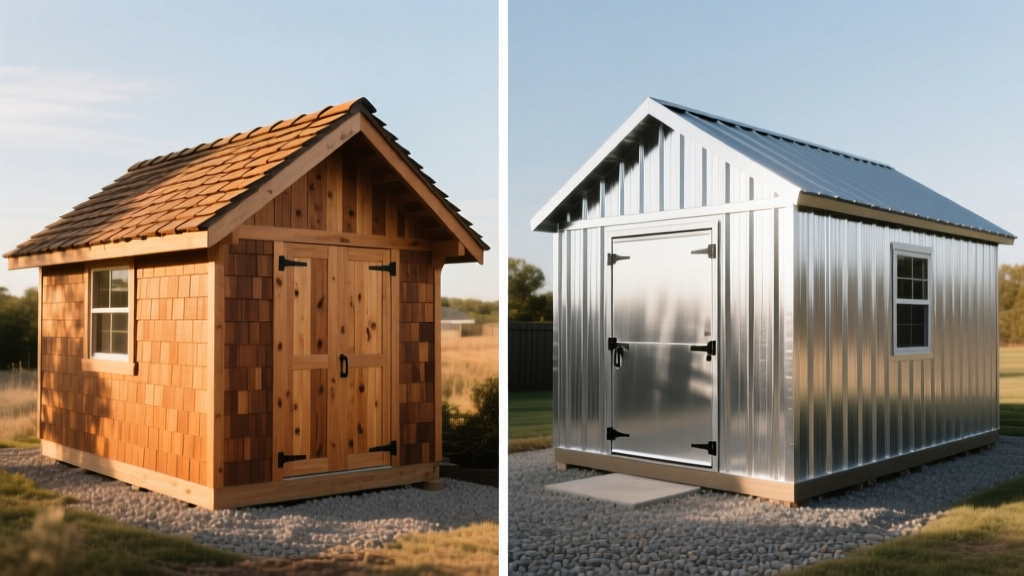
Stick-built wood sheds offer the highest structural integrity. Framing is typically done with #2 grade Spruce-Pine-Fir (SPF) dimensional lumber. For siding, LP Building Solutions manufactures the industry-standard SmartSide engineered wood siding, which features a zinc borate treatment to resist termite and fungal degradation. While T1-11 plywood siding is cheaper upfront (around $1.50 per square foot), LP SmartSide lap siding (approx. $2.50 to $3.50 per square foot) holds paint significantly longer and resists warping, making it the superior choice for long-term cost efficiency.
Metal: The Budget-Conscious Choice
Metal sheds, typically constructed from 29-gauge or 26-gauge galvanized steel, are the most affordable option. However, they come with a critical hidden cost: condensation. In climates with high humidity or significant temperature swings, moisture will accumulate on the interior roof panels and drip onto stored items. To mitigate this, you must install a closed-cell spray foam insulation or a specialized vapor barrier, which can add $1.50 to $3.00 per square foot to your total build cost.
Resin: The Zero-Maintenance Middle Ground
High-density polyethylene (HDPE) resin sheds from brands like Lifetime and Keter feature double-wall construction that resists denting and rot. They are entirely impervious to water damage. The primary limitation is structural: you cannot hang heavy shelving or pegboards directly to resin walls without purchasing proprietary, brand-specific metal reinforcement brackets, which typically cost $40 to $80 per shelf tier.
Foundation Costs: The Hidden Budget Variable
Skipping a proper foundation is the most common cause of premature shed failure. Placing a shed directly on bare soil leads to moisture wicking, floor joist rot, and structural racking. The National Association of Home Builders emphasizes that proper site prep is non-negotiable for structural longevity.
- Concrete Slab (4-inch, 3000 PSI): Costs $8 to $12 per square foot. Requires forming, a 4-inch base of compacted crushed stone, and 6x6 W1.4/W1.4 wire mesh for crack prevention. Best for heavy workshops or storing vehicles.
- Gravel Pad (4-inch crushed #57 stone): Costs $3 to $5 per square foot. Requires excavating 6 inches of topsoil, laying heavy-duty geotextile fabric, and filling with crushed stone. This is the most cost-effective and structurally sound foundation for standard wood and resin sheds.
- Pressure-Treated Skids (4x4 PT Lumber): Costs $1 to $2 per square foot. The cheapest option, but highly susceptible to settling and frost heave in colder climates. Only recommended for temporary or highly portable metal kits.
Labor and Installation: DIY vs. Professional Rates
Labor typically accounts for 40% to 60% of the total cost to build shed projects when hiring professionals. A licensed framing carpenter or specialized shed builder will charge between $70 and $150 per hour, depending on regional labor markets.
The DIY Reality Check
Building an 8x10 stick-built wood shed from scratch requires approximately 40 to 60 hours of skilled labor for a two-person crew. If you lack experience cutting precise roof rafters (using a speed square and rafter tables) or plumbing walls, the risk of structural failure or water intrusion is high. Prefabricated kits reduce DIY assembly time to 12 to 18 hours but require strict adherence to manufacturer torque specs and anchoring requirements.
Roofing and Siding Upgrades: Pros and Cons
Upgrading your exterior envelope drastically impacts both the upfront cost to build shed structures and their long-term maintenance requirements.
| Upgrade | Added Cost | Pros | Cons |
|---|---|---|---|
| Architectural Shingles (vs. 3-tab) | +$1.50/sq ft | 30-year warranty, better wind resistance (130 mph) | Heavier, requires reinforced roof trusses |
| Standing Seam Metal Roof | +$6.00/sq ft | 50-year lifespan, sheds snow easily, no exposed fasteners | High upfront cost, noisy during rainstorms |
| Fiber Cement Siding (e.g., HardiePlank) | +$3.00/sq ft | Fireproof, rot-proof, immune to woodpecker damage | Extremely heavy, requires specialized cutting tools |
Real-World Cost Scenarios
To understand how these variables combine, here are three distinct build scenarios detailing the total cost to build shed structures for different use cases.
Scenario A: The Budget Lawn Storage (8x10 Metal on Skids)
- Shell: 29-gauge galvanized steel kit ($1,400)
- Foundation: 4x4 PT skids on leveled soil ($150)
- Labor: DIY assembly (Weekend project) ($0)
- Total Cost: $1,550
- Best For: Storing a push mower, rakes, and seasonal decorations on a strict budget.
Scenario B: The Backyard Workshop (10x14 Wood on Gravel)
- Shell: Stick-built 2x4 framing with LP SmartSide siding and architectural shingles ($7,500)
- Foundation: 4-inch crushed #57 stone gravel pad with PT perimeter ($800)
- Upgrades: Two double-pane windows, heavy-duty workbench framing, and exterior lighting ($1,200)
- Labor: Professional contractor build ($4,500)
- Total Cost: $14,000
- Best For: Woodworking, potting, or a dedicated hobby space requiring insulation and electrical rough-ins.
Scenario C: The Premium Studio (12x16 Custom on Concrete)
- Shell: Custom timber-frame design with cedar board-and-batten siding and standing seam metal roof ($18,000)
- Foundation: 4-inch reinforced concrete slab with vapor barrier ($2,200)
- Upgrades: French doors, skylights, interior drywall, and mini-split HVAC prep ($6,500)
- Labor: Specialized design-build firm ($12,000)
- Total Cost: $38,700
- Best For: Home offices, art studios, or guest spaces that require full climate control and high-end aesthetics.
Ultimately, defining the exact cost to build shed structures comes down to aligning your material choices with your long-term utility needs. Investing heavily in a robust foundation and moisture-resistant siding like engineered wood or resin will drastically reduce the total cost of ownership over the structure's lifespan, preventing the expensive repairs associated with rot and structural settling.
Written by
James ThorntonJames Thornton is a construction industry veteran with 25 years of hands-on experience in wood framing, lumber grading, and residential building codes. He started as a framing carpenter in rural Oregon, earned his ICC Residential Building Inspector certification, and eventually became a senior plan reviewer for the City of Portland Bureau of Development Services. James holds a B.S. in Wood Science & Technology from Oregon State University and is a certified lumber grader through the West Coast Lumber Inspection Bureau (WCLIB). He has inspected over 3,000 residential construction sites and authored the city's internal guide on advanced framing techniques (2x6 at 24" O.C.). James lives in Bend, OR, where he builds custom timber-frame cabins and competes in lumberjack sports.
More from James Thornton
View all
Insulation
Best Home Insulation Materials: Complete 2026 Guide
Compare top home insulation materials for 2026. Find R-values, installed costs per square foot, and best uses for fiberglass, spray foam, and mineral wool.
Aug 4, 2026

Sustainable Building
Certify Your Green Building Material for LEED and WELL
Step-by-step guide to certifying a green building material for LEED v5 and WELL v2. Master EPDs, HPDs, and VOC limits for 2026 project specifications.
Aug 4, 2026

Stone & Masonry
Veneer Stacked Stone Panels: Interior Design & Style Showcase
Discover how veneer stacked stone panels transform interiors. Explore modern design profiles, material pairings, and technical installation specs.
Aug 4, 2026