How Much Would It Cost to Build a Bunker? 2026 Breakdown
Discover exactly how much it costs to build a bunker in 2026. Detailed pricing breakdown for excavation, concrete shells, blast doors, and NBC filtration.

Answering the Core Question: How Much Would It Cost to Build a Bunker?
Estimating the price of an underground shelter requires separating basic storm cellars from hardened, long-term survival structures. When clients ask how much would it cost to build a bunker, the answer depends entirely on the threat model: are you building for F5 tornadoes, or are you engineering for nuclear fallout and prolonged off-grid habitation? In 2026, material costs for specialized structural steel and reinforced concrete have stabilized, but specialized life-support components remain premium imports.
2026 Bunker Cost Tiers at a Glance
- Tier 1: Basic Storm Shelter (100–200 sq ft): $18,000 – $35,000. Prefabricated corrugated steel or fiberglass, buried 3 feet deep. No independent life support.
- Tier 2: Mid-Range Survival Bunker (500–800 sq ft): $95,000 – $180,000. Poured reinforced concrete, basic NBC (Nuclear, Biological, Chemical) air filtration, 500-gallon water cistern, and generator hookups.
- Tier 3: High-End Hardened Facility (1,500+ sq ft): $350,000 – $1.2M+. EMP-shielded, 6-inch reinforced concrete shell, vault blast doors, independent aquifer well, and advanced hydroponic capabilities.
Phase 1: Site Preparation, Excavation, and Shoring
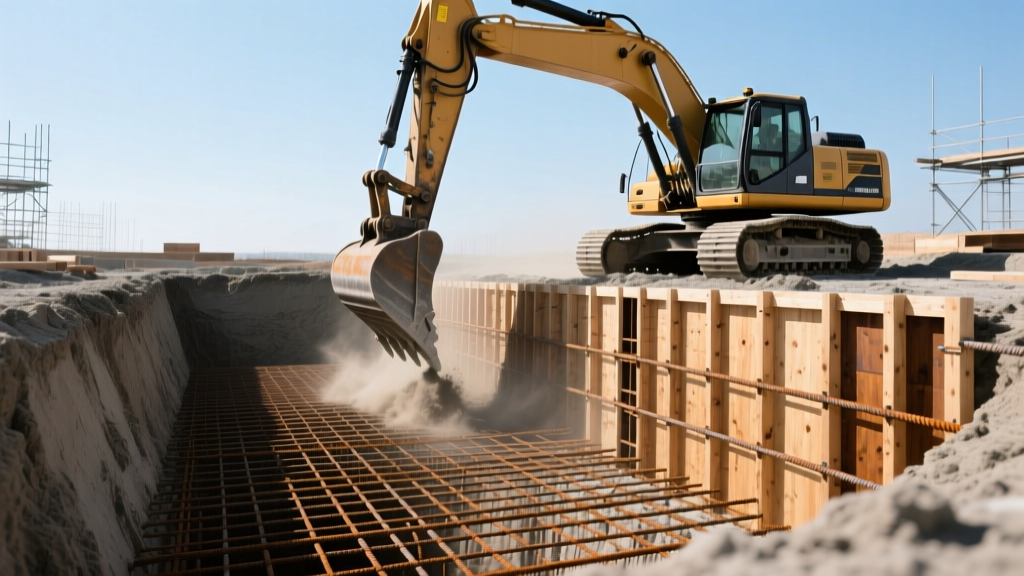
Before any concrete is poured, the earth must be moved. A standard 500-square-foot bunker with an 8-foot interior ceiling requires an excavation pit roughly 12 feet deep to accommodate the foundation, roof thickness, and 3 feet of soil cover for radiation and thermal mass shielding. This translates to moving approximately 220 cubic yards of earth.
In standard soil conditions, excavation and hauling cost between $18 and $28 per cubic yard, totaling $3,900 to $6,100. However, geological edge cases rapidly inflate this budget. If your site sits on bedrock, mechanical blasting or hydraulic hammering is required, pushing excavation costs to $45–$75 per cubic yard. Furthermore, if the local water table is high, you must implement a dewatering system and install a French drain matrix wrapped in geotextile fabric before the foundation is laid, adding $4,500 to $8,000 to the site work.
"Never skip the geotechnical soil report. A $2,500 soil bore test will tell you if your excavation walls will collapse during the pour, potentially saving you $15,000 in emergency shoring and backfill costs."
Phase 2: Structural Shell Materials and Engineering
The shell is the most critical expense. To meet modern blast and fallout resistance standards, engineers specify a minimum of 5,000 PSI concrete mix with a low water-to-cement ratio to prevent cracking and moisture intrusion. Walls and roofs should be a minimum of 8 inches thick, reinforced with a dual-mat grid of #5 rebar spaced at 12 inches on center (O.C.).
| Shell Material | Cost per Sq Ft (Installed) | Blast Resistance | Lifespan |
|---|---|---|---|
| Poured Reinforced Concrete | $140 – $210 | Exceptional (Customizable) | 100+ Years |
| Corrugated Steel Culvert | $90 – $130 | Moderate (Soil-Dependent) | 40 – 60 Years |
| Prefab Fiberglass | $110 – $160 | Low (Tornado/Storm Only) | 50+ Years |
For serious survival applications, poured concrete is the only viable option. The FEMA Building Science Safe Rooms guidelines (specifically P-361 and ICC 500 standards) dictate strict requirements for safe room anchoring and impact resistance, which corrugated steel often fails to meet in severe debris-flow scenarios without massive concrete collars.
Phase 3: Life Support, NBC Filtration, and Hardening
A bunker without independent air and power is merely a concrete tomb. Life support systems represent roughly 20% to 30% of the total budget for a Tier 2 or Tier 3 build.
NBC Air Filtration Systems
You must maintain positive overpressure inside the bunker to prevent contaminated surface air from seeping through micro-cracks in the concrete. A military-grade NBC filtration system, such as those manufactured by Andair or Swiss SafeRoom, pulls outside air through a pre-filter, a HEPA filter for biological agents, and a massive activated carbon bed for chemical and radiological gases. Expect to pay between $12,000 and $18,500 for a rated system capable of supporting 6 to 10 people. Warning: Do not substitute this with a standard HVAC system equipped with a MERV-16 filter; standard systems cannot scrub radioactive iodine or nerve agents, nor can they maintain the necessary 2-3 Pascal overpressure.
Blast Valves and EMP Shielding
All intake and exhaust pipes must be fitted with rapid-acting blast valves that snap shut within milliseconds if a shockwave is detected, preventing the overpressure from a nearby explosion from rupturing your eardrums or destroying your internal lungs. Furthermore, if your threat model includes high-altitude electromagnetic pulses (HEMP), all external wiring, solar arrays, and antenna lines must pass through MIL-STD-188-125 compliant EMP filters, and the bunker's electrical room must be lined in a continuous copper or galvanized steel Faraday mesh. This EMP hardening adds $15,000 to $35,000 to the electrical rough-in.
Phase 4: Blast Doors and Entryways
The entryway is the weakest point of any hardened structure. Standard residential steel doors will fail under the negative pressure phase of a blast wave or buckle under the weight of soil shifting during a seismic event. You must install a dedicated blast door featuring a vault-style multi-point locking mechanism, 3/8-inch solid steel construction, and an integrated EMP gasket. Manufacturers like Swiss Compact or Ronstan produce rated doors that cost between $18,000 and $42,000, depending on the PSI rating and whether they include integrated mechanical gearboxes for easy opening against heavy soil loads.
Hidden Costs That Derail Bunker Budgets
When calculating how much it costs to build a bunker, amateur builders frequently overlook the following expenses:
- Permitting and Zoning Variances ($2,000 - $8,000): Many municipalities do not have specific zoning codes for 'fallout shelters,' forcing you to apply for them as 'uninhabitable storage cellars' or requiring expensive variance hearings.
- Soil Hauling and Backfill ($5,000 - $12,000): You cannot simply push the excavated dirt back over the roof. The soil must be compacted in 6-inch lifts using a vibratory plate compactor to prevent future subsidence and water pooling.
- Crane Services ($3,500 - $7,000 per day): If you are lowering pre-cast concrete sections or massive steel blast doors, a 100-ton mobile crane is required on-site.
- Waste Management Systems ($6,000 - $15,000): Standard septic tanks require gravity drainage. If your bunker is deep, you must install a sealed, macerating sewage ejector pump system to push waste up to the surface leach field.
Frequently Asked Questions
Can I build a bunker under my existing house?
Retrofitting a bunker under an existing foundation is structurally perilous and vastly more expensive than building on an open lot. Underpinning an existing house to excavate beneath it can cost upwards of $300 per square foot just for structural shoring. It is highly recommended to build the bunker in the backyard and connect it via a buried, reinforced concrete tunnel.
How deep does a bunker need to be for nuclear fallout?
According to Ready.gov nuclear explosion guidelines, the earth itself is an excellent radiation shield. Three feet of packed earth reduces gamma radiation exposure by a factor of 1,000 (a Protection Factor of 1,000). Therefore, a bunker buried with 36 inches of soil cover over a reinforced concrete roof provides adequate fallout protection without needing to be excavated to extreme, unmanageable depths.
What is the cheapest way to build a survival bunker?
The most cost-effective approach for a tight budget is to purchase a surplus corrugated steel culvert pipe (typically 8 to 10 feet in diameter), seal the ends with poured concrete bulkheads, and bury it on a rural property. While it lacks the blast resistance of a monolithic concrete pour, it provides excellent tornado protection and basic fallout shielding for under $30,000.
Written by
Sarah WhitfieldSarah Whitfield is a chartered quantity surveyor (MRICS) and construction cost analyst with 15 years of experience in material pricing, procurement strategy, and project budgeting. She earned her degree in Construction Management from the University of Reading (UK) and has worked on projects ranging from $2M custom homes to $180M mixed-use developments across North America and Europe. Sarah currently leads cost estimating for BuildMat Insight, maintaining a proprietary database of 4,000+ material price points updated quarterly. She is a frequent contributor to RSMeans cost data panels and has presented at the International Cost Engineering Council (ICEC) congress. Based in Denver, CO, Sarah is an avid trail runner and volunteer mentor for Women in Construction.
More from Sarah Whitfield
View all
Wood & Lumber
What Are the Different Types of Wood? A Builder's Guide
Compare structural softwoods, finish hardwoods, and engineered lumber. Analyze Janka ratings, MOE values, and 2026 pricing for construction.
Aug 4, 2026

Walls & Panels
Steel Framing vs Wood Framing: Corrosion and Moisture Defense
Compare steel framing vs wood framing for moisture resistance. Learn about galvanized coatings, condensation risks, and corrosion protection strategies.
Jul 21, 2026

Stone & Masonry
How to Cut Stone Veneer: Wet Saw vs Grinder Comparison
Compare the best tools for cutting stone veneer. We review wet saws, angle grinders, and chop saws to help you achieve clean, chip-free cuts.
Jul 21, 2026