How Much Does a Cruise Ship Cost to Build? Size & Scope Breakdown
Discover how much a cruise ship costs to build. Our size and scope calculator breaks down tonnage, passenger capacity, and interior fit-out expenses.

Estimating the capital expenditure for a modern cruise vessel requires moving beyond simple square footage or weight metrics. When maritime executives and naval architects ask, how much does a cruise ship cost to build, the answer is dictated by a complex interplay of gross tonnage (GT), passenger berth count, propulsion technology, and interior theming. In 2026, with global shipyard order books full through the end of the decade and stringent environmental regulations in force, the cost matrix has shifted dramatically from historical baselines.
This guide serves as a size and scope calculator for maritime investors, marine engineers, and procurement teams, breaking down the exact financial variables that dictate the final delivery price of a cruise vessel.
The Economics of Scale: Cost Per Berth vs. Gross Tonnage
Unlike commercial cargo vessels, which are priced primarily by deadweight tonnage (DWT), cruise ships are evaluated on a Cost Per Berth (passenger capacity) and Cost Per Gross Ton (internal volume) basis. Gross Tonnage is a measure of enclosed volume, not weight, and it directly correlates to the revenue-generating 'hotel' spaces onboard.
Industry Benchmark Rule of Thumb
In the current shipbuilding market, mainstream mega-ships average $220,000 to $280,000 per lower berth. Conversely, ultra-luxury and expedition vessels can exceed $600,000 to $850,000 per berth due to high space-to-passenger ratios, specialized ice-class hulls, and bespoke interior finishes.
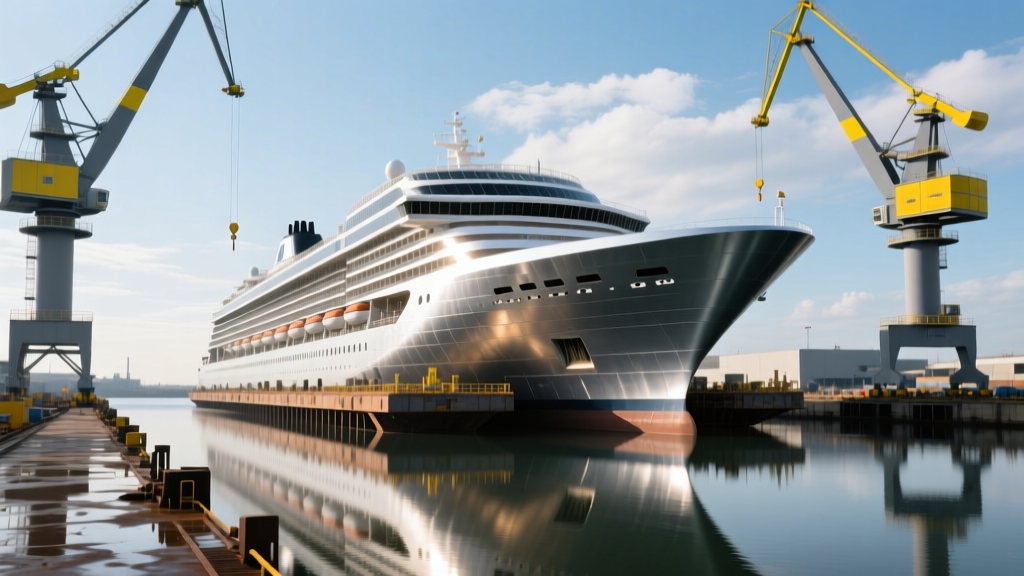
Size & Scope Cost Matrix: 2026 Ship Classes
The table below outlines the estimated base construction costs across the three primary cruise ship categories, factoring in current steel prices, labor rates at the 'Big Three' cruise shipyards (Fincantieri, Meyer Werft, and Chantiers de l'Atlantique), and standard propulsion systems.
| Ship Category | Gross Tonnage (GT) | Passenger Capacity | Est. Total Cost (USD) | Cost Per Berth |
|---|---|---|---|---|
| Expedition / Boutique | 10,000 - 35,000 | 100 - 600 | $150M - $400M | $500k - $800k+ |
| Premium / Mid-Size | 60,000 - 120,000 | 1,500 - 3,000 | $600M - $1.1B | $300k - $450k |
| Ultra-Large / Mega | 180,000 - 250,000+ | 4,500 - 7,500 | $1.4B - $2.2B | $220k - $320k |
The 40/60 Rule: Hull & Machinery vs. The 'Hotel'
A common mistake in early-stage scoping is underestimating the interior fit-out. A cruise ship is essentially a floating resort, and the division of capital expenditure generally follows the 40/60 rule.
1. Base Hull, Machinery & Propulsion (35% - 45% of Total Cost)
This covers the steel cutting, block assembly, welding, and the installation of the power plant. Modern vessels utilize advanced steel grades to reduce hull weight while maintaining structural integrity against hogging and sagging stresses in open ocean swells. The propulsion system—typically diesel-electric with ABB Azipod azimuth thrusters—represents a massive capital outlay. A single high-power Azipod unit can cost upwards of $15 million, and a mega-ship requires three to four for optimal maneuverability and fuel efficiency.
2. The 'Hotel' & Interior Fit-Out (55% - 65% of Total Cost)
The 'hotel' encompasses everything above the main deck bulkheads: HVAC systems, plumbing, cabin modules, theaters, dining venues, and elaborate thematic elements. Cabin modules are often prefabricated off-site and slotted into the steel framework like drawers. However, public spaces require custom architecture. For example, a multi-deck atrium with a custom kinetic light sculpture and reinforced glass bulkheads can add $20 million to the fit-out budget alone.
Propulsion & Regulatory Cost Drivers
The regulatory landscape governed by the International Maritime Organization (IMO) has fundamentally altered shipbuilding costs. The push toward decarbonization means new builds must integrate alternative fuels or advanced exhaust scrubbing systems.
- LNG Dual-Fuel Systems: Liquefied Natural Gas (LNG) is currently the standard for new mega-ships. Integrating cryogenic LNG bunkering tanks and dual-fuel engines (like those from WinGD or MAN Energy Solutions) adds approximately 15% to 20% to the total propulsion and machinery budget compared to traditional Heavy Fuel Oil (HFO) setups.
- Shore Power Connectivity: Vessels must now be equipped with high-voltage shore connection (HVSC) systems to plug into port grids while docked, eliminating auxiliary engine emissions. This requires specialized onboard transformers and switchboards, adding $3M - $5M to the electrical scope.
- SOLAS Compliance: The Safety of Life at Sea (SOLAS) treaty mandates rigorous fire zoning, redundant navigation systems, and lifeboat capacities. Sourcing marine-grade, non-combustible interior materials that meet stringent fire safety codes is significantly more expensive than commercial real estate equivalents.
Hidden Expenses: Sea Trials, Classification, and Yard Fees
When calculating the final scope, procurement teams must allocate budget for the 'soft costs' and post-construction validation phases. These are frequently omitted from headline shipyard contract prices.
Don't Forget the Classification Society Fees
Every cruise ship must be classed by a recognized society (e.g., DNV, Lloyd's Register, or ABS). These organizations survey the vessel at every construction milestone to ensure compliance with structural and safety standards. Classification fees, plan approvals, and sea trial certifications can easily exceed $5 million over a three-year build cycle.
Additionally, Sea Trials require the shipyard to fuel the vessel, hire a skeleton crew, and run the ship through rigorous speed, crash-stop, and maneuvering tests in open water. The fuel costs for a multi-day sea trial on a 250,000 GT vessel can exceed $1 million. Finally, owners must budget for Owner's Supplies—the loose inventory ranging from galley equipment and linens to IT servers and casino slot machines—which typically requires an additional $20M to $40M in procurement outside the shipyard contract.
Real-World Case Studies: The 2026 Fleet
To contextualize these metrics, consider the recent benchmarks set by the industry's largest players, as tracked by maritime analysts and global trade logistics reports:
Royal Caribbean's Icon Class
At roughly 250,800 GT and a capacity of over 7,000 passengers, the Icon-class vessels represent the pinnacle of the ultra-large category. With an estimated build cost of $2.0 billion to $2.2 billion per ship, the cost per berth sits around $285,000. The high cost is driven by the integration of LNG propulsion, fuel cell technology, and massive, structurally complex public spaces like the 'AquaDome' and 'Central Park' biomes.
Scenic Eclipse II (Expedition/Discovery Yacht)
At the opposite end of the spectrum, this 17,000 GT vessel carries just 228 passengers. Priced at approximately $250 million, the cost per berth exceeds $1 million. The exorbitant per-berth cost is justified by its PC6 Ice-Class hull (requiring thicker, specialized steel), two onboard helicopters, a submarine, and ultra-luxury interior finishes that rival five-star boutique hotels.
Summary: Scoping Your Build
Determining how much a cruise ship costs to build requires a granular approach to the vessel's intended operational profile. A mainstream Caribbean cruiser prioritizes maximum berth density and high-throughput dining, keeping the per-berth cost lower through economies of scale. Conversely, an expedition vessel prioritizes hull strength, dynamic positioning systems, and high space-to-guest ratios, driving the per-berth cost to the top of the global market. When utilizing this size and scope framework, always apply a 12% to 15% contingency buffer to the shipyard contract price to account for supply chain volatility in global steel markets and late-stage owner change orders.
Written by
Marcus ChenMarcus Chen is a licensed structural engineer (PE) and building materials analyst with over 12 years of experience across residential, commercial, and industrial construction. He holds a Master of Science in Civil Engineering from UC Berkeley and spent six years at Thornton Tomasetti before transitioning to independent consulting and technical writing. Marcus specializes in material selection for seismic-prone regions, concrete reinforcement strategies, and lifecycle cost analysis. His work has been cited by the American Concrete Institute (ACI) and the Structural Engineers Association of California (SEAOC). When he is not on a job site or at his desk, you will find him hiking the Sierra Nevada or restoring a 1920s craftsman bungalow in Oakland, CA.
More from Marcus Chen
View all
Construction Cost
How Much Did the Eiffel Tower Cost to Build?
How much did the Eiffel Tower cost to build in 1889? We adjust for inflation and compare its budget to modern skyscraper construction.
Aug 4, 2026

Fire Resistance
What Is a Fire Resistant Material? Testing & Certification Guide
Discover what is a fire resistant material through ASTM and UL testing. Learn how fire ratings, certifications, and assemblies work in construction.
Aug 4, 2026

Construction Cost
How Much Did the Burj Khalifa Cost to Build?
How much did the Burj Khalifa cost to build? We break down the $1.5B project and extract 5 money-saving strategies for your next build.
Jul 30, 2026