Financing the Cost to Build a House in Indiana: A Complete Guide
Discover how to finance the cost to build a house in Indiana. Compare construction loans, USDA options, and draw schedules for your custom build.
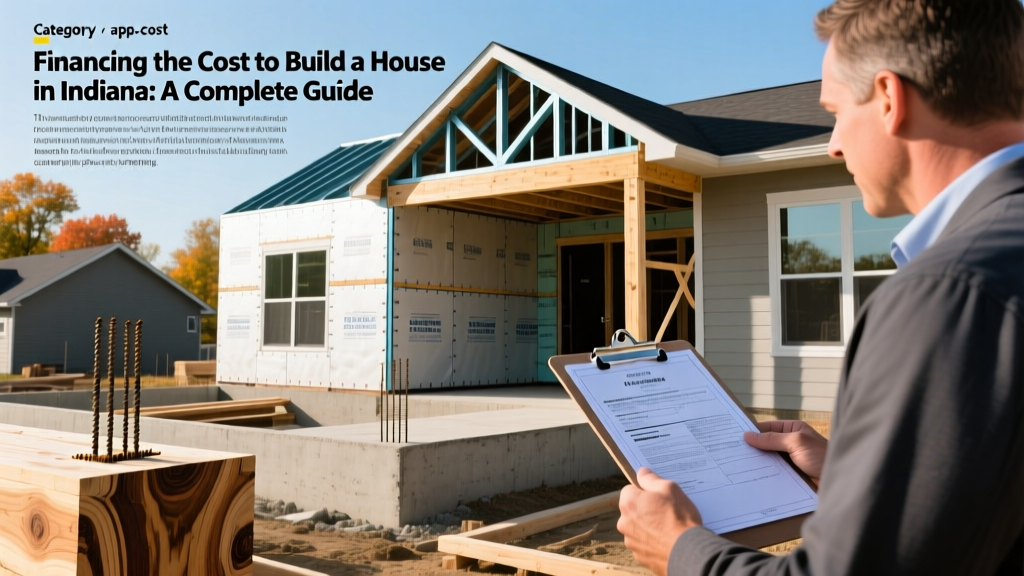
The Baseline: Calculating the True Cost to Build a House in Indiana
Before approaching a lender, you must establish a highly accurate baseline budget. The total cost to build a house in Indiana varies dramatically depending on whether you are building in the suburban corridors of Hamilton County or the rural expanses of Starke County. As of 2026, standard production-style builds average between $125 and $165 per square foot, while fully custom architectural homes routinely push past $220 per square foot. For a 2,200-square-foot custom home, your hard construction costs will range from $275,000 to $484,000, excluding land acquisition, site preparation, and utility tap fees.
Lenders will not finance a vague estimate. They require a line-item budget backed by a licensed general contractor. When evaluating the cost to build a house in Indiana, your budget must explicitly separate hard costs (lumber, concrete, labor) from soft costs (architectural fees, permits, soil testing). According to data from the National Association of Home Builders, soft costs typically account for 15% to 20% of the total project budget, yet many first-time builders fail to include them in their initial loan applications, resulting in severe underfunding.
Primary Financing Vehicles for Indiana Custom Builds
Financing a ground-up build requires specialized mortgage products. Standard 30-year fixed mortgages cannot be used until the home is complete and a certificate of occupancy (CO) is issued. Here are the primary loan structures available to Indiana builders:
Construction-to-Permanent (Single-Close) Loans
This is the gold standard for custom builds. You close once, securing both the short-term construction financing and the long-term 30-year mortgage. During the 9-to-12-month build phase, you make interest-only payments on the funds actually drawn. Once the home is complete, the loan automatically converts to a standard mortgage without requiring a second closing, saving you thousands in duplicate origination and title fees.
FHA One-Time Close (OTC) Construction Loans
For buyers with lower down payment reserves, the FHA OTC loan requires just 3.5% down. However, the FHA imposes strict county-level loan limits. In 2026, the FHA single-family loan limit for most Indiana counties is $498,257, though higher-cost areas near Indianapolis may have slightly elevated ceilings. The primary drawback is that the FHA requires you to use an FHA-approved builder, which can limit your choice of custom, boutique contractors.
Conventional Standalone Construction Loans
These are short-term (typically 12 months), interest-only loans that require a second closing to convert to a permanent mortgage. While they offer more flexibility in builder selection and design, they carry the risk of interest rate fluctuations between the first and second closings. If mortgage rates spike during your build, your permanent mortgage payment will increase accordingly.
The USDA Advantage in Rural Indiana
Indiana has 92 counties, and the vast majority of the state's landmass qualifies for USDA Rural Development housing programs. The USDA Section 502 Direct and Guaranteed loan programs offer 0% down payment construction-to-permanent financing. If your build site is located outside the incorporated limits of major metros like Fort Wayne, Evansville, or South Bend, you can leverage USDA construction loans to finance both the land and the build with zero money down, provided your household income falls within the county's adjusted median limits.
Mitigating Interest Carry Costs During Indiana Winters
One of the most heavily overlooked financial risks when calculating the cost to build a house in Indiana is the impact of the Midwestern freeze-thaw cycle on your loan's interest carry. Construction loans accrue interest daily on disbursed funds. If you break ground in late October or November, you risk hitting frozen ground by December.
When the ground freezes, excavators cannot dig footings, and concrete trucks cannot pour foundations without expensive ground-thawing equipment and insulated blankets. This can halt vertical progress for 60 to 90 days. During this standstill, you are still paying monthly interest on your land loan and any initial site-prep draws, but you have no vertical equity to show for it.
Strategic Fix: Time your loan closing and initial ground-breaking for early March. By aligning your foundation and framing phases with the dry, warming months of April and May, you ensure rapid draw disbursements and minimize dead-interest periods. If you must build through the winter, negotiate a 15% contingency reserve into your loan specifically earmarked for winter construction premiums, such as concrete heating admixtures and temporary site enclosures.
Structuring Your Builder Draw Schedule
Lenders do not hand the builder a lump sum. Funds are released in "draws" tied to specific completion milestones. An improperly structured draw schedule can bankrupt a builder or stall your project. In Indiana, a standard custom build utilizes a 5-draw or 6-draw schedule. Below is the industry-standard matrix for Midwestern construction financing:
| Draw Phase | Completion Milestone | Typical Fund Release |
|---|---|---|
| Draw 1 | Site prep, excavation, and foundation pouring | 15% - 20% |
| Draw 2 | Framing, roof trusses, and sheathing (Dried-in) | 25% - 30% |
| Draw 3 | MEP rough-ins (Mechanical, Electrical, Plumbing) and insulation | 20% - 25% |
| Draw 4 | Drywall, interior trim, cabinets, and exterior siding | 20% - 25% |
| Draw 5 | Final finishes, flooring, landscaping, and Certificate of Occupancy | 10% - 15% |
Never agree to a front-loaded draw schedule where the builder requests 40% or more before the home is framed and dried-in. If a contractor demands heavy upfront capital to "buy materials," it is a severe red flag indicating poor cash flow management. A reputable Indiana builder will have established credit lines with local lumberyards (like Carter Lumber or 84 Lumber) and will not require your loan funds to purchase basic framing packages.
Using Land Equity as Your Down Payment
If you already own the lot where you intend to build, the Indiana Housing and Community Development Authority and conventional lenders allow you to use your land equity as your down payment. This is known as an "equity injection."
For example, if the total cost to build a house in Indiana on your specific project is $400,000, and you own a fully paid-off lot appraised at $80,000, that $80,000 represents a 20% equity injection. The lender will treat your land as the down payment, allowing you to finance the full $400,000 construction cost without bringing liquid cash to the closing table. However, the lender will require a fresh, independent appraisal of the raw land. If the land was purchased more than 12 months ago, the lender will use the current appraised value or the original purchase price, whichever is lower, to prevent inflated equity claims.
Frequently Asked Questions
Do I need to pay property taxes while building my house in Indiana?
Yes, but not at the residential rate. During construction, your land is typically taxed as vacant or agricultural property. Once the home is complete and the county assessor updates the property card, your tax burden will increase significantly. Ensure your post-construction escrow estimates account for the new, higher assessed value.
What happens if my construction loan expires before the house is finished?
Most construction loans have a 12-month term. If supply chain delays or severe Indiana weather push your build past 12 months, you must request a loan extension. Lenders typically grant one 3-to-6-month extension, but they will charge an extension fee (usually 0.5% to 1% of the loan balance) and may require you to inject additional cash reserves to cover the extended interest carry.
Are impact fees included in the construction loan?
They must be. Indiana municipalities charge varying tap fees for water, sewer, and stormwater management. In rapidly growing counties like Boone or Hendricks, these municipal impact fees can exceed $15,000. Ensure your general contractor explicitly lists municipal tap fees in the soft-cost section of the loan budget so the lender includes them in the total loan amount.
Written by
Priya KapoorPriya Kapoor is a real estate market analyst and construction economics researcher with expertise in housing affordability, development feasibility, and infrastructure investment. She holds a Master of Regional Planning from Cornell University and previously worked as a senior analyst at CBRE's Investment Properties group, where she modeled returns for $4B in mixed-use development pipelines. Priya now runs an independent research practice advising developers, municipalities, and REITs on construction cost forecasting and market timing. She publishes the quarterly "BuildMat Market Pulse" report tracking material price indices across 12 commodity categories. Based in Austin, TX, Priya serves on the board of Habitat for Humanity Austin and is a marathon runner.
More from Priya Kapoor
View all
Construction Cost
Cost to Build a 1600 Sq Ft Home in 2026: Full Breakdown
Accurate 2026 cost to build a 1600 sq ft home—material, labor, and regional pricing breakdowns included. Plan your budget with real-time estimates.
Aug 11, 2026

Wood & Lumber
Name the Types of Wood for Pressure Treatment and Preservation
Learn how to name the types of wood best suited for pressure treatment. Compare species treatability, chemical retention levels, and 2026 preservation costs.
Aug 4, 2026

Stone & Masonry
Stone Veneer Suppliers Lindenhurst: 2026 Cost Analysis
Analyze 2026 stone veneer costs in Lindenhurst, NY. Compare local supplier pricing, delivery fees, and Suffolk County installation labor rates.
Aug 4, 2026