Financing the Cost to Build Storage Units: A Complete Guide
Discover how to finance the cost to build storage units. Compare SBA loans, conventional debt, and capital stack strategies for self-storage construction.
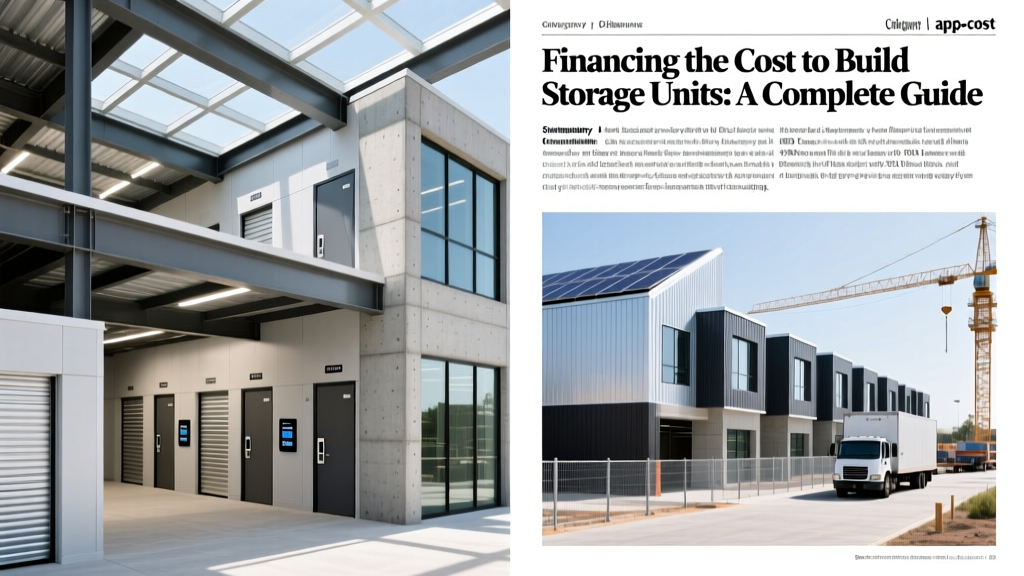
The Real Cost to Build Storage Units: Hard vs. Soft Costs
Securing capital for a self-storage development requires a precise understanding of where the money goes. The cost to build storage units has shifted significantly, driven by fluctuations in structural steel pricing, concrete foundation requirements, and specialized climate-control HVAC systems. Before approaching a lender, you must separate hard construction costs from soft costs and land acquisition.
According to recent construction data tracked by the U.S. Census Bureau, commercial building costs remain elevated. For self-storage, single-story, non-climate-controlled facilities typically range from $45 to $65 per square foot for hard costs. Multi-story, climate-controlled facilities push that figure to $90 to $140+ per square foot due to the need for reinforced concrete decks, elevators, and specialized vapor barriers.
| Cost Category | Single-Story (Non-Climate) | Multi-Story (Climate-Controlled) | Notes & Edge Cases |
|---|---|---|---|
| Site Work & Grading | $4.00 - $8.00 / sq ft | $6.00 - $12.00 / sq ft | Heavily dependent on soil conditions; rock blasting can double this. |
| Foundation & Concrete | $6.00 - $10.00 / sq ft | $15.00 - $25.00 / sq ft | Multi-story requires deep piles and reinforced post-tension slabs. |
| Steel Erection & Framing | $12.00 - $18.00 / sq ft | $18.00 - $28.00 / sq ft | Subject to global steel tariffs and supply chain lead times. |
| Roofing & Exterior Skin | $5.00 - $9.00 / sq ft | $8.00 - $14.00 / sq ft | Insulated metal panels (IMPs) required for climate control. |
| HVAC & Climate Control | $0.50 - $1.50 / sq ft | $12.00 - $18.00 / sq ft | Requires commercial dehumidification and zoned mini-split or VRF systems. |
| Soft Costs (Permits, Arch) | 12% - 18% of Hard Costs | 15% - 22% of Hard Costs | Includes architectural, engineering, legal, and loan origination fees. |
Primary Financing Vehicles for Self-Storage Construction
Unlike multifamily or industrial real estate, self-storage is frequently classified by lenders as a 'special purpose' property. This is because a failed storage facility cannot be easily converted into office space or apartments without massive capital expenditure. This perceived risk dictates the financing vehicles available to developers.
Comparing the Top Debt Structures
| Loan Type | Max LTV / LTC | Typical Term | Interest Rate Structure | Best Use Case |
|---|---|---|---|---|
| SBA 504 Loan | 85% - 90% | 25 Years (Amortized) | First Mortgage (Market) + CDC Debenture (Fixed) | Owner-occupied or long-term hold sponsors with 15% equity. |
| SBA 7(a) Loan | 85% - 90% | 10 - 25 Years | Prime + Spread (Variable or Fixed) | Sponsors needing to finance heavy soft costs or working capital. |
| Conventional C2P (Construction-to-Permanent) | 65% - 75% | 12-24 Mo (Const) / 5-10 Yr (Perm) | SOFR + 250-400 bps | Highly experienced sponsors with strong balance sheets. |
| Private Debt Fund / Hard Money | 70% - 80% LTC | 12 - 36 Months | SOFR + 500-900 bps | Fast closings, distressed land, or sponsors lacking bank liquidity. |
The Underwriting Gauntlet: Metrics Lenders Demand
When underwriting the cost to build storage units, lenders do not just look at the appraisal; they stress-test the project's future cash flow against current debt markets. You must present a proforma that satisfies three critical metrics.
1. Debt Service Coverage Ratio (DSCR)
Lenders require a minimum DSCR of 1.25x to 1.35x for self-storage. This means your projected Net Operating Income (NOI) must be 25% to 35% higher than your annual debt service. Because storage facilities take 18 to 36 months to reach stabilization (85%+ occupancy), lenders will underwrite the DSCR based on a 'stabilized year 3' proforma, but they will require an interest reserve to cover the shortfall during the lease-up phase.
2. Debt Yield
Debt Yield (NOI / Loan Amount) is a metric that ignores interest rate fluctuations and amortization schedules. Most institutional lenders and CMBS conduits require a minimum Debt Yield of 10% to 12% for self-storage. If your projected stabilized NOI is $500,000, a 10% debt yield caps your maximum loan amount at $5,000,000, regardless of what the appraisal says.
3. Loan-to-Cost (LTC) vs. Loan-to-Value (LTV)
During construction, lenders lend against the cost (LTC), not the as-completed value (LTV). If your total project cost is $8,000,000 and the as-completed appraisal is $10,000,000, a 70% LTC loan yields $5,600,000. You must bring the remaining $2,400,000 (30%) as equity or mezzanine debt. Lenders will fund the project via monthly draws based on the percentage of completion, verified by a third-party inspector.
Structuring the Capital Stack
Rarely does a single loan cover the entire cost to build storage units. Developers assemble a 'capital stack' to bridge the gap between senior debt and total project costs. Here is how a typical $10M ground-up storage project is structured in the current market:
- Senior Construction Debt (60% - 65%): The primary bank loan. This is the cheapest capital but has the strictest covenants. It covers hard costs and a portion of soft costs.
- Interest Reserve (5%): Lenders require you to budget 6 to 12 months of interest payments into the loan itself. This ensures the bank gets paid while the facility is leasing up and cash flow is negative.
- Mezzanine Debt or Preferred Equity (10% - 15%): If the senior lender only provides 65% LTC, you may need mezzanine debt to reach 80% LTC. Mezzanine lenders sit second in priority and charge higher rates (often 12% to 16% unlevered), but they do not require personal guarantees in the same way senior banks do.
- Sponsor Equity (15% - 25%): Your 'skin in the game.' Banks will not issue a construction loan unless the sponsor has already injected their equity into the project before the first bank draw is released.
Hidden Capital Traps That Derail Funding
Even well-capitalized sponsors see their financing collapse due to non-obvious edge cases in the self-storage sector. Protect your capital stack by anticipating these specific hurdles:
The 'Special Purpose' SBA Classification
Under standard SBA 504 rules, borrowers can put down just 10%. However, the SBA classifies self-storage as a 'Special Purpose Property' (SOP 50 10). Because the building's utility is tied strictly to its storage use, the SBA mandates a 15% equity injection. If your financial model assumes 10% down, your capital stack will be short by 5% at closing, potentially killing the deal.
Phase 1 Environmental Site Assessment (ESA) Failures
Lenders require a Phase 1 ESA (conducted to ASTM E1527-21 standards) before finalizing construction debt. If the land was previously a gas station, dry cleaner, or agricultural site, the Phase 1 will trigger a Phase 2 subsurface soil test. This delays closing by 60 to 90 days and costs $10,000 to $30,000. Worse, if contamination is found, the lender will immediately pull the term sheet, and you will be left holding the land.
Zoning and Entitlement Contingencies
Never close on a land loan or hard money construction loan without your zoning entitlements fully secured. Self-storage facilities face intense NIMBY (Not In My Back Yard) opposition from local municipalities who view them as low-tax-revenue generators compared to retail or residential. If your construction loan rate lock expires while you are stuck in planning board appeals, the rate reset can destroy your DSCR and violate the lender's debt yield requirements.
The Stabilization Refinance Gap
Construction loans are short-term (12-24 months). To pay off the construction loan, you must refinance into a permanent commercial mortgage. However, permanent lenders require the facility to be 'stabilized' (typically 80% to 85% physical occupancy). If local market saturation slows your lease-up and you are only at 60% occupancy when the construction loan matures, you will be forced to extend the construction loan at punitive default rates or bring in expensive rescue capital. Always negotiate a minimum 12-month extension option on your construction facility before signing the initial note.
Written by
Priya KapoorPriya Kapoor is a real estate market analyst and construction economics researcher with expertise in housing affordability, development feasibility, and infrastructure investment. She holds a Master of Regional Planning from Cornell University and previously worked as a senior analyst at CBRE's Investment Properties group, where she modeled returns for $4B in mixed-use development pipelines. Priya now runs an independent research practice advising developers, municipalities, and REITs on construction cost forecasting and market timing. She publishes the quarterly "BuildMat Market Pulse" report tracking material price indices across 12 commodity categories. Based in Austin, TX, Priya serves on the board of Habitat for Humanity Austin and is a marathon runner.
More from Priya Kapoor
View all
Construction Cost
Cost to Build a 1600 Sq Ft Home in 2026: Full Breakdown
Accurate 2026 cost to build a 1600 sq ft home—material, labor, and regional pricing breakdowns included. Plan your budget with real-time estimates.
Aug 11, 2026

Wood & Lumber
Name the Types of Wood for Pressure Treatment and Preservation
Learn how to name the types of wood best suited for pressure treatment. Compare species treatability, chemical retention levels, and 2026 preservation costs.
Aug 4, 2026

Stone & Masonry
Stone Veneer Suppliers Lindenhurst: 2026 Cost Analysis
Analyze 2026 stone veneer costs in Lindenhurst, NY. Compare local supplier pricing, delivery fees, and Suffolk County installation labor rates.
Aug 4, 2026