How Much Did It Cost to Build the Titanic? Mega-Project Budgeting
Discover how much it cost to build the Titanic, breaking down the 1912 budget, modern inflation equivalents, and mega-project budget planning lessons.

The Original Price Tag: Answering How Much Did It Cost to Build the Titanic
When analyzing historical mega-projects for modern budget planning frameworks, few case studies offer as much insight as the RMS Titanic. To answer the fundamental question of how much did it cost to build the Titanic, we must look at the final ledger presented by the Harland & Wolff shipyard in Belfast. The final construction cost was approximately £1.5 million, which translated to roughly $7.5 million in 1912 US dollars. While this figure seems remarkably low by contemporary standards, it represented an unprecedented capital expenditure at the time, equivalent to the gross domestic product of several small nations.
Total Construction Cost: £1,500,000 (1912)
1912 USD Equivalent: $7,500,000
Adjusted for General CPI Inflation (2026): ~$235,000,000
Adjusted for Maritime Construction Index (2026): ~$450,000,000+
Understanding this cost requires more than a simple inflation calculator. For construction estimators and project managers, the Titanic serves as a masterclass in contract structuring, material procurement, and the fatal consequences of aggressive value engineering.
The Cost-Plus Contract: A Budget Planning Masterclass
The most critical budget planning detail regarding the Titanic's construction is the contractual arrangement between the White Star Line and Harland & Wolff. The ship was not built under a fixed-price or lump-sum contract. Instead, it utilized a cost-plus percentage contract. Under this agreement, White Star Line paid for all raw materials, labor, and overhead at cost, plus a guaranteed 5% profit margin for the shipyard.
From a modern estimating perspective, this shifts all financial risk of material price fluctuations and labor inefficiencies onto the client (White Star Line) while guaranteeing the contractor's profitability. While this ensured that Harland & Wolff would never cut corners on material quality to protect their margins, it also removed the financial incentive for the shipyard to optimize labor efficiency or minimize waste. For modern mega-projects, cost-plus contracts are typically reserved for highly complex, rapidly evolving scopes where a fixed price is impossible to accurately estimate upfront. However, without a Guaranteed Maximum Price (GMP) cap, the client remains entirely exposed to budget creep.
Line-Item Cost Estimation: Where the £1.5 Million Went
Breaking down the historical ledger provides a fascinating look at early 20th-century naval architecture economics. The budget was heavily skewed toward the physical hull and the massive propulsion machinery, with interior fittings representing a smaller, though highly visible, portion of the total expenditure.
| Cost Category | 1912 Estimate (£) | % of Total Budget | Modern Estimating Equivalent |
|---|---|---|---|
| Hull & Steelwork | £600,000 | 40% | Structural & Envelope |
| Machinery & Boilers | £450,000 | 30% | MEP & Propulsion |
| Interior Fittings | £300,000 | 20% | Architectural Finishes |
| Insurance & Contingency | £150,000 | 10% | Risk & Builder's Risk |
The hull was constructed using Siemens-Martin open-hearth steel, a premium material at the time that cost roughly £4 to £5 per ton. The ship required approximately 26,000 tons of steel. Today, estimators use parametric modeling based on tonnage and material grade, but in 1912, the sheer volume of manual riveting—over 3 million rivets—drove massive labor costs that modern automated welding has virtually eliminated.
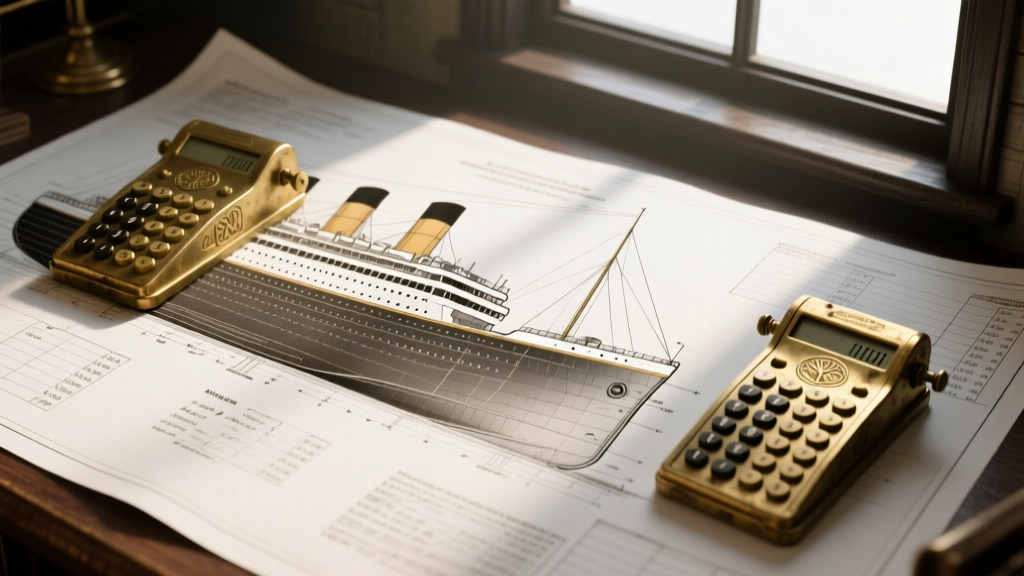
Value Engineering vs. Safety: The Bulkhead Budget Compromise
One of the most vital lessons in construction budget planning is the danger of value engineering compromising the core safety case. The Titanic featured 16 watertight compartments divided by transverse bulkheads. However, to save weight, reduce material costs, and maximize first-class passenger space on the upper decks, these bulkheads were not extended all the way up to the main watertight deck. They stopped at the E or D decks.
According to historical archives maintained by Titanic Belfast, the pursuit of luxury and spatial aesthetics routinely overrode redundant safety engineering in the upper decks, a classic example of scope creep diluting the safety budget.
Inflation and the Modern Equivalent: What Would It Cost in 2026?
Calculating the modern equivalent of the Titanic's construction cost requires separating general consumer inflation from specialized maritime construction inflation. Using the Bureau of Labor Statistics CPI inflation calculator, $7.5 million in 1912 equates to roughly $235 million today. However, this is a gross underestimation for a modern build.
If you were to commission a ship of the exact same physical dimensions (882 feet long, 46,000 gross tons) in 2026, the cost would easily exceed $450 million. Why the discrepancy? Modern naval architecture is governed by the International Convention for the Safety of Life at Sea (SOLAS), which was established directly in response to the Titanic disaster. A modern equivalent would require:
- Double-hull construction: Increasing steel tonnage and complexity by 30%.
- Advanced MEP systems: Modern HVAC, desalination, and electrical redundancy systems that did not exist in 1912.
- Life-saving appliances: Enclosed lifeboats for 100% of passengers and crew, plus marine evacuation systems.
- Digital navigation: Radar, sonar, and automated damage control sensors.
To put this in perspective, modern Oasis-class cruise ships, which are roughly three times the size of the Titanic, cost between $1.5 billion and $2 billion to build. The cost per gross ton has skyrocketed due to regulatory compliance and technological integration, proving that historical analog estimating must always apply a heavy complexity multiplier.
Applying Historical Cost Data to Modern Parametric Estimating
While you will never build the Titanic today, the methodologies used to analyze its budget are foundational to modern parametric estimating. When estimators lack detailed engineering drawings in the conceptual phase, they rely on historical analogs. Here is the framework for adapting historical data to current budget planning:
- Normalize the Unit of Measure: Convert historical costs to a standard metric, such as Cost Per Gross Ton (CPGT) or Cost Per Square Foot. The Titanic's CPGT was roughly £32. Modern cruise ships operate at a CPGT of $8,000 to $12,000.
- Apply Location & Labor Factors: The Titanic was built in Belfast, leveraging cheap, abundant manual labor. Adjust historical labor rates using current local prevailing wage data and union indexes.
- Factor in Regulatory Multipliers: Identify the building codes or maritime regulations introduced after the historical project. Assign a percentage premium (typically 15-25%) for modern code compliance, fireproofing, and environmental controls.
- Adjust for Technological Obsolescence: Remove costs for obsolete techniques (e.g., manual riveting, coal bunkers) and insert costs for modern equivalents (e.g., automated welding, LNG dual-fuel engines).
Frequently Asked Questions
Did the Titanic construction experience cost overruns?
Because the contract was a cost-plus agreement, traditional 'overruns' did not exist in the way they do in fixed-price contracts. Any increase in material costs or labor hours was simply passed on to the White Star Line. However, the final £1.5 million price tag was slightly higher than initial conceptual estimates due to late-stage design changes requested by J.P. Morgan and the White Star Line executives, particularly regarding the expansion of first-class parlor suites.
How much did it cost to insure the Titanic during construction?
Builder's risk insurance and marine insurance for the vessel during its construction and sea trials cost approximately £75,000. Interestingly, White Star Line chose not to insure the ship for its full value once it entered service, opting to self-insure a portion of the fleet to save on annual premiums—a catastrophic budget planning failure when the ship was lost.
What was the most expensive single component of the Titanic?
The propulsion machinery, specifically the two massive four-cylinder triple-expansion reciprocating engines and the low-pressure Parsons turbine, represented the single most expensive and complex line item. The machining of the massive bronze propellers and the forging of the engine cylinders required specialized subcontractors, driving the machinery budget to nearly a third of the total project cost.
Written by
Elena RodriguezElena Rodriguez is a civil engineer and technical writer specializing in concrete technology, masonry systems, and ASTM/ACI compliance. She earned her B.S. in Civil Engineering from Texas A&M University and spent a decade at a materials testing laboratory, performing over 2,000 concrete compressive strength tests and masonry prism evaluations. Elena is an ACI-certified Field Testing Technician (Grade I) and a member of ASTM Committee C12 on Natural Building Stone. She currently consults on forensic engineering cases involving concrete failures and moisture intrusion. Based in San Antonio, TX, Elena is a proud member of the Society of Women Engineers (SWE) and coaches her daughter's FIRST Robotics team.
More from Elena Rodriguez
View all
Walls & Panels
Cost Analysis: Light Gauge Steel Framing Advantages and Disadvantages
Evaluate light gauge steel framing advantages and disadvantages through a strict cost analysis lens, comparing material, labor, and lifecycle expenses.
Aug 4, 2026

Walls & Panels
Gypsum Board Types: Exact Specifications, Thickness & Dimensions
Compare standard, Type X, and moisture-resistant gypsum board types. Get exact specifications, thicknesses, dimensions, and ASTM standards for your project.
Aug 4, 2026

Fire Resistance
Best Fire-Resistant Outdoor Decking Materials: 2026 Buyer Guide
Discover the best fire-resistant outdoor decking materials for 2026. Compare Class A PVC, aluminum, and hardwood options for WUI compliance and safety.
Aug 4, 2026