Cost to Build a House in Utah: Complete Estimating Guide
Analyze the true cost to build a house in Utah, including regional pricing, expansive soil foundation requirements, seismic codes, and WUI mandates.

The True Cost to Build a House in Utah (2026 Baseline)
Calculating the cost to build a house in Utah requires moving beyond national averages. As of 2026, the baseline construction cost for a standard custom home in Utah ranges from $210 to $310 per square foot, excluding land acquisition. For a typical 2,500-square-foot single-family residence, this translates to a hard construction cost between $525,000 and $775,000. However, Utah's unique topography, stringent seismic building codes, and localized impact fees create extreme cost variances that generic estimating software routinely misses.
According to data tracked by the U.S. Census Bureau Construction Data, the Mountain Division consistently outpaces the national median for residential construction due to labor shortages and specialized material requirements. In Utah, factors like ancient lakebed soil compositions and Wildland-Urban Interface (WUI) fire codes can inflate foundation and exterior envelope budgets by 15% to 25% compared to neighboring states.
Regional Price Variations Across the Beehive State
Utah is not a monolithic housing market. The cost to build a house in Utah fluctuates dramatically depending on the county, local labor availability, and topographical challenges. Below is a breakdown of current hard construction costs (excluding land and soft costs) across major Utah building corridors.
| Region / County | Cost per Sq. Ft. (Standard) | Cost per Sq. Ft. (High-End) | Primary Cost Drivers |
|---|---|---|---|
| Salt Lake County (Wasatch Front) | $230 - $290 | $350 - $450 | Expansive clay soils, high impact fees, WUI codes in foothills. |
| Utah County (Provo / Orem) | $200 - $260 | $300 - $380 | High water table in western valleys, rapid labor demand. |
| Summit County (Park City) | $450 - $550 | $700 - $900+ | Extreme snow loads, mountain access logistics, luxury finishes. |
| Washington County (St. George) | $190 - $250 | $280 - $360 | Rock excavation, high cooling loads, water-wise landscaping mandates. |
| Davis / Weber Counties (Ogden) | $185 - $240 | $270 - $340 | Standard soil conditions, lower municipal impact fees. |
Hidden Utah Construction Costs: Soil, Seismic, and Snow
The most frequent budget overruns for out-of-state developers and first-time custom builders in Utah stem from subsurface and structural engineering requirements. These three factors are non-negotiable in modern Utah residential construction.
1. Lake Bonneville Expansive Clay Soils
Much of the Wasatch Front (particularly Salt Lake, Davis, and northern Utah counties) sits on the ancient lakebed of Lake Bonneville. This soil is rich in expansive clay, which swells significantly when exposed to moisture and shrinks during droughts. Pouring a standard slab-on-grade foundation here guarantees severe structural cracking within three to five years.
2. Seismic Bracing and IBC Amendments
Utah is seismically active, with the Wasatch Fault posing a significant threat. The Kem C. Gardner Policy Institute notes that local municipalities strictly enforce International Building Code (IBC) seismic amendments. Framers must utilize continuous load path engineering, which requires specialized Simpson Strong-Tie hold-downs, heavy-duty shear walls, and specific nailing patterns. Expect to pay an additional $3,500 to $6,000 in structural hardware and specialized framing labor for a 2,500-square-foot home to meet local seismic shear requirements.
3. Snow Load Engineering (Northern vs. Southern Utah)
Roof truss engineering varies wildly by zip code. In Park City or the Cottonwood Heights foothills, roof trusses must be engineered for 50 to 65 pounds per square foot (psf) ground snow loads. This requires heavier timber (e.g., 2x8 or 2x10 top chords instead of 2x4s) and closer spacing (16 inches on center instead of 24 inches). Conversely, St. George requires engineering for only 20 psf. This structural difference adds roughly $1.50 to $3.00 per square foot of roof area in northern mountain regions.
Material & Labor Breakdown for a 2,500 Sq. Ft. Utah Home
Understanding where your capital is allocated helps identify areas for value engineering. The following breakdown represents a mid-tier custom build in the Salt Lake City metropolitan area, based on current National Association of Home Builders (NAHB) regional multipliers and local supplier quotes.
- Sitework & Excavation: $22,000 - $35,000 (Includes rock blasting if building on the benches/foothills).
- Foundation (Post-Tensioned): $38,000 - $48,000.
- Framing & Sheathing: $85,000 - $105,000 (Lumber packages remain elevated due to western timber supply constraints).
- Exterior Envelope (Stucco/Stone): $55,000 - $75,000 (Three-coat stucco is the regional standard for durability and fire resistance).
- Roofing (Class A Fire Rated): $28,000 - $42,000 (Concrete tile or standing seam metal).
- MEP (Mechanical, Electrical, Plumbing): $95,000 - $120,000 (Includes high-efficiency HVAC for extreme temperature swings).
- Interior Finishes: $140,000 - $220,000 (Highly variable based on cabinetry and flooring selections).
- Landscaping & Hardscaping: $25,000 - $45,000.
Navigating Utah's Water-Wise Landscaping Mandates
Traditional turf grass is increasingly restricted in new Utah developments. Municipalities like Washington County and various Salt Lake County cities mandate that 70% to 80% of the landscaped area be 'water-wise' or xeriscaped. While this saves water, the upfront installation cost is higher. Installing a comprehensive drip irrigation system, permeable pavers, and mature drought-tolerant plantings (like Russian Sage, Yarrow, and ornamental grasses) costs between $12 and $18 per square foot of landscaped area, compared to $6 to $9 per square foot for basic sod and spray heads.
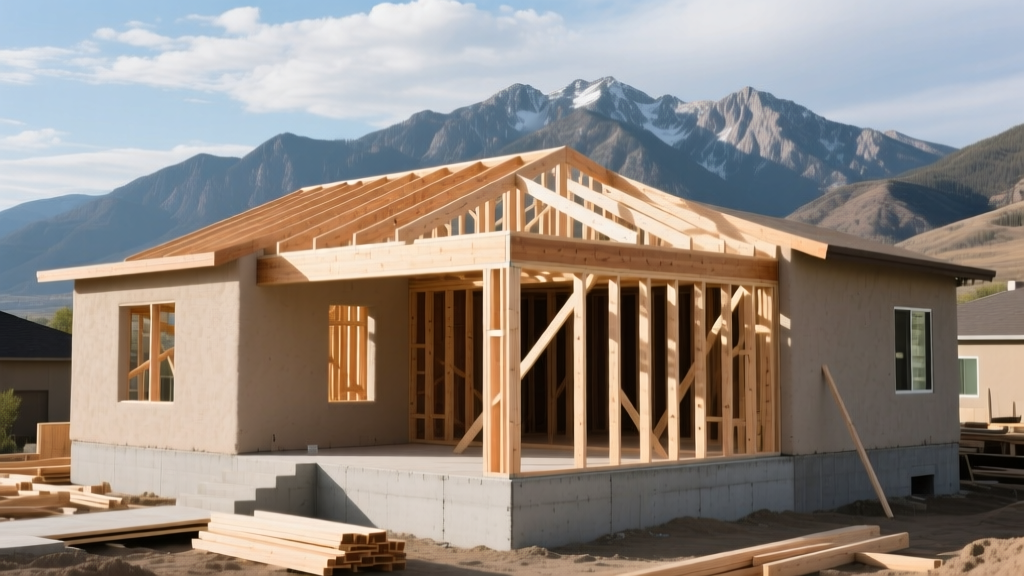
Permitting, Impact Fees, and WUI Fire Codes
Soft costs and municipal fees in Utah are among the highest in the nation. Before breaking ground, you must account for local impact fees, which fund schools, roads, and water infrastructure. In rapidly growing areas like Utah County and northern Salt Lake County, single-family impact fees frequently range from $18,000 to $28,000 per lot. Always verify the exact fee schedule with the specific city recorder, as crossing a street boundary can change your fee liability by $10,000.
The Wildland-Urban Interface (WUI) Cost Premium
If your lot is located in the foothills or canyons (e.g., Draper, Herriman, Holladay, or North Ogden), it will likely fall within a designated WUI zone. WUI building codes are strict and non-negotiable. Requirements include:
- Class A Fire-Rated Roofing: Asphalt shingles are often prohibited. You must use concrete tile, slate, or metal.
- Ignition-Resistant Siding: Vinyl siding is banned. You must use fiber cement (like JamesHardie), stucco, or masonry.
- Exterior Sprinkler Systems: Some extreme-risk zones require roof-mounted wildfire sprinkler systems tied to an independent water cistern.
- Defensible Space: Grading and clearing budgets must account for a 30-foot to 100-foot defensible zone around the structure, which often requires retaining walls if the lot is sloped.
Building in a WUI zone will add a minimum of $20,000 to $40,000 to your exterior envelope and sitework budget compared to a valley floor lot.
Actionable Framework: Estimating Your Specific Build
To generate a highly accurate budget for your specific Utah project, follow this sequential framework before purchasing land or finalizing blueprints:
Step 2: Check the WUI Map. Access the county GIS portal and overlay the Wildland-Urban Interface map on your target parcel. If it is in the red zone, immediately add 10% to your exterior finish budget.
Step 3: Request the City Impact Fee Schedule. Call the local public works department and ask for the exact current single-family residential impact fee sheet. Do not rely on real estate agent estimates.
Step 4: Factor in Utility Trenching. If building on a bench or rural lot, trenching for culinary water, sewer, and power can cost $80 to $150 per linear foot. A 300-foot driveway utility run will add $24,000 to $45,000 to your sitework costs.
By systematically addressing Utah's unique subsurface conditions, seismic requirements, and municipal fee structures, you can transition from a naive square-foot estimate to a defensible, construction-ready budget. Accurate forecasting in this market requires respecting the local geography and regulatory environment, ensuring your capital is allocated to structural resilience rather than reactive change orders.
Written by
David NakamuraDavid Nakamura is a licensed architect (AIA) and construction technology writer focused on sustainable building methods, mass timber engineering, and high-performance building envelopes. He holds a Master of Architecture from the University of Washington and is a certified Passive House Consultant (CPHC). David spent eight years at the Seattle firm Mithun, where he led the design of three LEED Platinum projects, before founding his own practice specializing in net-zero residential design. He serves on the editorial advisory board of GreenBuilder Magazine and has authored peer-reviewed papers on cross-laminated timber (CLT) connections for the Journal of Structural Engineering. In his spare time, David teaches woodworking at Pratt Fine Arts Center and kayaks the Puget Sound.
More from David Nakamura
View all
Construction Cost
Labor Cost to Build a Deck Per Sq Ft: 2026 Installation Guide
Discover the exact labor cost to build a deck per sq ft in 2026. This installation guide breaks down contractor rates, complexity factors, and hidden fees.
Aug 4, 2026

Construction Cost
How Much Does It Cost to Build a 3 Bedroom House? Financing Guide
Learn exactly how much it costs to build a 3 bedroom house and explore 2026 financing options, construction loan types, and budget frameworks for your build.
Aug 4, 2026

Construction Cost
Cost to Build a Tennis Court: 2026 Guide
How much does it cost to build a tennis court in 2026? Breakdowns for asphalt, concrete, and synthetic surfaces plus fencing and lighting.
Jul 30, 2026