Financing the Cost to Demolish a Building: Loans & Options
Learn how to finance the cost to demolish a building. Explore demolition loans, construction-to-permanent mortgages, and hidden budget factors.

The True Financial Scope of Building Demolition
Calculating the cost to demolish a building requires moving beyond simple square-footage estimates. While national averages place mechanical demolition between $4 and $15 per square foot, securing financing demands a granular understanding of site-specific variables, debris management, and municipal compliance. For a standard 2,000-square-foot wood-frame residential structure, base demolition costs range from $8,000 to $30,000. However, lenders evaluating demolition loan applications require comprehensive budgets that account for environmental remediation, utility severance, and landfill tipping fees.
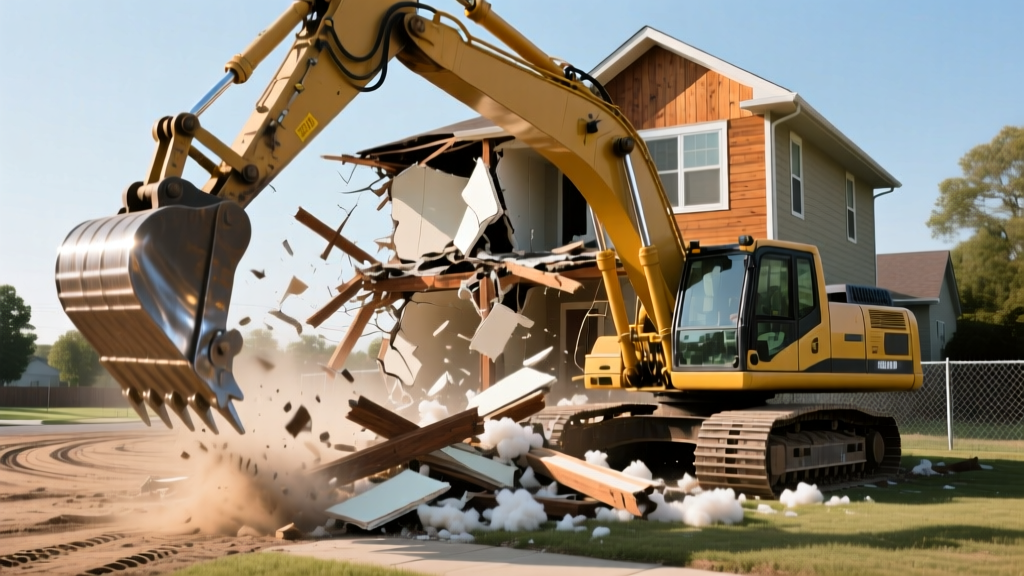
Primary Financing Vehicles for Demolition Projects
Funding a teardown is rarely accomplished through standard personal loans due to the high capital requirements and the fact that the collateral (the existing structure) is being destroyed. Instead, borrowers must leverage specialized financing products designed for land development and property transformation.
Construction-to-Permanent (C2P) Loans: The Tear-Down Mortgage
For investors or homeowners planning to demolish an existing structure to build a new primary residence, the Construction-to-Permanent (C2P) loan is the industry standard. This single-close mortgage finances both the demolition phase and the subsequent new build.
- Land Equity Advantage: If you already own the lot and the existing structure, lenders typically allow the appraised land value (minus the teardown structure) to count toward your 20% down payment requirement.
- Draw Schedule Mechanics: The demolition contractor is paid via a specialized draw schedule. The lender disburses funds directly to the contractor upon verification of completed milestones (e.g., utility capping, structural leveling, debris hauling, and final grading).
- Interest-Only Phase: During the demolition and construction phase (usually 6 to 12 months), you only pay interest on the funds drawn, keeping carrying costs manageable before the permanent mortgage amortization begins.
FHA 203(k) Rehabilitation Loans for Partial Demolition
If your project involves a 'gut rehab' or partial demolition—where the foundation and exterior load-bearing walls remain but the interior is entirely stripped—the FHA 203(k) loan is a highly effective tool. According to the U.S. Department of Housing and Urban Development (HUD), the Standard 203(k) program allows borrowers to finance up to 110% of the property's after-improved value. This is ideal for scenarios where the cost to demolish a building's interior and structural additions exceeds $35,000, which is the minimum threshold for the Standard 203(k) program.
Home Equity Lines of Credit (HELOC) for ADU Preparation
For homeowners demolishing detached garages, sheds, or dilapidated secondary structures to prepare a pad for an Accessory Dwelling Unit (ADU), a HELOC offers the most flexible capital access. Because the primary residence remains intact and serves as collateral, HELOCs provide revolving credit with lower closing costs than C2P loans. This is optimal for smaller demolition budgets ranging from $3,000 to $12,000.
Hidden Costs That Derail Demolition Budgets
Lenders will reject demolition loan applications if the budget lacks adequate contingency for environmental and logistical hidden costs. When estimating the cost to demolish a building, you must underwrite the following line items:
| Cost Category | Estimated Range | Financial Impact & Lender Requirement |
|---|---|---|
| Asbestos & Lead Abatement | $2 - $5 per sq. ft. | Mandatory Phase I ESA (Environmental Site Assessment) required by most commercial lenders before funding. |
| Utility Capping & Severance | $1,200 - $2,500 | Permanent capping of sewer, water, and gas lines at the municipal main or property line. |
| Underground Storage Tank (UST) Removal | $2,500 - $8,000+ | Common in pre-1980 structures; requires soil testing and potential remediation. |
| Basement/Foundation Extraction | $3,000 - $10,000 | Often excluded from base quotes; requires heavy excavation and backfill compaction. |
Many municipalities now mandate that 50% to 75% of demolition debris be diverted from landfills through recycling. While the Environmental Protection Agency (EPA) notes that materials like concrete and clean wood can be recycled, the labor and specialized sorting required to achieve compliance can increase upfront demolition labor costs by 15% to 20%. Ensure your contractor's bid explicitly includes waste sorting and diversion reporting.
Grants and Municipal Subsidies for Blight Removal
If the structure being demolished is classified as a public nuisance or blighted property, traditional financing may be supplemented or replaced by municipal subsidies. Many local governments utilize Community Development Block Grants (CDBG) to fund the demolition of abandoned, structurally unsound buildings in targeted revitalization zones.
To access these funds, the property must typically be acquired through tax foreclosure or purchased at a severe discount. The municipality pays the demolition contractor directly, effectively reducing your acquisition and site-prep costs to near zero. Furthermore, some state-level environmental agencies offer brownfield redevelopment grants that cover the cost of environmental testing and hazardous material abatement prior to demolition.
Step-by-Step Financial Execution Plan
To successfully secure capital and manage the cash flow of a demolition project, follow this execution framework:
- Procure a Demolition Appraisal: Hire an appraiser to determine the 'as-vacant' land value. This establishes your baseline equity for a C2P loan application.
- Order a Phase I Environmental Site Assessment: Before signing a purchase agreement or applying for a loan, spend the $1,500 to $3,000 required for a Phase I ESA to identify hidden hazardous material liabilities.
- Solicit Itemized Bids: Require contractors to separate base demolition, debris hauling, utility capping, and hazardous abatement into distinct line items. Lenders require this granularity to build the draw schedule.
- Establish a 20% Contingency Reserve: Demolition is highly susceptible to unforeseen conditions (e.g., discovering an unmarked concrete foundation or undocumented asbestos). Lenders will require a contingency reserve held in escrow.
- Execute the Draw Schedule: Release funds only after municipal inspectors have signed off on utility severance and final grading, ensuring the site is legally cleared for the next phase of development.
Frequently Asked Questions
Can I roll demolition costs into a standard mortgage?
No. Standard mortgages (like conventional 30-year fixed loans) require the property to be habitable and structurally sound at the time of closing. Demolition must be financed through specialized construction loans, land development loans, or cash/HELOC equity prior to securing a permanent mortgage on the new structure.
How does asbestos affect the cost to demolish a building?
Asbestos abatement requires licensed specialists, negative air pressure enclosures, and specialized hazardous waste transport. If a 2,000 sq. ft. home tests positive for friable asbestos in the drywall or pipe insulation, expect abatement costs to add $4,000 to $10,000 to the total project budget, and anticipate a 2-to-3-week delay in the demolition schedule.
Is it cheaper to demolish a building manually or mechanically?
Mechanical demolition using excavators and skid steers is significantly cheaper and faster, typically costing $4 to $8 per square foot. Manual demolition (deconstruction) costs $10 to $25 per square foot due to high labor costs. However, manual deconstruction allows for the salvage and resale of high-value materials (like old-growth timber or architectural fixtures), which can sometimes offset the higher labor costs and provide tax write-offs if materials are donated to qualified non-profits.
Written by
Elena RodriguezElena Rodriguez is a civil engineer and technical writer specializing in concrete technology, masonry systems, and ASTM/ACI compliance. She earned her B.S. in Civil Engineering from Texas A&M University and spent a decade at a materials testing laboratory, performing over 2,000 concrete compressive strength tests and masonry prism evaluations. Elena is an ACI-certified Field Testing Technician (Grade I) and a member of ASTM Committee C12 on Natural Building Stone. She currently consults on forensic engineering cases involving concrete failures and moisture intrusion. Based in San Antonio, TX, Elena is a proud member of the Society of Women Engineers (SWE) and coaches her daughter's FIRST Robotics team.
More from Elena Rodriguez
View all
Walls & Panels
Cost Analysis: Light Gauge Steel Framing Advantages and Disadvantages
Evaluate light gauge steel framing advantages and disadvantages through a strict cost analysis lens, comparing material, labor, and lifecycle expenses.
Aug 4, 2026

Walls & Panels
Gypsum Board Types: Exact Specifications, Thickness & Dimensions
Compare standard, Type X, and moisture-resistant gypsum board types. Get exact specifications, thicknesses, dimensions, and ASTM standards for your project.
Aug 4, 2026

Fire Resistance
Best Fire-Resistant Outdoor Decking Materials: 2026 Buyer Guide
Discover the best fire-resistant outdoor decking materials for 2026. Compare Class A PVC, aluminum, and hardwood options for WUI compliance and safety.
Aug 4, 2026