Average Labor Cost to Build a Greenhouse: DIY vs Pro
Compare the average labor cost to build a greenhouse in 2026. Breakdowns for DIY, handyman, and professional contractor installation rates.

The True Labor Cost to Build a Greenhouse in 2026
Calculating the labor cost to build a greenhouse requires moving beyond simple square-footage multipliers. Unlike standard shed construction, greenhouse assembly demands specialized knowledge in glazing, structural wind-load bracing, and climate-control integration. In 2026, the national average for professional greenhouse installation labor ranges from $1,800 to $8,500, heavily dependent on the structure type, foundation requirements, and utility trenching.
According to industry data tracked by Greenhouse Grower's labor management reports, the shortage of skilled agricultural construction workers has pushed specialized hourly rates up by 14% over the last three years. General contractors often underestimate the precision required for greenhouse framing, leading to costly glazing failures and structural leaks. Understanding where your labor dollars are actually spent is critical for budgeting accurately.
Labor Estimates by Greenhouse Structure Type
The physical design of the greenhouse dictates the skill level required, which directly impacts the hourly rate and total hours billed. Below is a comparative matrix of labor requirements for the three most common residential and small-farm greenhouse types.
| Structure Type | Avg Dimensions | Pro Labor Hours | Est. Labor Cost (2026) | Skill Level Required |
|---|---|---|---|---|
| Hoop House (High Tunnel) | 20' x 40' | 35 - 50 hrs | $1,575 - $3,750 | General Labor (Brute force) |
| Polycarbonate Kit | 12' x 16' | 40 - 65 hrs | $3,400 - $9,100 | Carpentry / Glazing |
| Custom Glass / Timber | 16' x 24' | 120 - 200+ hrs | $12,000 - $28,000+ | Master Carpenter / Glazier |
Hoop Houses and High Tunnels
Hoop houses rely on galvanized steel or PVC bows driven into ground posts. The labor here is physically demanding but technically forgiving. A crew of three can typically frame a 20x40-foot high tunnel in two days. The most labor-intensive phase is stretching the 6-mil polyethylene film. This requires four people minimum to maintain even tension and prevent tearing; attempting this with a two-person crew often results in ruined film and repeated labor. The Cornell University High Tunnel Project notes that proper end-wall framing and door hanging account for nearly 30% of the total hoop house labor hours, as these areas require custom carpentry to seal against wind intrusion.
Polycarbonate and Aluminum Frame Kits
Kits from manufacturers like Palram or Juliana feature hundreds of extruded aluminum pieces, stainless steel fasteners, and twin-wall polycarbonate panels. While marketed as DIY-friendly, the reality of assembling these kits often involves misaligned pre-drilled holes and brittle rubber gaskets that snap in cold weather. Professional installers use pneumatic rivet tools and specialized UV-resistant silicone tapes to speed up the glazing process. A major labor sink in polycarbonate kits is the roof vent installation; aligning the automated wax-cylinder openers requires precise calibration to ensure the polycarbonate panels do not bind when expanding in the summer heat.
Custom Glass and Timber-Frame Structures
Building a traditional glass greenhouse (such as a Lord & Burnham style replica) is a master-level construction project. The labor cost to build a greenhouse of this caliber is dominated by foundation tolerances and glass handling. The concrete stem wall must be level within 1/8 of an inch across the entire perimeter; if it is not, the timber frame will rack, and the tempered glass panels will shatter under torsional stress. Glaziers use heavy-duty suction lifts and require custom scaffolding, adding significant equipment and hourly premiums to the project.
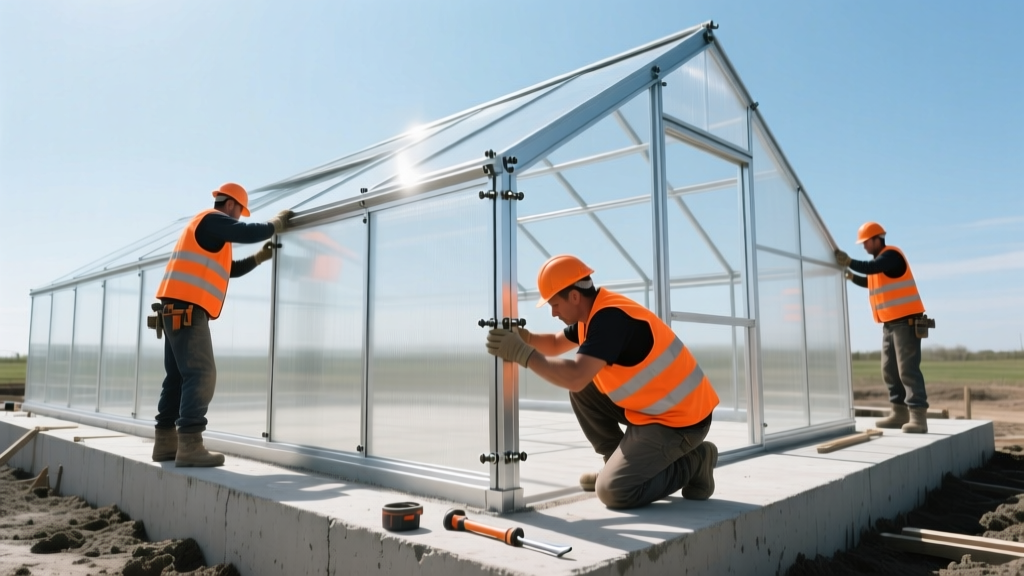
DIY vs. Handyman vs. Licensed Contractor: A Cost Matrix
Choosing who builds your greenhouse involves balancing upfront labor savings against long-term structural integrity and warranty validity.
- The DIY Route: Saves $2,000 to $8,000 in direct labor. However, you absorb the risk of voiding the manufacturer's warranty (most polycarbonate kits void the warranty if not anchored to a concrete perimeter). Expect to spend 80+ hours on a 12x16 kit, including site leveling and assembly.
- The General Handyman: Charges $45-$75/hr. Suitable for site prep, pouring concrete slabs, and building hoop house end-walls. Warning: Most handymen lack experience with polycarbonate expansion gaps. If they over-tighten screws through the polycarbonate panels, the panels will crack during the first freeze-thaw cycle.
- The Specialized Greenhouse Contractor: Charges $85-$140/hr. They bring proprietary jigs for squaring aluminum frames, know exactly how to apply butyl glazing tape, and understand how to integrate automated shade curtains without interfering with the roof vents.
"The most expensive part of a greenhouse isn't the glass or the aluminum—it's the site prep. If a DIYer spends 10 hours trying to hand-dig post holes in clay soil, they've already lost the money they would have saved by just hiring a mini-excavator and an operator for three hours."
— Senior Agricultural Construction Foreman, Pacific Northwest
Hidden Labor Multipliers That Inflate Your Budget
When contractors quote the labor cost to build a greenhouse, they often exclude the "infrastructure" labor. These hidden multipliers can easily add 20 to 40 hours of billed time to your project.
- Frost-Free Utility Trenching: Running water and electricity to a detached greenhouse requires trenching below the local frost line (often 36 to 48 inches deep). Manual trenching through rocky soil can take a two-person crew three full days ($1,200+ in labor). Machine trenching with a walk-behind Ditch Witch reduces this to 4 hours ($400).
- Electrical Subpanel Installation: Modern greenhouses require power for exhaust fans, circulating fans, heated propagation mats, and automated louver vents. Running a single 120V GFCI drop is insufficient. A licensed electrician must install a 60-amp outdoor subpanel, which adds 8 to 12 hours of high-rate electrical labor ($1,100 - $1,900).
- Bedrock Anchoring: If your site sits on shallow bedrock, standard concrete footings won't work. Contractors must use rotary hammer drills to sink 1/2-inch wedge anchors directly into the stone. This slows foundation work down by 50% and requires specialized masonry labor.
- Glazing Film Replacement: If building a hoop house, the poly-film must be replaced every 4 to 6 years. The labor to remove old film, clean the purlins, and stretch new film is nearly identical to the initial installation labor.
Phase-by-Phase Labor Allocation
To accurately track contractor billing or plan your own DIY weekend schedule, break the project down into these four distinct labor phases. This allocation is based on a standard 12x16-foot polycarbonate kit installed on a pre-existing level site.
- Phase 1: Foundation and Anchoring (25% of total labor)
Even if the concrete slab is already poured, drilling anchor holes, setting wedge anchors, and sealing the base plate with closed-cell foam gaskets takes 10-15 hours. Precision here prevents the entire structure from racking out of square.
- Phase 2: Framing and Structural Assembly (40% of total labor)
Assembling the sidewalls, roof trusses, and ridge pole. This phase requires constant measuring of diagonal distances to ensure the frame is perfectly square before tightening the structural bolts. Rushing this phase guarantees that the doors will not close properly later.
- Phase 3: Glazing and Sealing (25% of total labor)
Snapping polycarbonate panels into aluminum H-profiles and applying UV-resistant silicone to the roof ridges. This is tedious, detail-oriented work. Professionals use specialized roller tools to seat the rubber gaskets without tearing them.
- Phase 4: Hardware, Doors, and Vent Calibration (10% of total labor)
Hanging the double doors, installing the threshold sweep, and mounting the automatic roof vent openers. The wax cylinders in the vent openers must be calibrated to the specific microclimate of your yard, requiring multiple adjustments over the first week of operation.
Sourcing and Vetting: Avoiding the "Cheap Labor" Trap
When evaluating bids for the labor cost to build a greenhouse, beware of contractors who quote significantly below the $65/hour threshold for specialized glazing. Greenhouses are essentially lightweight, transparent sails. If the structural connections are under-torqued or the foundation anchors are spaced too far apart to save time, a 50-mph wind event will lift the structure entirely off its slab. Always require your contractor to provide a wind-load rating certification for their anchoring method, and verify their experience specifically with agricultural or horticultural structures, not just general carpentry.
Written by
Sarah WhitfieldSarah Whitfield is a chartered quantity surveyor (MRICS) and construction cost analyst with 15 years of experience in material pricing, procurement strategy, and project budgeting. She earned her degree in Construction Management from the University of Reading (UK) and has worked on projects ranging from $2M custom homes to $180M mixed-use developments across North America and Europe. Sarah currently leads cost estimating for BuildMat Insight, maintaining a proprietary database of 4,000+ material price points updated quarterly. She is a frequent contributor to RSMeans cost data panels and has presented at the International Cost Engineering Council (ICEC) congress. Based in Denver, CO, Sarah is an avid trail runner and volunteer mentor for Women in Construction.
More from Sarah Whitfield
View all
Wood & Lumber
What Are the Different Types of Wood? A Builder's Guide
Compare structural softwoods, finish hardwoods, and engineered lumber. Analyze Janka ratings, MOE values, and 2026 pricing for construction.
Aug 4, 2026

Walls & Panels
Steel Framing vs Wood Framing: Corrosion and Moisture Defense
Compare steel framing vs wood framing for moisture resistance. Learn about galvanized coatings, condensation risks, and corrosion protection strategies.
Jul 21, 2026

Stone & Masonry
How to Cut Stone Veneer: Wet Saw vs Grinder Comparison
Compare the best tools for cutting stone veneer. We review wet saws, angle grinders, and chop saws to help you achieve clean, chip-free cuts.
Jul 21, 2026