How Much Does It Cost to Build a Pool? 2026 Regional Price Guide
Discover how much does it cost to build a pool in your state. Our 2026 regional price analysis breaks down inground pool costs by climate and zone.

The True Cost of Inground Pools: Beyond the National Average
When homeowners ask how much does it cost to build a pool, they are often met with a vague national average that fails to account for localized geological and regulatory realities. In 2026, the baseline cost for a standard 14x28-foot inground gunite pool ranges from $55,000 to $85,000. However, this figure is practically useless for precise budgeting. A pool built in the sandy soils of Central Florida will have a vastly different excavation and engineering profile than one carved into the caliche rock of Phoenix, Arizona, or the frost-heaved clay of upstate New York.
2026 National Baseline Averages
- Gunite/Shotcrete: $65 - $95 per square foot
- Fiberglass: $50,000 - $80,000 (installed)
- Vinyl Liner: $40,000 - $65,000 (installed)
- Standard Excavation: $1,500 - $4,500 (highly variable by soil)
Data reflects Q1 2026 contractor bids for a standard 14x28 ft rectangular footprint with basic coping and standard filtration.
According to Angi's comprehensive pool cost database, regional labor rates, material transport logistics, and site-specific soil remediation can swing your final invoice by upwards of 40%. To accurately estimate your project, you must deconstruct the cost by regional variables rather than relying on flat national metrics.
Regional Price Matrix: How Much Does It Cost to Build a Pool by State?
The following matrix breaks down the anticipated costs for a standard 14x28 gunite pool across five major U.S. climate and construction zones. These figures include excavation, steel rebar framing, plumbing, gunite application, basic plaster, and standard deck coping.
| Region | Representative States | Average Total Cost | Cost per Sq. Ft. | Primary Regional Cost Driver |
|---|---|---|---|---|
| Southeast | FL, GA, SC, NC | $48,000 - $68,000 | $55 - $72 | High water table dewatering |
| Southwest | AZ, TX, NV, NM | $55,000 - $78,000 | $62 - $82 | Caliche rock excavation |
| West Coast | CA, OR, WA | $75,000 - $110,000 | $85 - $115 | Strict Title 24/permitting |
| Northeast | NY, MA, CT, PA | $70,000 - $105,000 | $80 - $110 | Frost-line engineering |
| Midwest | IL, OH, MI, MN | $60,000 - $90,000 | $68 - $95 | Expansive clay soil retention |
Why the Southwest and Southeast Dominate Pool Construction
The Southeast and Southwest account for over 65% of new residential pool starts. In the Southeast, the lack of a frost line allows for shallower plumbing trenches and simpler deck footings, keeping structural costs low. Conversely, the Southwest benefits from a highly saturated contractor market, which creates competitive pricing for gunite and steel, though extreme summer heat often requires specialized curing compounds to prevent the shotcrete from flash-setting and cracking.
Climate and Soil Factors Driving Regional Price Variations
The single largest point of failure in pool budgeting is ignoring the geotechnical reality of your specific lot. Soil composition dictates excavation methods, engineering requirements, and long-term structural integrity. Here is how regional soil types directly impact your bottom line:
- Caliche and Bedrock (Southwest/Texas): Caliche is a hardened natural cement of calcium carbonate. Standard excavators cannot dig it. Contractors must bring in a mini-excavator with a hydraulic hammer attachment or use controlled blasting. Expect to add $3,500 to $8,000 to your excavation budget specifically for rock-breaking.
- Expansive Clay (Midwest/Texas): Clay soils swell when wet and shrink when dry, exerting thousands of pounds of lateral pressure on pool walls. Engineers must over-dig the hole by 12 to 18 inches and backfill with a non-expansive material like crushed gravel or sand to create a slip plane. This adds $2,000 to $4,500 in material and labor.
- High Water Tables (Florida/Coastal Carolinas): Digging in sandy soil is fast and cheap ($1,500 average), but hitting the water table turns the excavation into a mud pit. Installing a wellpoint dewatering system—a network of perforated pipes and trash pumps that run 24/7 during construction—is mandatory to keep the hole dry for the gunite crew. Budget an extra $2,500 to $4,000 for dewatering.
- Deep Frost Lines (Northeast/Midwest): In regions where the ground freezes, the frost line can extend 36 to 48 inches deep. Pool plumbing must be trenched below this line and pitched for complete winter drainage to prevent pipe bursting. Furthermore, pool decks require engineered helical piers or deep concrete footings to prevent frost heave from cracking the coping. This structural over-engineering adds $5,000 to $9,000.
Material Costs by Region: Gunite vs. Fiberglass vs. Vinyl
Material selection is heavily influenced by regional supply chains and climate demands. While gunite remains the national standard, alternative materials offer distinct regional advantages.
| Material | Best Suited Regions | 2026 Installed Cost Range | Longevity & Maintenance Profile |
|---|---|---|---|
| Gunite/Shotcrete | Southwest, West Coast, Northeast | $65,000 - $100,000+ | 50+ year shell life. Requires acid washing and replastering every 12-15 years ($8k-$12k). |
| Fiberglass | Southeast, Midwest, Mid-Atlantic | $55,000 - $85,000 | ISO-certified gel coats resist algae. Shell flexes with frost heave. 25+ year structural warranty. |
| Vinyl Liner | Midwest, Northeast, Rural areas | $45,000 - $70,000 | Steel/polymer walls. Liner requires replacement every 7-10 years ($4k-$6k). Vulnerable to tears. |
Fiberglass pools are surging in the Midwest and Northeast because the monolithic shell flexes slightly with seasonal frost heave, whereas rigid gunite shells require extensive (and expensive) structural steel reinforcement to survive freeze-thaw cycles. Conversely, in the Southwest, fiberglass is less common due to the logistical nightmare of transporting massive one-piece shells across highways with low-clearance overpasses and tight desert subdivision access roads.
Hidden Regional Costs: Permits, HOA, and Utility Routing
Beyond dirt and concrete, local bureaucracies and infrastructure dictate hidden costs that rarely appear in initial brochures.
'In California, Title 24 energy mandates require all new pools to be equipped with variable-speed pumps (minimum 1.5 THP) and solar-ready plumbing routing. This immediately adds $1,200 to $1,800 in compliance costs compared to states with baseline DOE pump regulations.'
— 2026 Regional Building Code Analysis, Pool & Hot Tub Alliance (PHTA)
Permitting and Impact Fees: In high-growth Texas municipalities, residential impact fees for water and sewer can add $1,500 to the permit phase. In contrast, rural counties may charge a flat $250 grading permit. Utility Routing: If your electrical panel lacks the 240V/50A capacity required for a modern heat pump and variable-speed filter, an electrician must run a new dedicated line from the main house panel. At $12 to $18 per linear foot for underground trenching and conduit, a pool located 80 feet from the main panel will incur $1,000 to $1,400 in electrical routing alone. Barrier Fencing: Most jurisdictions enforce BOCA (Building Officials and Code Administrators) pool barrier codes, requiring a minimum 48-inch fence with self-closing, self-latching gates. If your existing yard fence does not meet code, installing 150 linear feet of aluminum or mesh pool fencing will add $3,500 to $6,000.
Furthermore, environmental regulations are tightening. The EPA WaterSense guidelines increasingly influence local municipal codes in drought-prone areas like Nevada and Southern California, where evaporation covers and strict backwash-recycling systems are now mandated, adding $800 to $1,500 to the equipment pad.
Step-by-Step Framework to Estimate Your Local Pool Cost
To move beyond generic online calculators and determine exactly how much does it cost to build a pool on your specific property, follow this localized estimation framework:
- Pull Your Geotechnical Data: Access your county's online GIS soil survey maps. Identify if your lot sits on expansive clay, bedrock, or a high water table. Apply the specific remediation costs outlined above to your baseline budget.
- Audit Your Electrical Panel: Check your main breaker box. If you have a 100-amp service, you will likely need a $2,500 to $4,000 panel upgrade to 200-amp to support the pool equipment, spa heater, and existing home load simultaneously.
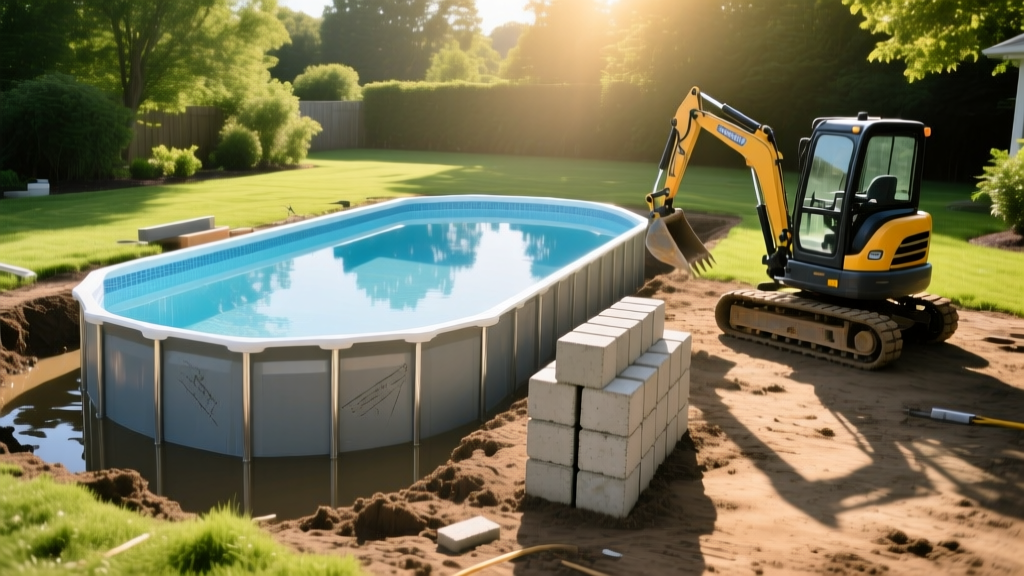
- Measure the Access Corridor: Measure the narrowest point of entry from the street to your backyard. If the clearance is under 8 feet wide or 10 feet high, standard trackhoes cannot enter. You will be forced to use a mini-excavator, which triples the excavation time and increases labor costs by 25%.
- Calculate the Spoil Removal: A 14x28 pool dug to a 5.5-foot average depth yields roughly 80 cubic yards of dirt. Because soil expands by 20-30% when excavated (the 'swell factor'), you are looking at 100+ cubic yards to haul away. At $150 to $250 per dump truck load (10-12 yards), dirt removal alone will cost $1,500 to $2,500 unless you can use it to grade another part of your lot.
- Request Itemized Bids: Demand that contractors separate excavation, steel, gunite, plumbing, and electrical into line items. This prevents them from hiding rock-clause contingencies or dewatering fees in the final contract.
By systematically addressing soil mechanics, local energy codes, and logistical access constraints, you can accurately forecast your regional pool construction costs and avoid the catastrophic change orders that derail backyard projects.
Written by
Priya KapoorPriya Kapoor is a real estate market analyst and construction economics researcher with expertise in housing affordability, development feasibility, and infrastructure investment. She holds a Master of Regional Planning from Cornell University and previously worked as a senior analyst at CBRE's Investment Properties group, where she modeled returns for $4B in mixed-use development pipelines. Priya now runs an independent research practice advising developers, municipalities, and REITs on construction cost forecasting and market timing. She publishes the quarterly "BuildMat Market Pulse" report tracking material price indices across 12 commodity categories. Based in Austin, TX, Priya serves on the board of Habitat for Humanity Austin and is a marathon runner.
More from Priya Kapoor
View all
Construction Cost
Cost to Build a 1600 Sq Ft Home in 2026: Full Breakdown
Accurate 2026 cost to build a 1600 sq ft home—material, labor, and regional pricing breakdowns included. Plan your budget with real-time estimates.
Aug 11, 2026

Wood & Lumber
Name the Types of Wood for Pressure Treatment and Preservation
Learn how to name the types of wood best suited for pressure treatment. Compare species treatability, chemical retention levels, and 2026 preservation costs.
Aug 4, 2026

Stone & Masonry
Stone Veneer Suppliers Lindenhurst: 2026 Cost Analysis
Analyze 2026 stone veneer costs in Lindenhurst, NY. Compare local supplier pricing, delivery fees, and Suffolk County installation labor rates.
Aug 4, 2026