Proven Ways to Lower the Cost to Build Gazebo Structures
Discover actionable strategies to reduce the cost to build gazebo structures. Compare material pricing, DIY footings, and roofline hacks to save thousands.

The average custom-built 12x12 wood gazebo costs between $8,500 and $14,000 in 2026, with labor accounting for up to 50% of the total expense. However, the cost to build gazebo structures can be reduced by 40% to 60% through strategic material selection, simplified architectural designs, and targeted DIY efforts. By avoiding over-engineered footings and premium lumber where it isn't structurally necessary, you can construct a durable, code-compliant outdoor structure for $3,500 to $5,500.
The True Breakdown of Gazebo Construction Costs
Before cutting costs, you must understand where the money goes. A traditional stick-built gazebo budget is heavily skewed toward skilled carpentry labor and premium finish materials.
| Cost Category | Custom Pro-Built (12x12) | Optimized DIY/Hybrid (12x12) | Primary Cost Driver |
|---|---|---|---|
| Materials (Lumber & Hardware) | $4,500 - $6,500 | $2,200 - $3,000 | Cedar/Redwood vs. Pressure-Treated Pine |
| Roofing & Finishes | $1,500 - $2,500 | $600 - $900 | Cedar shakes vs. Architectural asphalt |
| Labor & Site Prep | $3,500 - $5,500 | $500 - $1,200 | Professional excavation vs. DIY Sonotubes |
| Permits & Engineering | $300 - $800 | $150 - $300 | Complex hip roofs requiring stamped plans |
| Total Estimated Cost | $9,800 - $15,300 | $3,450 - $5,400 |
5 High-Impact Strategies to Lower Your Build Cost
1. Choose Pressure-Treated Pine Over Cedar or Redwood
Western Red Cedar and Redwood are the traditional choices for outdoor structures due to their natural decay resistance, but they command a massive premium. In 2026, clear-grade Western Red Cedar costs between $8.00 and $12.00 per linear foot, while #2 Grade Pressure-Treated Southern Yellow Pine (PT SYP) costs $2.50 to $3.50 per linear foot.
To ensure longevity with PT SYP, you must specify the correct AWPA (American Wood Protection Association) retention levels. According to the USDA Forest Products Laboratory, use UC4A (Above Ground) treated lumber for rafters, joists, and railings, and UC4B (Ground Contact) for the 6x6 structural posts, even if they are resting on concrete piers. This prevents wicking moisture from compromising the post bases. Furthermore, you must use hot-dipped galvanized (HDG) or ZMAX-coated fasteners; the copper-based preservatives in modern PT wood will rapidly corrode standard zinc-plated screws.
2. Simplify the Roofline: Gable vs. Hexagonal Hip
The roof is the most labor-intensive and material-heavy component of a gazebo. A traditional hexagonal or octagonal hip roof requires complex compound miter cuts, specialized framing hardware, and generates significant material waste.
- Hexagonal Hip Roof: Requires custom-cut rafters, a central ring beam, and high labor hours. Framing labor alone can add $1,500 to $2,500 to the project.
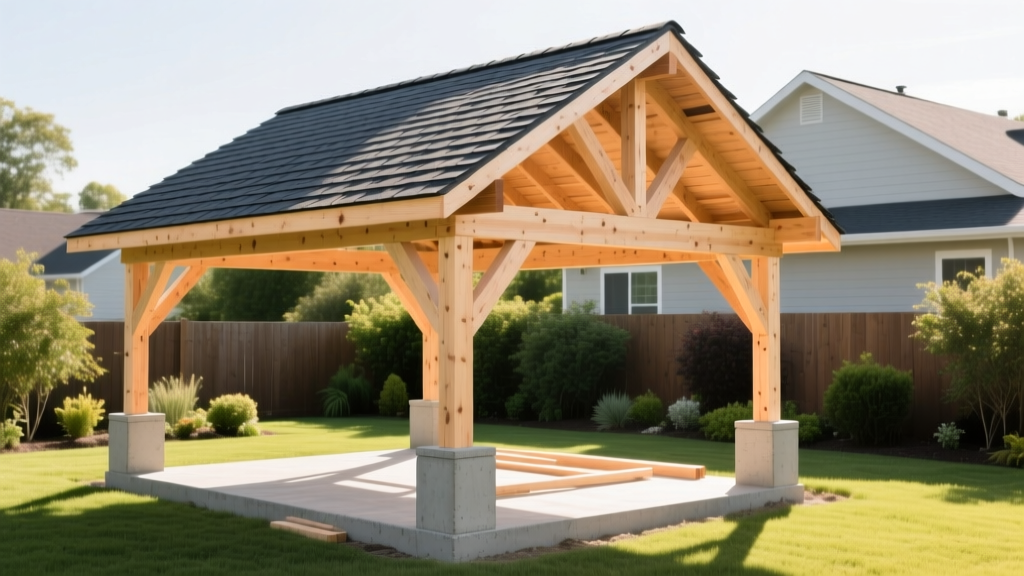
- Simple Gable or Shed Roof: A rectangular 12x16 gazebo with a standard gable roof utilizes repetitive, identical trusses or rafters. You can order pre-fabricated engineered wood trusses from a local lumber yard for $45 to $85 each, eliminating days of complex framing labor.
For roofing material, skip the cedar shakes ($450+ per square). Opt for architectural asphalt shingles, such as GAF Timberline HDZ, which cost roughly $130 to $160 per square (100 sq. ft.) installed and offer a Class A fire rating and 30-year warranty.
3. DIY the Site Prep and Concrete Footings
Professional excavation and poured concrete piers can cost $150 to $300 per footing. For a standard 12x12 gazebo requiring six footings, that is up to $1,800 in labor. You can reduce this to under $300 by pouring your own Sonotube piers.
- Call 811 to have underground utilities marked.
- Dig holes below your local frost line (e.g., 36 inches in Climate Zone 5) using a manual post-hole digger or a rented motorized auger ($65/day).
- Insert 12-inch diameter Sonotube forms and brace them plumb.
- Pour 4000 PSI high-strength concrete mix.
- Embed a Simpson Strong-Tie ABA44Z adjustable post base into the wet concrete. This keeps the wood post elevated above the concrete surface, preventing end-grain water absorption and rot.
4. Utilize Pre-Engineered Kits for the Superstructure
If stick-framing from scratch is outside your skill set, high-quality prefabricated gazebo kits offer a middle ground between custom carpentry and cheap pop-up canopies. Brands like Yardistry and Backyard Discovery manufacture CNC-cut, pre-drilled cedar and PT wood kits. A 12x12 cedar kit typically retails for $3,500 to $5,000. While the material cost is slightly higher than buying raw PT lumber, you eliminate the $3,000+ framing labor cost, as two people can assemble a kit in a single weekend using basic tools.
5. Skip Integrated Electrical and Plumbing
Running underground UF-B electrical wire to a gazebo and installing a sub-panel, weatherproof outlets, and a ceiling fan circuit requires a licensed electrician and a separate electrical permit, adding $1,200 to $2,500 to the project. To save money, design the gazebo as a passive shade structure. If lighting is essential, use high-lumen, solar-powered LED architectural fixtures mounted to the rafters, which require zero trenching or wiring.
⚠ Warning: The "Hidden Cost" of Wind Loads and Permits
Never skip the building permit to save $200. Gazebos act as large sails. In high-wind regions, the American Wood Council span tables and local IRC codes require specific post-to-beam connections (like hurricane ties) and deeper footings. If an unpermitted gazebo fails in a storm and damages neighboring property, your homeowner's insurance will likely deny the claim. Always verify your local zoning setbacks (usually 5 to 10 feet from property lines) before pouring concrete.
Material Cost Comparison Matrix (2026 Pricing)
Use this matrix to select materials that balance upfront costs with long-term durability. Prices reflect national averages for a 12x12 structure.
| Component | Premium Choice (High Cost) | Budget-Smart Choice (Low Cost) | Estimated Savings |
|---|---|---|---|
| Structural Posts (6x6) | Western Red Cedar ($45/ft) | PT SYP UC4B Ground Contact ($14/ft) | $1,100 - $1,400 |
| Decking / Flooring | Composite (Trex/PVC) ($12/sq ft) | 5/4x6 PT Decking ($2.50/sq ft) | $1,100 - $1,300 |
| Roofing Material | Hand-split Cedar Shakes ($450/sq) | Architectural Asphalt Shingles ($140/sq) | $800 - $1,200 |
| Fasteners & Hardware | Stainless Steel ($0.45/screw) | Hot-Dipped Galvanized ($0.12/screw) | $150 - $250 |
| Railing Balusters | Custom Wood Spindles ($3.50/ea) | Pre-assembled PT Panels ($45/section) | $400 - $600 |
Sourcing Materials: Where the Real Savings Happen
Big-box home improvement stores are convenient but rarely offer the best pricing on large-scale structural lumber. For a project of this size, take your cut list to a professional lumber yard or a regional building supplier (e.g., 84 Lumber, Builders FirstSource, or local equivalents).
Pro yards offer several distinct financial advantages:
- Volume Discounts: They will discount the total ticket by 10% to 15% for full-structure packages.
- Higher Grade Selection: You can hand-select #1 or Select Structural grade PT lumber for visible beams, avoiding the heavy wane and warping often found in big-box #2 grade bins.
- Free or Cheap Delivery: Pro yards use boom trucks that can drop a 2,000 lb lumber package directly into your backyard for a flat $75 to $125 fee, saving you from renting a trailer and making multiple trips.
Expert Tip: Order your pressure-treated lumber as close to the build date as possible. PT wood is saturated with liquid preservatives and will warp, twist, and cup rapidly if left stacked in the sun for weeks before installation. If you must store it, keep it tightly banded, stickered (spaced with scrap wood for airflow), and weighted down heavily.
When to Hire a Pro vs. When to DIY
Lowering the cost to build gazebo structures requires an honest assessment of your skills. Mismanaging the structural connections can lead to catastrophic failure.
- DIY Safely: Site clearing, digging footing holes, pouring Sonotubes, assembling pre-cut kits, laying decking, and installing asphalt shingles.
- Hire a Professional: If your site requires a retaining wall for leveling, if you are building on a steep slope requiring engineered helical piles, or if local code mandates a stamped engineering drawing for high-wind roof tie-downs. Paying a structural engineer $400 for a stamped plan is cheaper than a failed municipal inspection.
By substituting premium aesthetics with structural-grade pressure-treated materials, simplifying the roof geometry, and taking on the site preparation yourself, you can build a permanent, code-compliant gazebo for a fraction of the traditional contractor price.
Written by
Priya KapoorPriya Kapoor is a real estate market analyst and construction economics researcher with expertise in housing affordability, development feasibility, and infrastructure investment. She holds a Master of Regional Planning from Cornell University and previously worked as a senior analyst at CBRE's Investment Properties group, where she modeled returns for $4B in mixed-use development pipelines. Priya now runs an independent research practice advising developers, municipalities, and REITs on construction cost forecasting and market timing. She publishes the quarterly "BuildMat Market Pulse" report tracking material price indices across 12 commodity categories. Based in Austin, TX, Priya serves on the board of Habitat for Humanity Austin and is a marathon runner.
More from Priya Kapoor
View all
Construction Cost
Cost to Build a 1600 Sq Ft Home in 2026: Full Breakdown
Accurate 2026 cost to build a 1600 sq ft home—material, labor, and regional pricing breakdowns included. Plan your budget with real-time estimates.
Aug 11, 2026

Wood & Lumber
Name the Types of Wood for Pressure Treatment and Preservation
Learn how to name the types of wood best suited for pressure treatment. Compare species treatability, chemical retention levels, and 2026 preservation costs.
Aug 4, 2026

Stone & Masonry
Stone Veneer Suppliers Lindenhurst: 2026 Cost Analysis
Analyze 2026 stone veneer costs in Lindenhurst, NY. Compare local supplier pricing, delivery fees, and Suffolk County installation labor rates.
Aug 4, 2026