2026 Regional Analysis: Cost to Build Custom Home Per Sq Ft
Discover the true cost to build custom home per sq ft across US regions in 2026. Analyze labor, code, and material variances to budget accurately.
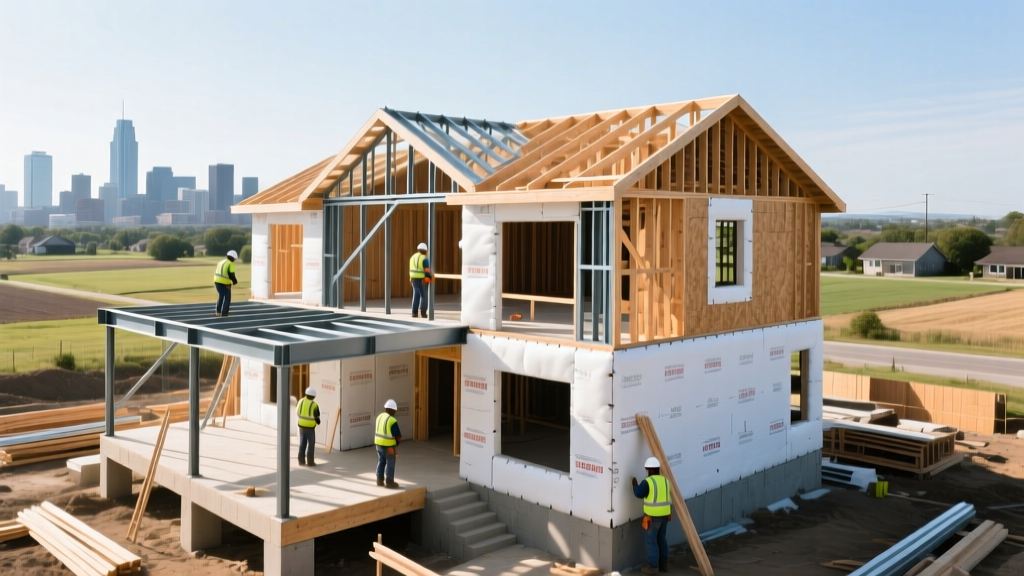
The National Baseline vs. Regional Reality
When planning a bespoke residential project, relying on a single national average is a critical budgeting error. The national baseline for the cost to build custom home per sq ft in 2026 sits between $275 and $325 for standard custom specifications, scaling up to $450 to $800+ for luxury finishes and complex architectural geometries. However, these aggregates mask extreme localized variances driven by municipal labor rates, micro-climate building codes, and regional supply chain logistics. A 3,000-square-foot modern farmhouse that costs $900,000 to build in rural Georgia could easily exceed $1.6 million to construct to the exact same material specifications in coastal California or suburban Boston.
2026 Regional Cost Matrix: Cost to Build Custom Home Per Sq Ft
The following matrix breaks down the estimated hard construction costs (excluding land and soft fees) for custom residential builds across major U.S. regions. Data is synthesized from current contractor bidding averages and RSMeans Data Online regional modifiers.
| Region | Metro Base ($/sq ft) | Metro High-End ($/sq ft) | Rural Variance | Primary Cost Driver |
|---|---|---|---|---|
| Northeast | $310 - $360 | $550 - $750+ | -10% to -15% | Union labor, stretch energy codes, deep frost footings |
| Southeast | $220 - $270 | $400 - $550 | -5% to -10% | HVAC loads, moisture mitigation, hurricane impact codes |
| Midwest | $205 - $250 | $380 - $500 | -15% to -20% | Lower material transport costs, expansive clay soil prep |
| Mountain West | $260 - $320 | $480 - $650 | +5% to +15% | Topography grading, winter build premiums, WUI fire codes |
| Pacific Coast | $350 - $425 | $650 - $900+ | -5% | Title 24 compliance, seismic engineering, prevailing wage |
Deep Dive: Why Your Zip Code Dictates Your Budget
Understanding the cost to build custom home per sq ft requires dissecting the localized variables that inflate or deflate the baseline matrix above. These are not arbitrary markups; they are structural realities of building in specific jurisdictions.
Labor Market Discrepancies and Unionization
Labor accounts for 40% to 50% of hard construction costs. In states with high union density and prevailing wage requirements (such as Illinois, New York, and California), framing crews and finish carpenters command fully burdened hourly rates that can be 35% to 60% higher than in right-to-work states like Texas or Florida. Furthermore, in rural mountain regions (e.g., Summit County, Colorado or Teton County, Wyoming), the rural variance actually increases costs. Contractors must pay per diem and travel premiums to bring skilled trades up from lower-elevation cities, driving the cost to build custom home per sq ft well above state averages.
Micro-Climates and Stringent Building Codes
Local building codes mandate specific structural and thermal assemblies that drastically alter material costs:
- Hurricane Prone Zones (Florida HVHZ & Gulf Coast): Building within the High-Velocity Hurricane Zone requires Miami-Dade Notice of Acceptance (NOA) approved impact windows, reinforced concrete block (CBS) construction, and engineered roof tie-downs. Expect impact glazing to add $18 to $28 per square foot of window area compared to standard dual-pane vinyl.
- Seismic Zones (California & Pacific Northwest): Custom homes in Seismic Design Categories D and E require heavily reinforced foundations, hold-downs at every shear wall, and flexible utility connections. A structural engineer's seismic retrofit plan can add $12,000 to $25,000 to the foundation budget alone.
- Wildland-Urban Interface (WUI) Zones: In Colorado and California foothills, WUI codes mandate Class A fire-rated roofing, non-combustible siding (like fiber cement or stucco), and ember-resistant venting. This eliminates the use of cost-effective cedar shakes or standard vinyl siding, pushing exterior envelope costs up by 15% to 22%.
Site-Specific Hidden Variables That Break Budgets
The U.S. Census Bureau Construction Spending data frequently highlights that site development is the most volatile line item in custom home building. Before calculating the vertical cost per square foot, you must account for the dirt beneath it.
In regions like the Texas Blackland Prairie or the expansive clay corridors of Colorado, standard slab-on-grade foundations will crack and fail. You must budget for post-tensioned slabs or drilled concrete piers, which can add $15,000 to $35,000 to the foundation cost. Conversely, in the rocky Northeast or Mountain West, blasting and excavating bedrock can cost $8 to $15 per cubic yard, easily adding $20,000+ just to dig a basement.
Utility Tap Fees and Infrastructure: In rural or semi-rural subdivisions, municipal water and sewer tap fees can range from $2,500 to over $15,000 per connection. If municipal sewer is unavailable, engineering and installing a modern aerobic septic system or a sand-mound system for poor-percolation soils will cost between $18,000 and $40,000, a cost entirely absent in urban infill lots.

Finishing Tiers: Adjusting the Multiplier
The base cost to build custom home per sq ft only gets you to a 'builder-grade' custom standard. True custom homes are categorized by finishing tiers. Apply these multipliers to your regional base cost to estimate your actual target:
- Standard Custom (1.0x Multiplier): 2x6 advanced framing, quartz countertops, luxury vinyl plank (LVP) flooring, asphalt architectural shingles, and standard 8-foot ceilings. ($250 - $350/sq ft national average).
- Premium Custom (1.4x Multiplier): Engineered hardwood, 10-foot ceilings, solid core doors, high-end appliance packages (e.g., Sub-Zero/Wolf), standing seam metal roofing, and smart home automation infrastructure. ($380 - $520/sq ft national average).
- Luxury/Bespoke (2.0x to 3.0x Multiplier): Imported natural stone, custom millwork and coffered ceilings, motorized window treatments, geothermal HVAC systems, and complex architectural rooflines with multiple valleys and dormers. ($600 - $1,000+/sq ft).
Strategic Framework: Value Engineering by Region
To keep your custom build financially viable without sacrificing architectural integrity, apply regional value engineering. If you are building in the high-cost Northeast or Pacific Coast, offset the massive labor and code-compliance costs by simplifying your structural footprint. A simple, rectangular two-story box minimizes the exterior wall-to-floor area ratio, drastically reducing the cost of high-priced framing labor and expensive continuous exterior insulation required by stretch energy codes.
"The most expensive square footage in a custom home is the corners. Every time you add an articulation, a bump-out, or a roof valley in a high-labor market, you aren't just paying for more materials; you are paying for the skilled carpentry time required to flash, frame, and finish complex intersections."
Conversely, if building in the lower-cost Southeast or Midwest, you can afford more complex architectural footprints, but you must reallocate those savings toward superior building envelope sealing. Investing in closed-cell spray foam insulation (R-value 6.5 per inch) and ZIP System sheathing for airtightness will yield massive long-term dividends in humid climates where HVAC dehumidification loads are extreme. Ultimately, accurately forecasting the cost to build custom home per sq ft requires marrying your architectural vision with the uncompromising economic and geological realities of your specific zip code.
Written by
Sarah WhitfieldSarah Whitfield is a chartered quantity surveyor (MRICS) and construction cost analyst with 15 years of experience in material pricing, procurement strategy, and project budgeting. She earned her degree in Construction Management from the University of Reading (UK) and has worked on projects ranging from $2M custom homes to $180M mixed-use developments across North America and Europe. Sarah currently leads cost estimating for BuildMat Insight, maintaining a proprietary database of 4,000+ material price points updated quarterly. She is a frequent contributor to RSMeans cost data panels and has presented at the International Cost Engineering Council (ICEC) congress. Based in Denver, CO, Sarah is an avid trail runner and volunteer mentor for Women in Construction.
More from Sarah Whitfield
View all
Wood & Lumber
What Are the Different Types of Wood? A Builder's Guide
Compare structural softwoods, finish hardwoods, and engineered lumber. Analyze Janka ratings, MOE values, and 2026 pricing for construction.
Aug 4, 2026

Walls & Panels
Steel Framing vs Wood Framing: Corrosion and Moisture Defense
Compare steel framing vs wood framing for moisture resistance. Learn about galvanized coatings, condensation risks, and corrosion protection strategies.
Jul 21, 2026

Stone & Masonry
How to Cut Stone Veneer: Wet Saw vs Grinder Comparison
Compare the best tools for cutting stone veneer. We review wet saws, angle grinders, and chop saws to help you achieve clean, chip-free cuts.
Jul 21, 2026