2026 Cost to Build Home on Land: Regional Price Breakdown
Discover the 2026 cost to build home on land across US regions. Compare site prep, foundation, and framing expenses by state and climate zone.

The Baseline: National Averages vs. Regional Realities
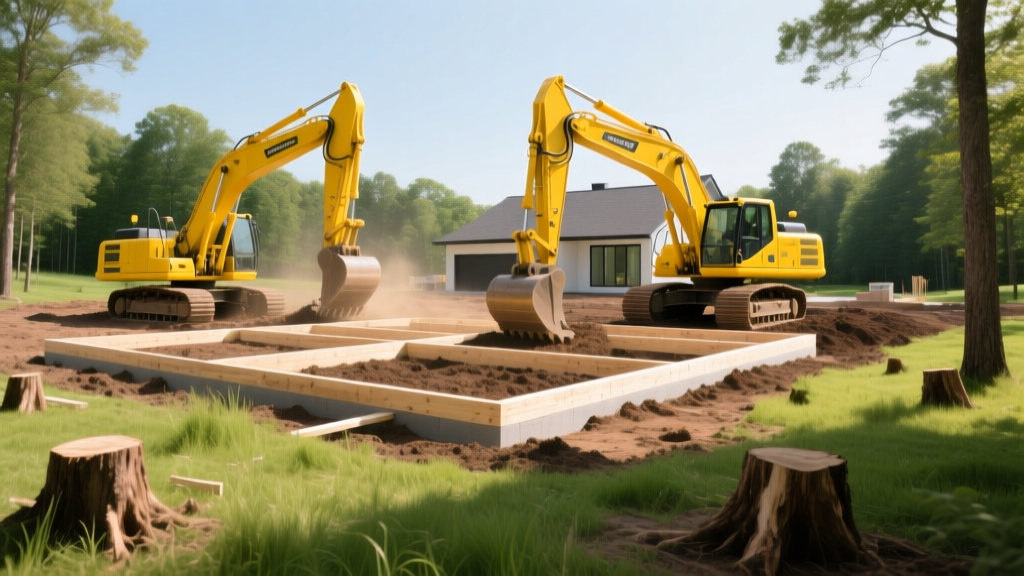
Calculating the true cost to build home on land requires moving past national averages. While the national baseline for residential construction sits between $150 and $220 per square foot in 2026, raw land development introduces extreme regional variances. A flat, sandy parcel in the coastal Southeast demands entirely different site preparation, foundation engineering, and code compliance than a rocky, sloped lot in the Northeast or a wildfire-prone ridge in California.
According to the National Association of Home Builders (NAHB), site work and foundation costs account for roughly 15% to 20% of total construction expenses, but this can spike to 35% on unimproved rural land. The following analysis breaks down regional pricing, soil-specific engineering requirements, and local code drivers that dictate your final budget.
2026 National Snapshot: Land-to-Home Development
- National Average Build Cost: $175 per sq. ft. (excluding land purchase)
- Average Site Prep (Clearing, Grading, Utilities): $18,500 - $42,000
- Highest Cost Region: Pacific West ($240 - $310+ per sq. ft.)
- Lowest Cost Region: South Central ($145 - $185 per sq. ft.)
Regional Cost Matrix: Breaking Down the Variables
The table below maps the primary cost drivers for building on raw land across four major US climate and geological zones.
| Region | Avg Cost / Sq. Ft. | Primary Site Prep Hurdle | Standard Foundation Type | Major Code Driver |
|---|---|---|---|---|
| Northeast | $210 - $260 | Bedrock blasting, tree clearing | Full basement (frost walls) | Deep frost-line footings, snow loads |
| The South | $145 - $185 | Expansive clay soils, high water table | Post-tension slab or deep piers | Hurricane wind uplift, flood zones |
| Midwest | $155 - $195 | Agricultural land clearing, flat grading | Frost-Protected Shallow (FPSF) | Tornado wind shear, frost heave |
| Pacific West | $240 - $310+ | Seismic grading, steep slope terracing | Reinforced stem wall / caissons | WUI fire codes, seismic sheer walls |
Northeast & Mid-Atlantic: Frost Walls and Rocky Excavation
Building on raw land in states like New York, Pennsylvania, or Massachusetts often means dealing with glacial till and shallow bedrock. Before a foundation can be poured, excavators frequently encounter solid granite or shale. Blasting or mechanical rock breaking adds $5,000 to $20,000 to the site prep budget alone. Furthermore, the frost line in these regions dictates footings must be placed 48 to 60 inches below grade. This necessitates full frost walls or deep crawlspace foundations, requiring significantly more concrete and forming labor than slab-on-grade builds in warmer climates.
The South: Expansive Soils and Hurricane Strapping
In Texas, Louisiana, and the Carolinas, the dirt itself is the adversary. Expansive clay soils swell when wet and shrink when dry, capable of cracking standard concrete slabs and destroying structural integrity. To mitigate this, engineers mandate post-tensioned slab-on-grade foundations (adding $3,500 to $7,000 to foundation costs) or drilled concrete piers that anchor the home to stable load-bearing strata deep underground. Additionally, coastal and southern inland areas require continuous load-path engineering. As outlined by FEMA's Building Science division, hurricane straps, impact-resistant glazing, and reinforced roof-to-wall connections are mandatory, adding roughly $8 to $12 per square foot to the framing and roofing budget.
The Midwest: Frost-Protected Shallow Foundations
The Midwest offers some of the most cost-effective land development, primarily due to flat topography and deep, easily excavated soils. However, extreme winter temperature swings require specialized engineering. The Frost-Protected Shallow Foundation (FPSF) has become the regional standard for unheated or lightly heated structures, and increasingly for residential builds. By utilizing rigid foam insulation around the perimeter of the footing to trap geothermal heat, builders can pour footings at just 12 to 16 inches deep, saving thousands in excavation and concrete costs compared to traditional deep frost walls.
The West: Seismic Retrofits and Wildfire Zones
California, Oregon, and Washington present the highest barriers to entry for land developers. If your parcel sits in a Wildland-Urban Interface (WUI) zone, local codes dictate strict ignition-resistant construction. This mandates Class A fire-rated roofing (such as GAF Timberline UHDZ shingles), non-combustible siding (like James Hardie fiber cement), and specialized ember-resistant foundation vents (e.g., Brandguard Vents) which cost roughly $45 to $65 per unit. Furthermore, building on sloped land in seismic zones requires extensive geotechnical engineering, retaining walls, and deep caissons drilled into bedrock to prevent lateral shifting during an earthquake, as detailed in the International Code Council (ICC) seismic safety guidelines.
Hidden Land-Building Variables That Skew Budgets
Beyond the foundation and framing, raw land lacks the municipal infrastructure of developed subdivisions. Budget for these critical off-site variables:
- Well Drilling Depth: In arid regions or mountainous terrain, hitting potable water can require drilling 400+ feet. At $60 to $100 per foot, a deep well system with a constant pressure pump can exceed $35,000.
- Perc Tests and Septic Engineering: If the soil fails a standard percolation test, you may be forced to install an aerobic treatment unit (ATU) or a mound septic system, pushing wastewater costs from a standard $8,000 to over $25,000.
- Utility Tap and Trenching Fees: Running underground power, fiber-optic internet, and natural gas from the nearest municipal road to your build site costs an average of $25 to $45 per linear foot. A house set 500 feet back from the road will incur $12,500 to $22,500 in trenching and conduit costs.
- Driveway Engineering: Heavy equipment required for home construction will destroy a standard gravel driveway. Builders require a stabilized construction entrance, and the final driveway may require a geogrid base and 4 inches of asphalt, costing $15 to $30 per square foot.
"The biggest mistake land buyers make is assuming a cheap purchase price equals a cheap build. A $30,000 wooded lot on a 15-degree slope with a high water table will easily consume $60,000 in site work and retaining walls before the first piece of lumber is ever framed."
Decision Framework: Evaluating Your Specific Parcel
Use this conditional framework to estimate your site-specific risk and budget multipliers before purchasing raw land:
- Is the land heavily wooded or sloped greater than 10%?
If Yes: Add $15,000 - $30,000 for selective clearing, stump grinding, and cut-and-fill grading. Add $10,000+ for engineered retaining walls. - Are municipal sewer and water available at the lot line?
If No: Allocate $20,000 - $45,000 for well drilling, septic engineering, and installation. Require a successful perc test as a contingency in your purchase contract. - Does the parcel sit in a designated flood zone (FEMA Zone A or V)?
If Yes: You must budget for structural fill dirt to raise the building pad above the Base Flood Elevation (BFE), plus the cost of an elevation certificate and mandatory flood insurance. - Is the soil primarily expansive clay or organic peat?
If Yes: Commission a $1,500 geotechnical soil boring test. Expect foundation costs to increase by 20% to 40% for post-tension cables, void forms, or helical piers.
Frequently Asked Questions
Is it cheaper to buy land and build a house in 2026?
It depends on the region. In the Midwest and South, buying raw land and building can yield a 10% to 15% savings compared to purchasing an equivalent new-construction home in a developer subdivision, primarily due to avoiding developer lot premiums and HOA fees. In the Northeast and West, high site-prep costs and strict environmental codes often make raw land builds more expensive than buying existing inventory.
How long does site preparation take before building can start?
For relatively flat, clear land with accessible utilities, site prep takes 2 to 4 weeks. For heavily wooded, sloped parcels requiring well drilling, septic installation, and rock blasting, site development can easily take 3 to 6 months before the foundation crew arrives.
Do construction loans cover land development and site prep?
Yes, most construction-to-permanent loans allow you to roll the cost of raw land, site preparation, well/septic installation, and the actual home build into a single financing package, provided the final appraised value of the completed home supports the total loan amount.
Written by
David NakamuraDavid Nakamura is a licensed architect (AIA) and construction technology writer focused on sustainable building methods, mass timber engineering, and high-performance building envelopes. He holds a Master of Architecture from the University of Washington and is a certified Passive House Consultant (CPHC). David spent eight years at the Seattle firm Mithun, where he led the design of three LEED Platinum projects, before founding his own practice specializing in net-zero residential design. He serves on the editorial advisory board of GreenBuilder Magazine and has authored peer-reviewed papers on cross-laminated timber (CLT) connections for the Journal of Structural Engineering. In his spare time, David teaches woodworking at Pratt Fine Arts Center and kayaks the Puget Sound.
More from David Nakamura
View all
Construction Cost
Labor Cost to Build a Deck Per Sq Ft: 2026 Installation Guide
Discover the exact labor cost to build a deck per sq ft in 2026. This installation guide breaks down contractor rates, complexity factors, and hidden fees.
Aug 4, 2026

Construction Cost
How Much Does It Cost to Build a 3 Bedroom House? Financing Guide
Learn exactly how much it costs to build a 3 bedroom house and explore 2026 financing options, construction loan types, and budget frameworks for your build.
Aug 4, 2026

Construction Cost
Cost to Build a Tennis Court: 2026 Guide
How much does it cost to build a tennis court in 2026? Breakdowns for asphalt, concrete, and synthetic surfaces plus fencing and lighting.
Jul 30, 2026