How Much Does It Cost to Build a Septic System? Cost Breakdown
Discover how much it costs to build a septic system. Get current pricing for conventional, aerobic, and mound systems, plus soil test and permit fees.

National Average Cost to Build a Septic System
Typical Range: $3,900 to $10,500
National Average: $6,800
High-End (Engineered/Alternative Systems): $15,000 to $25,000+
*Costs vary significantly based on soil percolation rates, local health department requirements, and system footprint.
System Type Cost Matrix: Conventional vs. Engineered
The phrase 'septic system' covers a wide array of wastewater treatment technologies. According to the Environmental Protection Agency (EPA), the system you are legally permitted to install is dictated entirely by your site's soil morphology and groundwater depth. Here is how the primary system types compare in both cost and application.
| System Type | Estimated Cost | Best Use Case | Footprint |
|---|---|---|---|
| Conventional (Gravel) | $3,900 - $8,500 | Deep, well-draining soils with low water tables. | Large |
| Chamber System | $4,500 - $9,000 | Sites where gravel delivery is prohibitively expensive. | Medium |
| Drip Distribution | $8,000 - $14,000 | Shallow soil depths over bedrock or restrictive layers. | Large |
| Aerobic Treatment Unit (ATU) | $10,000 - $20,000 | Small lots, poor soil, or proximity to water bodies. | Small |
| Mound System | $12,000 - $25,000 | High water tables or extremely shallow bedrock. | Very Large |
Preliminary and Hidden Costs: The Pre-Installation Phase
Before a single trench is dug, you must invest in site evaluation. Skipping or rushing these steps is the leading cause of catastrophic system failure and municipal fines.
1. Soil Percolation (Perc) Test and Morphological Evaluation
Cost: $300 to $1,500
A licensed soil scientist must evaluate your land. Modern health departments rarely rely on simple 'perc tests' (measuring how fast water drains from a hole). Instead, they require a morphological soil evaluation to identify the seasonal high water table and soil texture (e.g., sandy loam vs. heavy clay). If your soil has a high clay content or a restrictive layer within 18 inches of the surface, a conventional system will be denied, forcing you into a $15,000+ engineered alternative.
2. Engineering, Design, and Permitting
Cost: $800 to $3,000
Conventional systems often only require a standard health department permit ($250-$800). However, if you need an ATU or mound system, you must hire a licensed civil or environmental engineer to draft custom site plans, which typically costs $1,500 to $2,500 in design fees alone.
Fiberglass and polyethylene tanks are lighter and easier to install than concrete. However, in areas with high seasonal water tables, an empty plastic or fiberglass tank can literally float out of the ground like a boat when pumped out for maintenance. A standard 1,000-gallon concrete tank weighs roughly 8,000 lbs empty, anchoring it naturally. If you use a lightweight tank in wet soil, your installer must pour a concrete 'deadman' anchor pad at the bottom of the excavation, adding $600-$1,200 to the project.
Material Costs: Tank and Drain Field Components
The physical materials account for roughly 30% to 40% of the total project cost. Understanding the specifications of these materials prevents contractors from cutting corners.
Septic Tank Materials
- Precast Concrete ($1,200 - $2,500 for 1,000 gallons): The industry standard. Ensure the tank is manufactured to ASTM C1227 standards, which dictates structural integrity and watertightness. Concrete tanks feature internal baffles that are integral to the structure.
- Fiberglass ($1,500 - $2,200 for 1,000 gallons): Manufactured to ASTM D4021 standards. Excellent for sites with highly acidic soils that might degrade concrete over decades, but requires anti-buoyancy anchoring in wet conditions.
- Polyethylene / Plastic ($800 - $1,500 for 1,000 gallons): The cheapest option, but highly susceptible to deformation if the surrounding backfill is not properly compacted in 8-inch lifts. Not recommended for driveways or high-traffic areas due to crush risks.
Drain Field Innovations: Gravel vs. Chambers
Traditional drain fields require tons of washed gravel (typically 3/4-inch to 2-inch diameter) to surround the perforated PVC pipe. In rural areas where gravel must be trucked in from distant quarries, material and freight costs can exceed $3,000.
The Alternative: Plastic leaching chambers (such as the Infiltrator Quick4 Standard) are placed directly over the soil, eliminating the need for gravel entirely. While the chambers themselves cost $1,500 to $2,500, the elimination of gravel delivery and the reduction in trench width (which means less excavator time) usually results in a net savings of $1,000 to $2,000.
Labor, Excavation, and Site Preparation Variables
Labor typically accounts for 50% to 60% of your total bill. The primary variables that cause labor estimates to balloon include:
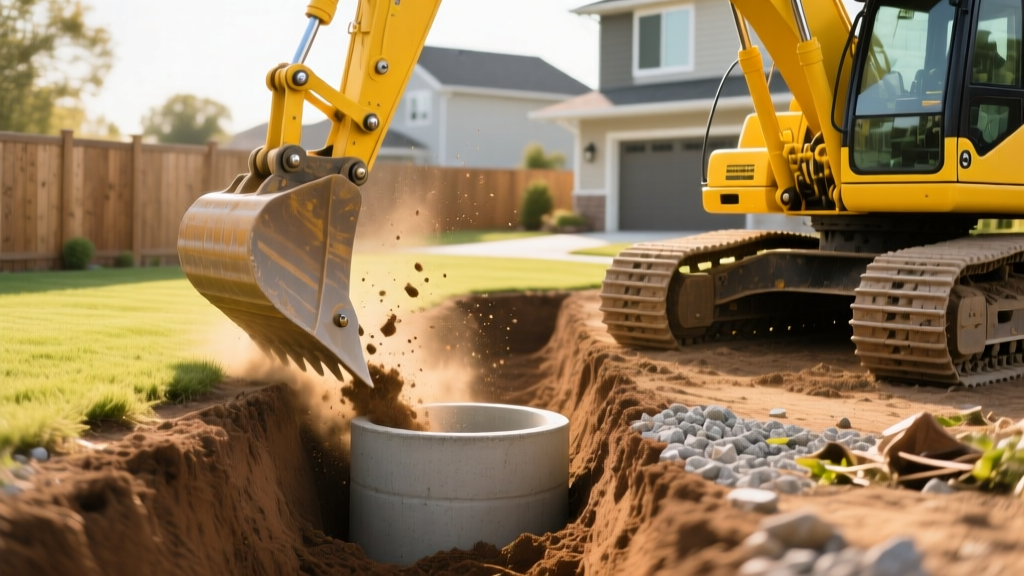
- Access Restrictions: If a standard tracked excavator (like a CAT 320) cannot fit between your house and the property line due to fences or landscaping, the contractor must use a mini-excavator. This doubles the excavation time and increases labor costs by 20% to 35%.
- Subsurface Obstructions: Hitting solid bedrock or massive glacial boulders during trenching requires a rock hammer attachment or manual blasting. Contractors usually include a 'rock clause' in their contracts, charging an additional $75 to $150 per hour for rock-breaking equipment.
- Distance from House: The trench connecting the house to the tank (the inlet line) requires a precise 1/8-inch per foot downward slope. If the tank is located 150 feet away, the trench must be nearly 2 feet deeper at the tank end, significantly increasing earthmoving volumes.
Long-Term Lifecycle and Maintenance Costs
Building the system is only the initial capital expenditure. According to Penn State Extension, proper maintenance is non-negotiable to prevent premature drain field clogging, which costs $10,000+ to replace.
| Maintenance Task | Frequency | Estimated Cost |
|---|---|---|
| Tank Pumping (Sludge removal) | Every 3 to 5 years | $300 - $500 |
| Effluent Filter Cleaning | Annually or during pumping | $50 - $100 (or DIY) |
| ATU Aerator Motor Replacement | Every 5 to 7 years | $400 - $800 |
| Drip Distribution Filter Flushing | Bi-annually | $150 - $250 |
If your local code does not mandate an effluent filter on the outlet baffle of your concrete tank, pay the extra $60 to $120 to have one installed (brands like Polylok or Tuff-Tite are industry standards). This filter catches suspended solids before they enter the drain field, effectively doubling the lifespan of your leach field and saving you from a five-figure replacement bill.
Frequently Asked Questions
Can I install a septic system myself to save money?
In most jurisdictions, it is illegal for an unlicensed individual to install a septic system. Health departments require the installer to hold a specific wastewater contractor license. Furthermore, the final inspection requires sign-off by a licensed soil scientist or county sanitarian. Attempting a DIY installation will result in failed inspections, fines, and mandatory removal of the unpermitted work.
Does a larger house always require a more expensive septic system?
Not necessarily. Septic system sizing is based on design flow, which is calculated by the number of bedrooms, not the total square footage or the number of bathrooms. A 5,000-square-foot home with 3 bedrooms requires the same 1,000-gallon tank and drain field size as a 1,500-square-foot home with 3 bedrooms. However, adding a fourth bedroom will legally bump the requirement to a 1,250-gallon tank and a 30% larger drain field, increasing costs by roughly $1,500 to $2,500.
What happens if my property fails the perc test?
Failing a perc test does not mean the land is unbuildable; it simply means a conventional gravity-fed system is prohibited. You will need to pivot to an engineered alternative, such as a sand mound system (which artificially elevates the drain field above the restrictive soil layer) or an Aerobic Treatment Unit (which pre-treats the wastewater to a higher standard, allowing for a smaller, shallower dispersal field). Expect your budget to increase by $8,000 to $15,000 in these scenarios.
Written by
David NakamuraDavid Nakamura is a licensed architect (AIA) and construction technology writer focused on sustainable building methods, mass timber engineering, and high-performance building envelopes. He holds a Master of Architecture from the University of Washington and is a certified Passive House Consultant (CPHC). David spent eight years at the Seattle firm Mithun, where he led the design of three LEED Platinum projects, before founding his own practice specializing in net-zero residential design. He serves on the editorial advisory board of GreenBuilder Magazine and has authored peer-reviewed papers on cross-laminated timber (CLT) connections for the Journal of Structural Engineering. In his spare time, David teaches woodworking at Pratt Fine Arts Center and kayaks the Puget Sound.
More from David Nakamura
View all
Construction Cost
Labor Cost to Build a Deck Per Sq Ft: 2026 Installation Guide
Discover the exact labor cost to build a deck per sq ft in 2026. This installation guide breaks down contractor rates, complexity factors, and hidden fees.
Aug 4, 2026

Construction Cost
How Much Does It Cost to Build a 3 Bedroom House? Financing Guide
Learn exactly how much it costs to build a 3 bedroom house and explore 2026 financing options, construction loan types, and budget frameworks for your build.
Aug 4, 2026

Construction Cost
Cost to Build a Tennis Court: 2026 Guide
How much does it cost to build a tennis court in 2026? Breakdowns for asphalt, concrete, and synthetic surfaces plus fencing and lighting.
Jul 30, 2026