Cost to Build a Wind Turbine: Residential vs. Agricultural Pricing
Compare the cost to build a wind turbine for residential homes versus agricultural farms. Breakdowns of tower, inverter, and installation expenses.
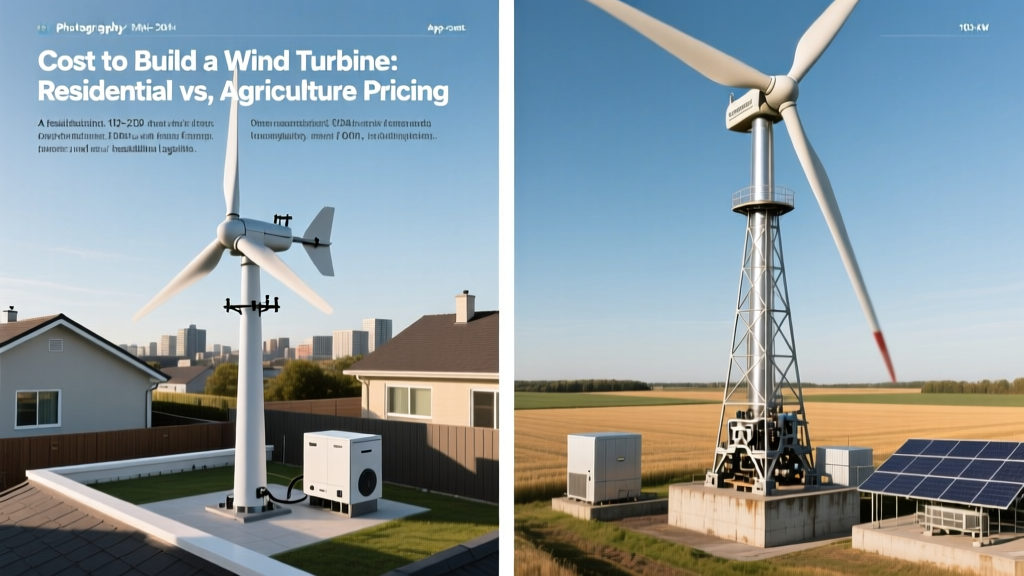
The cost to build a wind turbine varies drastically based on energy requirements, tower height, and grid connectivity. For small-scale residential and agricultural applications, pricing generally ranges from $4,000 to $8,000 per kilowatt (kW) of installed capacity. However, economies of scale significantly reduce the per-watt cost as system size increases. A 1.5 kW rooftop micro-turbine might cost $7,300 per kW, while a 50 kW agricultural turbine drops to roughly $3,000 per kW.
Accurately estimating your project requires moving beyond simple per-watt averages. You must account for geotechnical engineering, tower metallurgy, balance of system (BOS) electronics, and local zoning setbacks. According to the U.S. Department of Energy, site assessment and proper tower sizing are the most critical factors in determining both the upfront capital expenditure and the long-term levelized cost of energy (LCOE).
The Economics of Scale: Residential vs. Agricultural
Small wind systems are categorized by their rated capacity. Residential homes typically require between 1.5 kW and 10 kW, while large estates, farms, and small commercial operations utilize 10 kW to 100 kW systems. The following matrix outlines the turnkey installed costs for 2026, assuming an average wind speed site (12 mph annual average at hub height) and standard soil conditions.
| System Size | Application | Turbine & Rotor | Tower & Foundation | Inverter & BOS | Total Installed Cost |
|---|---|---|---|---|---|
| 1.5 kW | Off-grid cabin / Supplemental | $6,500 | $2,500 (Guyed) | $3,200 | $12,200 |
| 5 kW | Standard residential | $16,000 | $9,500 (Monopole) | $5,500 | $31,000 |
| 10 kW | Large home / Small farm | $29,000 | $16,000 (Monopole) | $7,800 | $52,800 |
| 50 kW | Agricultural / Commercial | $95,000 | $42,000 (Lattice) | $18,000 | $155,000 |
Component-Level Cost Breakdown
Understanding where your capital is allocated helps identify areas for optimization without compromising structural integrity or energy yield.
The Turbine and Rotor Assembly
The nacelle (housing the generator) and the rotor blades constitute roughly 35% to 45% of the total hardware cost. Modern small turbines utilize permanent magnet alternators (PMAs) which eliminate the need for external excitation current, improving low-wind efficiency. Blades are typically manufactured from pultruded fiberglass or carbon-fiber composites. A high-quality 10 kW turbine, such as the Bergey Excel 10, features a 23-foot rotor diameter and commands a premium price due to its proven 25-year operational lifespan and minimal moving parts.
Tower Engineering and Foundation Realities
Wind power increases with the cube of wind speed. Raising a turbine from a 40-foot tower to an 80-foot tower can double the energy output, but it exponentially increases the structural load and foundation costs.
Guyed towers are 30% to 40% cheaper than freestanding monopoles because the tensioned steel cables absorb the bending moments, allowing for a much smaller concrete anchor base. However, guyed towers require a land footprint with a radius at least 50% to 80% of the tower height, making them unsuitable for most suburban residential lots.
Balance of System (BOS) and Inverters
The BOS includes the charge controllers, disconnect switches, wiring, and the inverter. For grid-tied systems, you need a wind-specific inverter that can handle the variable frequency and voltage output of a PMA, converting it to clean 60Hz AC power synchronized with the utility grid. Premium models like the Schneider Electric Conext XW Pro or specialized wind inverters from OutBack Power cost between $4,000 and $7,500. Data from WINDExchange indicates that BOS components and electrical labor account for roughly 20% of the total project budget.
Grid-Tied vs. Off-Grid Configurations
Your connection strategy dictates the complexity and cost of your electrical infrastructure.
- Grid-Tied (Net Metering): The most cost-effective setup. Excess power is fed back into the utility grid, essentially using the grid as a free, infinite battery. This requires a bi-directional utility meter and utility interconnection approval, which can take 30 to 90 days and cost $500 to $1,500 in administrative and upgrade fees.
- Off-Grid (Battery Storage): Mandatory for remote sites. You must purchase a battery bank to store energy for calm days. A 20 kWh Lithium Iron Phosphate (LiFePO4) server-rack battery system (e.g., SOK or EG4) will add $8,000 to $12,000 to your budget. You will also need a dedicated wind charge controller with dynamic braking resistors to safely dump excess power when the batteries reach 100% state-of-charge, preventing the turbine from overspeeding and destroying itself.
- Hybrid Systems: Combines grid-tie with battery backup. This requires a complex sub-panel setup and an automatic transfer switch, adding $3,000 to $5,000 in electrical labor and specialized switchgear.
Zoning, Setbacks, and FAA Regulations
Before purchasing hardware, you must navigate local and federal airspace regulations. Most municipal zoning codes enforce a 'fall-zone' setback, requiring the turbine tower to be set back from all property lines and structures by a distance equal to 1.1 times the total height of the tower plus the rotor blade tip. For a 100-foot tower with a 20-foot rotor diameter, the total height is 110 feet, mandating a 121-foot setback from your neighbor's property line.
If your proposed tower height exceeds 200 feet above ground level (AGL), or if it is located within a specific radius of a registered airport, federal law requires you to file FAA Form 7460-1 (Notice of Proposed Construction or Alteration). While small residential towers rarely trigger this, large agricultural installations on elevated terrain frequently do.
Permitting costs vary wildly. Rural agricultural counties may issue a conditional use permit for $250, while strict suburban HOAs or coastal commissions may require $5,000 in environmental impact studies, acoustic modeling, and shadow-flicker analysis before granting approval.
DIY Kits vs. Turnkey Professional Installation
The market is flooded with cheap, sub-3kW wind turbines from overseas manufacturers priced under $2,000. These are almost universally inadequate for primary power generation. They utilize cheap neodymium magnets that demagnetize under high heat, lack proper overspeed braking mechanisms, and feature alternators that require high RPMs to produce usable voltage, resulting in near-zero output in average wind conditions.
Professional turnkey installation by a certified small wind installer ensures the tower is plumb, the grounding ring meets National Electrical Code (NEC) Article 250 standards, and the guy wires (if applicable) are tensioned with calibrated dynamometers to prevent harmonic resonance. Labor for a professional crew to erect an 80-foot monopole tower and commission the electrical system typically ranges from $6,000 to $12,000, depending on crane accessibility and site terrain. Skimping on professional erection is the leading cause of catastrophic tower failure and voided manufacturer warranties.
Calculating the Payback Period
The financial viability of a wind turbine hinges entirely on your local wind resource and utility electricity rates. A 10 kW turbine in a Class 3 wind resource (14 mph average) will generate roughly 15,000 kWh annually. If your utility charges $0.18 per kWh, the system offsets $2,700 in electrical costs per year. Against a $52,800 installed cost, the simple payback period is 19.5 years.
However, if you live in a Class 4 wind zone (16 mph average) or an area with utility rates exceeding $0.30 per kWh (such as remote parts of Hawaii or coastal California), that same 10 kW turbine generates 22,000 kWh annually, offsetting $6,600 per year, reducing the payback period to just 8 years. Always commission an independent anemometer study or utilize high-resolution micro-siting data from the National Renewable Energy Laboratory (NREL) before committing capital to a wind project.
Written by
David NakamuraDavid Nakamura is a licensed architect (AIA) and construction technology writer focused on sustainable building methods, mass timber engineering, and high-performance building envelopes. He holds a Master of Architecture from the University of Washington and is a certified Passive House Consultant (CPHC). David spent eight years at the Seattle firm Mithun, where he led the design of three LEED Platinum projects, before founding his own practice specializing in net-zero residential design. He serves on the editorial advisory board of GreenBuilder Magazine and has authored peer-reviewed papers on cross-laminated timber (CLT) connections for the Journal of Structural Engineering. In his spare time, David teaches woodworking at Pratt Fine Arts Center and kayaks the Puget Sound.
More from David Nakamura
View all
Construction Cost
Labor Cost to Build a Deck Per Sq Ft: 2026 Installation Guide
Discover the exact labor cost to build a deck per sq ft in 2026. This installation guide breaks down contractor rates, complexity factors, and hidden fees.
Aug 4, 2026

Construction Cost
How Much Does It Cost to Build a 3 Bedroom House? Financing Guide
Learn exactly how much it costs to build a 3 bedroom house and explore 2026 financing options, construction loan types, and budget frameworks for your build.
Aug 4, 2026

Construction Cost
Cost to Build a Tennis Court: 2026 Guide
How much does it cost to build a tennis court in 2026? Breakdowns for asphalt, concrete, and synthetic surfaces plus fencing and lighting.
Jul 30, 2026