SoFi Stadium Cost to Build: Analyzing the $5.5B Mega-Project
Explore the SoFi Stadium cost to build, analyzing the $5.5B mega-project's regional price drivers, seismic engineering, and 2026 construction projections.

The $5.5 Billion Breakdown: Where Did the Money Go?
When analyzing the SoFi Stadium cost to build, the final price tag of approximately $5.5 billion makes it the most expensive sports venue ever constructed. However, viewing this figure as a simple sum of concrete and steel misses the complex regional and regulatory realities of building in Inglewood, California. The 3.1 million-square-foot structure, which opened in 2020, required unprecedented engineering solutions driven by local geography, seismic risks, and aviation regulations.
Unlike traditional bowl stadiums, SoFi operates as a dual-sided, indoor-outdoor megastructure. The financial outlay was distributed across several non-traditional cost centers. Excavation alone consumed a massive portion of the early budget. Because of strict height limitations imposed by the Federal Aviation Administration (FAA) due to the proximity of Los Angeles International Airport (LAX), the stadium bowl had to be sunk 100 feet below grade. This required the removal of over 3 million cubic yards of soil, a logistical feat that cost upwards of $75 million in hauling, disposal, and site shoring alone.
Seismic Engineering Premium
Southern California's fault lines necessitated a state-of-the-art base isolation system. The stadium rests on 260 friction pendulum seismic isolators. These custom-machined steel and Teflon bearings allow the 100-million-pound canopy roof and seating bowl to move independently during an earthquake, absorbing up to 30 inches of lateral displacement. The specialized engineering and fabrication of these isolators added an estimated $30 million to the structural foundation budget.
Regional Cost Multipliers: The Southern California Premium
To understand the SoFi Stadium cost to build from a regional price analysis perspective, estimators must compare it against other recent NFL mega-projects. Construction costs in Los Angeles County are heavily inflated by prevailing wage mandates, stringent environmental regulations, and the high cost of logistics in a congested urban corridor.
According to data analyzed by Forbes, the cost per seat and cost per square foot at SoFi dwarf comparable venues built in the same decade. Below is a comparative matrix highlighting the regional cost disparities.
| Stadium (Location) | Total Cost | Square Footage | Cost / Sq Ft | Capacity | Cost / Seat |
|---|---|---|---|---|---|
| SoFi Stadium (Inglewood, CA) | $5.5 Billion | 3.1 Million | $1,774 | 70,240 | $78,300 |
| Allegiant Stadium (Las Vegas, NV) | $1.9 Billion | 1.75 Million | $1,085 | 65,000 | $29,230 |
| U.S. Bank Stadium (Minneapolis, MN) | $1.1 Billion | 1.75 Million | $628 | 66,860 | $16,450 |
The Los Angeles labor market heavily influenced these numbers. During peak construction, over 4,000 workers were on-site daily. Union ironworkers, crane operators, and specialized ETFE riggers in Southern California command total compensation packages (wages plus benefits and pension contributions) frequently exceeding $140 per hour. When combined with the logistical nightmare of delivering oversized steel trusses through dense Inglewood traffic, the regional multiplier pushed baseline material costs up by an estimated 35% compared to Midwestern or Sunbelt equivalents.
Material Spotlight: The ETFE Canopy and Oculus Screen
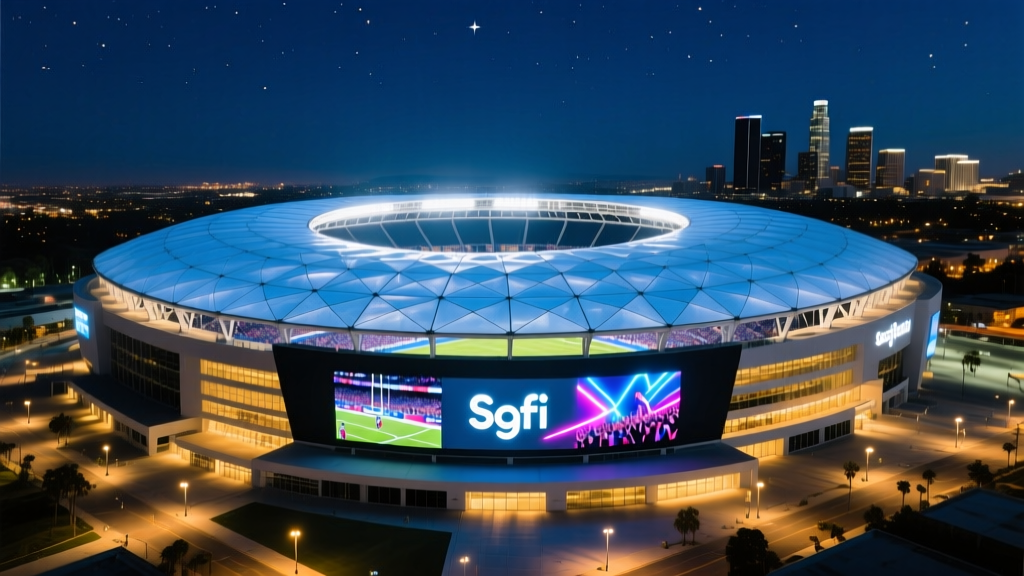
Two specific architectural features drove the SoFi Stadium cost to build well past initial estimates: the translucent roof and the center-hung digital display. As detailed by Architectural Record, the roof spans 37 acres and is composed of 302 individual panels made of ETFE (Ethylene Tetrafluoroethylene).
ETFE vs. Traditional Roofing Materials
ETFE is a fluorine-based plastic that is significantly lighter than glass, allowing for a reduction in the tonnage of structural steel required to support the canopy. However, the material itself and the specialized pneumatic tensioning systems required to keep the panels taut are highly specialized.
- Material Cost: ETFE foil cushions typically range from $15 to $30 per square foot for high-grade architectural applications, compared to $8 to $12 for standard PTFE fiberglass.
- Custom Fabrication: Because no two panels on the SoFi roof are identical, each had to be custom-cut and welded in Germany before shipping, adding severe freight and tariff costs.
- Acoustic Treatment: To prevent the stadium from sounding like an echo chamber, specific panels were perforated and layered with acoustic mesh, adding $4 million in material upgrades.
Hanging beneath this roof is the Samsung Infinity Screen, a dual-sided, 4K center-hung video board spanning 120,000 square feet. Weighing 2.2 million pounds, the screen required an independent steel catenary suspension system anchored directly into the stadium's primary mega-columns. The integration of the screen's power, cooling, and data infrastructure added an estimated $150 million to the AV and structural budget.
"Estimators often overlook the secondary structural costs of massive AV integrations. The steel required just to suspend the SoFi Oculus screen safely under seismic and wind-load conditions cost more than the entire seating bowl of a mid-tier Division I college stadium."
The FAA Height Restriction: A Hidden Cost Driver
One of the most critical factors in the SoFi Stadium cost to build was the 100-foot depth of the excavation. Standard NFL stadiums are built at grade or slightly elevated to accommodate parking and concourses underneath. Because LAX flight paths restrict building heights in Inglewood, architect HKS had to design the venue vertically inverted.
Digging a 100-foot-deep, 70-acre hole in a region with a high water table introduced massive geotechnical expenses. The project required continuous dewatering operations, utilizing hundreds of wellpoints to lower the water table and prevent hydrostatic uplift during construction. Furthermore, the perimeter shoring system—comprising miles of soldier piles and lagging—had to withstand the lateral earth pressure of a 100-foot drop while heavy cranes operated near the edges. This subterranean construction approach increased the concrete foundation and earthwork budget by roughly 40% compared to a standard at-grade build.
2026 Projection: What Would SoFi Cost to Build Today?
If a developer were to break ground on an identical structure in 2026, the SoFi Stadium cost to build would be substantially higher. According to historical data tracked by the Bureau of Labor Statistics Producer Price Index for nonresidential building construction, the industry has experienced compounding inflation in both materials and skilled labor since 2020.
2026 Cost Estimation Framework
- Structural Steel: Global supply chain shifts and domestic production tariffs have pushed fabricated structural steel prices up 28% since 2020.
- Specialized Labor: Prevailing wages for specialized riggers and electricians in LA County have increased by 22% to combat regional cost-of-living spikes.
- Concrete & Cement: Regional cement shortages and carbon-tax implementations in California have driven ready-mix concrete prices up by 19%.
Projected 2026 Total: Applying a conservative 32% cumulative inflation multiplier to the original $5.5 billion baseline, an identical SoFi Stadium would cost an estimated $7.26 billion to build in the current economic climate. This makes the original 2020 completion not just an architectural marvel, but a masterclass in pre-pandemic supply chain timing.
Key Takeaways for Mega-Project Estimators
When estimating regional costs for large-scale civic or sports venues, estimators must look beyond raw material tonnage. The SoFi Stadium cost to build proves that local regulatory constraints (FAA height limits), geotechnical realities (seismic isolators and dewatering), and highly specialized architectural envelopes (custom ETFE) are the true drivers of budget variance. A square-foot cost model derived from a Midwestern stadium will fail catastrophically when applied to the Southern California market.
Written by
Sarah WhitfieldSarah Whitfield is a chartered quantity surveyor (MRICS) and construction cost analyst with 15 years of experience in material pricing, procurement strategy, and project budgeting. She earned her degree in Construction Management from the University of Reading (UK) and has worked on projects ranging from $2M custom homes to $180M mixed-use developments across North America and Europe. Sarah currently leads cost estimating for BuildMat Insight, maintaining a proprietary database of 4,000+ material price points updated quarterly. She is a frequent contributor to RSMeans cost data panels and has presented at the International Cost Engineering Council (ICEC) congress. Based in Denver, CO, Sarah is an avid trail runner and volunteer mentor for Women in Construction.
More from Sarah Whitfield
View all
Wood & Lumber
What Are the Different Types of Wood? A Builder's Guide
Compare structural softwoods, finish hardwoods, and engineered lumber. Analyze Janka ratings, MOE values, and 2026 pricing for construction.
Aug 4, 2026

Walls & Panels
Steel Framing vs Wood Framing: Corrosion and Moisture Defense
Compare steel framing vs wood framing for moisture resistance. Learn about galvanized coatings, condensation risks, and corrosion protection strategies.
Jul 21, 2026

Stone & Masonry
How to Cut Stone Veneer: Wet Saw vs Grinder Comparison
Compare the best tools for cutting stone veneer. We review wet saws, angle grinders, and chop saws to help you achieve clean, chip-free cuts.
Jul 21, 2026