How Much Does It Cost to Build a Storage Shed? A Financing Guide
Discover how much it costs to build a storage shed and explore top financing options, from HELOCs to personal loans, to fund your backyard project.
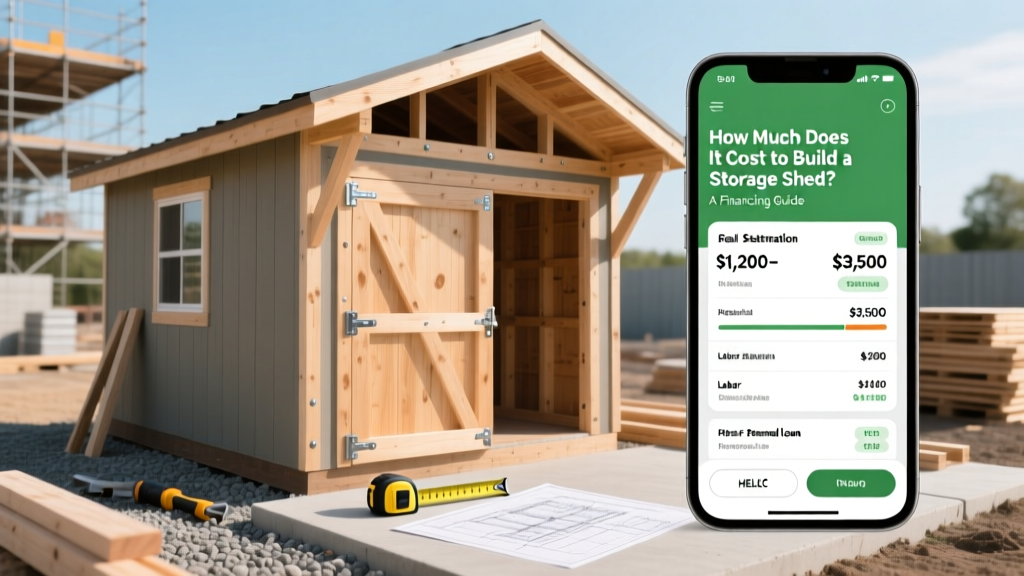
The True Cost Breakdown: How Much Does It Cost to Build a Storage Shed?
When homeowners ask, 'how much does it cost to build a storage shed,' the answer spans from $800 for a basic resin kit to over $25,000 for a custom-built, fully wired workshop. The final price tag hinges on three primary variables: footprint dimensions, material grade, and site preparation requirements. According to industry data analyzed by Forbes Home Improvement, the national average for a professionally built 10x12 wooden shed sits between $4,500 and $8,500 in 2026, factoring in both materials and labor.
Estimated Costs by Size and Material Tier
| Shed Dimensions | Material Profile | Material Cost | Labor & Prep | Total Estimated Cost |
|---|---|---|---|---|
| 8x10 (80 sq ft) | Prefab Resin / Vinyl | $600 - $1,200 | $300 - $600 | $900 - $1,800 |
| 10x12 (120 sq ft) | T1-11 Plywood & Asphalt | $2,500 - $4,000 | $2,000 - $3,500 | $4,500 - $7,500 |
| 12x16 (192 sq ft) | LP SmartSide & Architectural | $5,500 - $8,000 | $4,000 - $6,500 | $9,500 - $14,500 |
| 16x20 (320 sq ft) | Custom Framed & Insulated | $12,000 - $18,000 | $8,000 - $12,000 | $20,000 - $30,000 |
Financing Your Storage Shed: 4 Primary Pathways
Once you determine the scope of your project, securing capital is the next hurdle. In the 2026 lending environment, interest rates remain relatively elevated compared to the early 2020s, making the choice of financing vehicle critical to your overall budget.
1. Home Equity Line of Credit (HELOC)
A HELOC allows you to borrow against the equity in your home. It functions as a revolving credit line, typically featuring a 10-year draw period followed by a 20-year repayment phase. Current HELOC rates generally track 1% to 2% above the prime rate. The Consumer Financial Protection Bureau (CFPB) notes that HELOCs are ideal for large, phased projects because you only pay interest on the capital you actually draw. Best for: Custom 12x16 or larger sheds ($10,000+) where funds are needed in stages (e.g., paying the concrete crew first, then the framers).
2. Unsecured Personal Loans
Personal loans provide a lump sum with a fixed interest rate and a set repayment term (usually 36 to 84 months). Because they are unsecured, they do not put your home at risk, but rates are higher—typically ranging from 8.5% to 15% depending on your credit score. Funding is rapid, often within 48 hours. Best for: Mid-sized prefab or kit sheds ($3,000 to $8,000) where you need immediate capital without the appraisal and closing costs associated with home equity products.
3. Retailer Deferred Interest Credit Cards
Major home improvement retailers offer branded credit cards promoting '0% APR for 18 to 24 months.' Read the fine print carefully. These are typically deferred interest promotions, not true 0% APR offers. If you fail to pay the entire balance before the promotional period expires, the lender will retroactively apply standard interest (often 28.99% to 31.99%) to the original purchase amount from day one. Best for: DIYers purchasing materials directly from a big-box store who have the cash flow guaranteed to clear the balance before the promotional window closes.
4. Cash-Out Refinance or Home Equity Loan
Unlike a HELOC, a home equity loan provides a single lump sum with a fixed rate. This is advantageous if you are bundling the shed construction with a larger property renovation (like a deck replacement or fencing) to lock in a predictable monthly payment.
The 'Hidden' Costs That Derail Shed Budgets
When calculating how much it costs to build a storage shed, contractors often quote the 'shell' price. To avoid budget overruns, you must line-item the following site-specific expenses:
- Site Preparation & Base: Never place a wooden shed directly on dirt or grass. A proper base requires excavating 4 inches of topsoil, laying landscape fabric, and filling with 3/4-inch crushed gravel (often called 'crush and run' or 'dense grade aggregate'). Budget $1.50 to $2.50 per square foot for professional grading and gravel installation.
- Permitting & Zoning: Most municipalities require permits for structures over 120 or 200 square feet. Fees range from $50 to $250. Additionally, verify your local setback requirements; sheds often cannot be placed within 5 to 10 feet of a property line.
- Electrical Trenching: If you plan to wire the shed for lighting or power tools, running a dedicated 20-amp or 30-amp circuit requires trenching. Expect to pay $15 to $25 per linear foot to dig, lay PVC conduit, pull UF-B wire, and backfill.
- Wind Anchoring: In hurricane or high-wind zones, code requires structural tie-downs. Auger-style mobile home anchors or concrete sonotube footings can add $400 to $900 to the foundation budget.

Decision Matrix: Matching Project Scale to Capital Source
Use this framework to align your specific shed build with the most mathematically sound financing method.
| Project Scale | Estimated Cost | Recommended Financing | Why This Route? |
|---|---|---|---|
| Small DIY / Resin Kit | Under $2,500 | Cash Savings or 0% Credit Card | Avoids loan origination fees; easily paid off before deferred interest triggers. |
| Mid-Size Prefab Wood | $3,000 - $8,000 | Unsecured Personal Loan | Fixed payments, no risk to home equity, fast funding for turnkey delivery. |
| Large Custom Build | $10,000 - $20,000+ | HELOC or Home Equity Loan | Lowest interest rates; interest may be tax-deductible if the shed improves property value. |
| Bundled Renovation | $25,000+ | Cash-Out Refinance | Consolidates shed, fencing, and landscaping into one predictable mortgage payment. |
ROI and Property Value Impact
Does a storage shed yield a return on investment? The National Association of Realtors (NAR) consistently highlights that outdoor storage and organizational structures appeal strongly to buyers, though they rarely return 100% of their construction cost at resale. Typically, a well-built, aesthetically matching wooden shed recoups 60% to 75% of its cost in added home value.
However, the indirect ROI is often higher. By moving lawnmowers, seasonal decorations, and sporting equipment out of the garage, you restore the garage to its primary function: parking vehicles. A functional, uncluttered garage is a top-tier selling point that accelerates time-on-market and prevents price reductions during home inspections.
Step-by-Step Execution: From Approval to Groundbreaking
- Define the Footprint & Usage: Measure your available yard space, accounting for 3-foot clearance around the perimeter for maintenance and roof overhang. Decide if you need a standard 7-foot wall height or an 8-to-10-foot height for a loft or heavy equipment.
- Secure Financing Pre-Approval: Apply for your HELOC or personal loan before soliciting contractor bids. Knowing your exact liquidity prevents you from signing contracts you cannot immediately fund.
- Solicit Three Itemized Bids: Require contractors to separate material costs, labor, and site prep. Ensure bids specify exact material brands (e.g., 'GAF Timberline HDZ shingles' rather than 'standard roofing').
- File for Permits: Submit your site plan and structural drawings to the local building department. Do not break ground until the permit is physically in hand to avoid stop-work orders and fines.
- Execute Site Prep: Have the grading and gravel base completed and compacted at least 48 hours before the shed delivery or framing crew arrives.
Written by
Sarah WhitfieldSarah Whitfield is a chartered quantity surveyor (MRICS) and construction cost analyst with 15 years of experience in material pricing, procurement strategy, and project budgeting. She earned her degree in Construction Management from the University of Reading (UK) and has worked on projects ranging from $2M custom homes to $180M mixed-use developments across North America and Europe. Sarah currently leads cost estimating for BuildMat Insight, maintaining a proprietary database of 4,000+ material price points updated quarterly. She is a frequent contributor to RSMeans cost data panels and has presented at the International Cost Engineering Council (ICEC) congress. Based in Denver, CO, Sarah is an avid trail runner and volunteer mentor for Women in Construction.
More from Sarah Whitfield
View all
Wood & Lumber
What Are the Different Types of Wood? A Builder's Guide
Compare structural softwoods, finish hardwoods, and engineered lumber. Analyze Janka ratings, MOE values, and 2026 pricing for construction.
Aug 4, 2026

Walls & Panels
Steel Framing vs Wood Framing: Corrosion and Moisture Defense
Compare steel framing vs wood framing for moisture resistance. Learn about galvanized coatings, condensation risks, and corrosion protection strategies.
Jul 21, 2026

Stone & Masonry
How to Cut Stone Veneer: Wet Saw vs Grinder Comparison
Compare the best tools for cutting stone veneer. We review wet saws, angle grinders, and chop saws to help you achieve clean, chip-free cuts.
Jul 21, 2026