Tennis Court Cost to Build: Complete 2026 Pricing Guide
Discover the true tennis court cost to build in 2026. Compare surface materials, base prep, fencing, and lighting expenses for residential projects.

Calculating the accurate tennis court cost to build requires looking far beyond the visible playing surface. While the actual doubles playing area measures 36 feet by 78 feet, the construction footprint, base engineering, and peripheral structures dictate the final budget. In 2026, material volatility and stricter municipal drainage codes have shifted baseline pricing, making precise early-stage estimating critical for residential and commercial developers.
Standard Dimensions and Site Clearances
The most common budgeting error is sizing the site preparation to the playing lines rather than the required run-off zones. According to the United States Tennis Association (USTA) Facility Guidelines, a standard residential court requires a minimum total footprint of 60 feet by 120 feet (7,200 square feet). For tournament-level play or optimal safety margins, the footprint should expand to 70 feet by 130 feet.
Beyond the slab, site clearance is non-negotiable. You must maintain a minimum 50-foot clearance from large deciduous trees. Tree roots seeking the moisture beneath the court base will cause severe slab heaving and acrylic surface blistering, a failure mode that costs upwards of $25,000 to remediate via root barriers and mud-jacking.
Surface Material Cost Matrix
The surfacing material dictates not only the initial capital expenditure but also the 20-year lifecycle cost. Below is the 2026 pricing matrix for a standard 7,200 sq. ft. residential footprint, including base preparation and surfacing, but excluding fencing and lighting.
| Surface Type | Base Material | Total Cost Range (7,200 sq ft) | Expected Lifespan | Maintenance Intensity |
|---|---|---|---|---|
| Standard Hard Court | Asphalt + Acrylic | $65,000 - $85,000 | 15-20 years (Resurface every 5-8) | Low |
| Premium Hard Court | Post-Tension Concrete | $95,000 - $135,000 | 30+ years (Resurface every 8-10) | Low |
| Har-Tru Clay | Crushed Stone + Clay | $75,000 - $110,000 | Indefinite (Annual top-dressing) | High (Daily watering/dragging) |
| Synthetic Turf | Asphalt/Concrete + Sand Infill | $60,000 - $85,000 | 10-12 years | Medium (Debris removal, infill leveling) |
| Modular Tile | Concrete + Polypropylene Tiles | $80,000 - $105,000 | 15-20 years | Low |
The Base Layer: Post-Tension Concrete vs. Standard Asphalt
Standard asphalt remains the most common base for residential hard courts due to its lower upfront cost. However, asphalt is a flexible pavement that shrinks and expands with temperature fluctuations. In regions with severe freeze-thaw cycles, asphalt courts typically develop structural cracks within 5 to 8 years. Once a structural crack breaches the acrylic surface, water infiltration accelerates the degradation of the sub-base.
Post-Tension (PT) concrete is the industry standard for high-end residential and commercial facilities. PT concrete utilizes high-strength steel cables encased in protective sheathing, laid in a grid pattern across the slab. After the concrete cures, these cables are tensioned to roughly 26,000 PSI using hydraulic jacks. This massive compressive force holds the concrete together, effectively preventing shrinkage cracks even in highly expansive clay soils.
Essential Peripherals: Fencing, Lighting, and Net Systems
A court is not functional without its peripherals. These elements often account for 25% to 35% of the total tennis court cost to build.
Fencing and Wind Screens
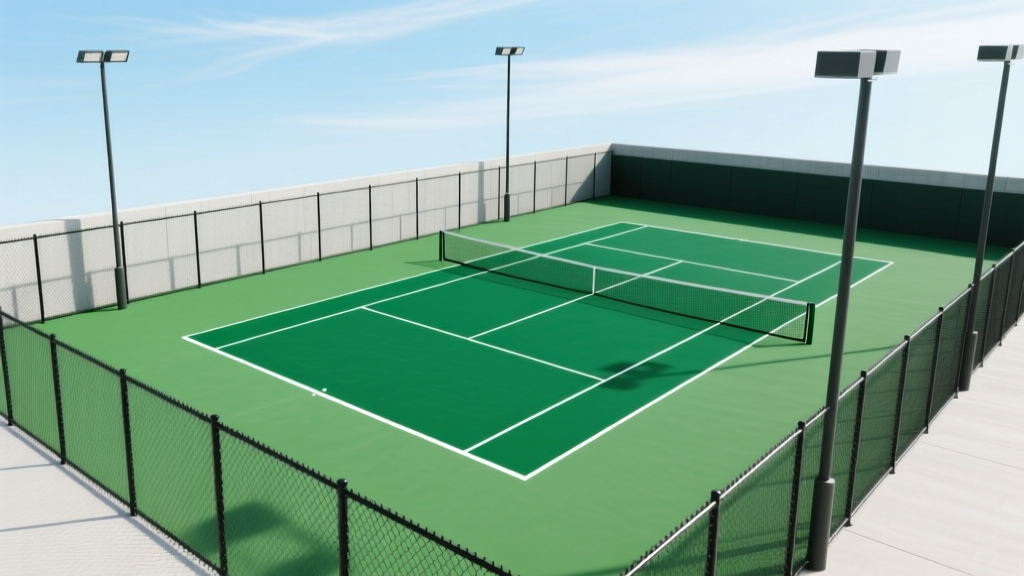
Standard court fencing is 10 feet high, utilizing 9-gauge galvanized steel chain-link fabric with a 2-inch mesh. The total perimeter of a 60x120 court is 360 linear feet. Expect to pay between $45 and $65 per linear foot for materials and installation, bringing the fencing budget to $16,200 - $23,400. Adding custom 95% density polyethylene wind screens and padded center-court posts will add approximately $3,500 to $5,000.
LED Lighting Systems
Municipal codes heavily restrict light spill in residential zones, making modern directional LED arrays mandatory. A standard recreational court requires an average of 30 to 50 foot-candles of illumination.
- 4-Pole LED System: $18,000 - $24,000. Adequate for casual residential play, but may create slight shadowing near the baselines.
- 6-Pole LED System: $26,000 - $34,000. Provides uniform, tournament-grade illumination with minimal light trespass beyond the fence line.
Earthwork, Grading, and the 1% Slope Rule
Site preparation is the most unpredictable variable in the budget. If your site requires significant cut-and-fill earthwork, retaining walls, or the removal of unsuitable soil (like peat or uncompacted fill), excavation costs can easily add $15,000 to $40,000 to the project.
Once the subgrade is compacted to 95% Proctor density, the base must be sloped for drainage. The American Sports Builders Association (ASBA) strictly mandates a slope of 0.83% to 1.0% (approximately 1 inch of drop per 10 feet of run).
A slope of less than 0.83% will result in 'birdbaths'—puddles that remain 48 hours after rain, which degrade the acrylic binder and cause algae growth. A slope exceeding 1.5% will cause tennis balls to roll visibly when placed on the court, ruining the playing experience. Laser-guided grading equipment is mandatory to achieve this tight 0.2% tolerance.
Permitting, Setbacks, and Orientation
Before breaking ground, verify local zoning setbacks. Many municipalities treat a tennis court as an 'impervious surface' or a 'sport court structure,' triggering strict lot-coverage ratios and rear-yard setback requirements (often 15 to 25 feet from property lines).
Furthermore, the court must be oriented strictly North-South (within a 15-degree variance). An East-West orientation will force players to look directly into the sun during morning and evening hours, rendering the court functionally obsolete for competitive play. If your lot only accommodates an East-West layout, you must budget for high-density shade structures or accept a compromised playing environment.
Long-Term Maintenance and Resurfacing Timelines
The initial build is only phase one of the financial commitment. Hard courts require acrylic resurfacing (filling micro-cracks, applying new color coats, and taping lines) every 5 to 8 years. A professional resurfacing job for a 7,200 sq. ft. court costs between $8,500 and $14,000 depending on the condition of the existing surface and the quality of the acrylic system used (e.g., Plexipave or DecoTurf).
Har-Tru clay courts demand daily labor. They must be dragged, brushed, and watered daily during the playing season, and require an annual top-dressing of 2 to 3 tons of new clay ($2,500 - $4,000 annually). If you cannot commit to daily maintenance, a clay court will quickly become hard, uneven, and unplayable.
Summary of Total Project Costs
For a turnkey, premium residential hard court built on a relatively flat, clear site with post-tension concrete, 10-foot fencing, and a 4-pole LED lighting system, the total tennis court cost to build in 2026 will reliably fall between $135,000 and $165,000. Opting for standard asphalt and skipping lighting can reduce this footprint to the $85,000 - $105,000 range, though with a significantly shortened lifecycle before major structural rehabilitation is required.
Written by
Elena RodriguezElena Rodriguez is a civil engineer and technical writer specializing in concrete technology, masonry systems, and ASTM/ACI compliance. She earned her B.S. in Civil Engineering from Texas A&M University and spent a decade at a materials testing laboratory, performing over 2,000 concrete compressive strength tests and masonry prism evaluations. Elena is an ACI-certified Field Testing Technician (Grade I) and a member of ASTM Committee C12 on Natural Building Stone. She currently consults on forensic engineering cases involving concrete failures and moisture intrusion. Based in San Antonio, TX, Elena is a proud member of the Society of Women Engineers (SWE) and coaches her daughter's FIRST Robotics team.
More from Elena Rodriguez
View all
Walls & Panels
Cost Analysis: Light Gauge Steel Framing Advantages and Disadvantages
Evaluate light gauge steel framing advantages and disadvantages through a strict cost analysis lens, comparing material, labor, and lifecycle expenses.
Aug 4, 2026

Walls & Panels
Gypsum Board Types: Exact Specifications, Thickness & Dimensions
Compare standard, Type X, and moisture-resistant gypsum board types. Get exact specifications, thicknesses, dimensions, and ASTM standards for your project.
Aug 4, 2026

Fire Resistance
Best Fire-Resistant Outdoor Decking Materials: 2026 Buyer Guide
Discover the best fire-resistant outdoor decking materials for 2026. Compare Class A PVC, aluminum, and hardwood options for WUI compliance and safety.
Aug 4, 2026