2026 Cost to Build a House in Texas Per Square Foot: Complete Guide
Analyze the 2026 cost to build a house in Texas per square foot. Breakdowns by region, soil types, material tiers, and hidden impact fees.

The 2026 Texas Baseline: Statewide Averages & Regional Divides
Calculating the accurate cost to build a house in Texas per square foot requires moving beyond statewide averages. Texas encompasses 268,596 square miles of wildly diverse topography, from the expansive clay of the Blackland Prairie to the caliche rock of the Hill Country and the flood-prone coastal plains. According to the National Association of Home Builders (NAHB), the national average for custom home construction hovers around $170 per square foot, but Texas-specific variables create a much wider spectrum.
2026 Statewide Cost Highlights
- Production/Tract Homes: $135 – $165 per sq. ft.
- Semi-Custom Builds: $175 – $225 per sq. ft.
- High-End Luxury Custom: $280 – $400+ per sq. ft.
- Statewide Median (Custom): $192 per sq. ft.
The U.S. Census Bureau Building Permits Survey consistently ranks Texas as the leader in new residential construction volume. This high demand keeps material supply chains robust but places immense pressure on specialized skilled labor, driving up the cost to build a house in Texas per square foot in high-growth metro corridors compared to rural counties.
Regional Breakdown: How Geography Dictates Your Price Per Square Foot
A 2,500-square-foot home in Dallas will not cost the same as an identical footprint in Midland. Regional labor markets, municipal impact fees, and local code requirements create distinct pricing tiers across the state's major building zones.
| Region | Avg. Cost / Sq. Ft. (Custom) | Primary Cost Drivers |
|---|---|---|
| Dallas-Fort Worth | $195 - $240 | Expansive clay foundations, high municipal impact fees, premium labor rates. |
| Austin / Hill Country | $210 - $265 | Caliche rock excavation, steep slope engineering, strict environmental setbacks. |
| Houston / Gulf Coast | $175 - $215 | FEMA elevation requirements, windstorm engineering, high humidity material prep. |
| West Texas / Rural | $155 - $185 | Lower labor costs offset by high material transport fees and well/septic installs. |
Foundation Engineering: The Hidden Texas Cost Multiplier
The most volatile variable in the cost to build a house in Texas per square foot lies beneath the soil. Texas geology is notorious for destroying poorly engineered foundations. The Texas A&M Real Estate Center frequently highlights soil remediation and specialized foundation engineering as a primary driver of budget overruns in the state.
⚠️ Critical Soil Warning: Expansive Clay vs. Caliche
DFW & San Antonio (Blackland Prairie): Highly expansive clay swells when wet and shrinks during droughts. Standard slab-on-grade will fail. You must budget for post-tensioned slabs (adds $4.50 - $6.00/sq. ft.) or drilled concrete piers extending 15-25 feet to bedrock (adds $9.00 - $14.00/sq. ft.).
Austin & Hill Country: Shallow topsoil over solid caliche and limestone. Excavation requires heavy machinery like hoe rams or blasting. Budget an additional $6,000 to $12,000 purely for rock removal and trenching for utilities before the foundation is even poured.
Material Specifications for the Texas Climate
Selecting materials based purely on aesthetic preference will inflate your long-term maintenance costs. Texas demands materials rated for extreme UV exposure, high winds, hail, and termite pressure. Here is how specific material choices impact your per-square-foot budget:
- Exterior Cladding: Traditional brick veneer remains popular ($9.50 - $13.00/sq. ft. installed), but James Hardie ColorPlus fiber cement siding ($8.00 - $11.50/sq. ft.) is increasingly specified in humid coastal regions for its imperviousness to rot and termites. Avoid standard vinyl siding in Central and West Texas; the intense UV radiation causes rapid embrittlement and warping.
- Roofing Systems: Standard architectural asphalt shingles cost $4.50 - $6.50/sq. ft., but Texas hailstorms routinely destroy them. Upgrading to a Class 4 Impact Resistant shingle (e.g., Owens Corning Duration Storm) adds $1.50/sq. ft. but can reduce home insurance premiums by up to 20%. For luxury builds, a 24-gauge standing seam metal roof ($16.00 - $22.00/sq. ft.) is the ultimate hail-proof investment.
- Insulation & Envelope: In Texas climate zones 2 and 3, attic temperatures routinely exceed 140°F in August. Standard fiberglass batts are insufficient. Budget $2.50 - $3.50/sq. ft. for closed-cell spray foam applied to the roofline, creating a conditioned attic space that drastically reduces HVAC tonnage requirements and energy loads.
Labor Rates and Crew Availability
Labor accounts for roughly 40% to 45% of your total build cost. While Texas lacks a state income tax and generally boasts a lower cost of living than coastal states, the sheer volume of commercial and residential construction creates a bidding war for skilled trades.
Expect to pay the following average rates for specialized subcontractors in major Texas metros in 2026:
- Framing Crews: $7.50 – $9.50 per square foot of floor area.
- Electricians: $85 – $125 per hour; roughly $4.00 – $6.00 per square foot for full rough-in and trim on a custom home.
- Plumbers: $90 – $135 per hour; PEX-A piping systems (like Uponor) are now the standard over copper, saving roughly $1.20 per square foot in material and labor.
- HVAC Installation: $5,500 – $8,500 per ton of cooling capacity. A 2,500 sq. ft. home typically requires a 4-ton to 5-ton high-efficiency system (16+ SEER2 rating).
Soft Costs: Impact Fees, Permitting, and Site Prep
Builders and buyers often fixate on the cost to build a house in Texas per square foot based on vertical construction alone, ignoring the soft costs that must be paid before a single piece of lumber is delivered.
- Municipal Impact Fees: Fast-growing suburbs (e.g., Frisco, Georgetown, Fulshear) charge aggressive impact fees to fund new schools, roads, and water infrastructure. These can range from $15,000 to over $35,000 per single-family lot.
- Site Preparation & Clearing: If your lot features heavy cedar brush (common in the Hill Country), mechanical clearing and mulching will cost $2,500 to $4,500 per acre. Add $3,000 to $5,000 for a standard concrete driveway approach and temporary construction power poles.
- Water & Wastewater: In rural counties lacking municipal water, drilling a water well ($8,000 - $15,000 depending on aquifer depth) and installing an aerobic septic system ($10,000 - $18,000 for rocky or clay-heavy soils) is mandatory.
- Architectural & Engineering: Custom blueprints and structural engineering stamps typically cost between $12,000 and $25,000, translating to roughly $5.00 to $10.00 per square foot.
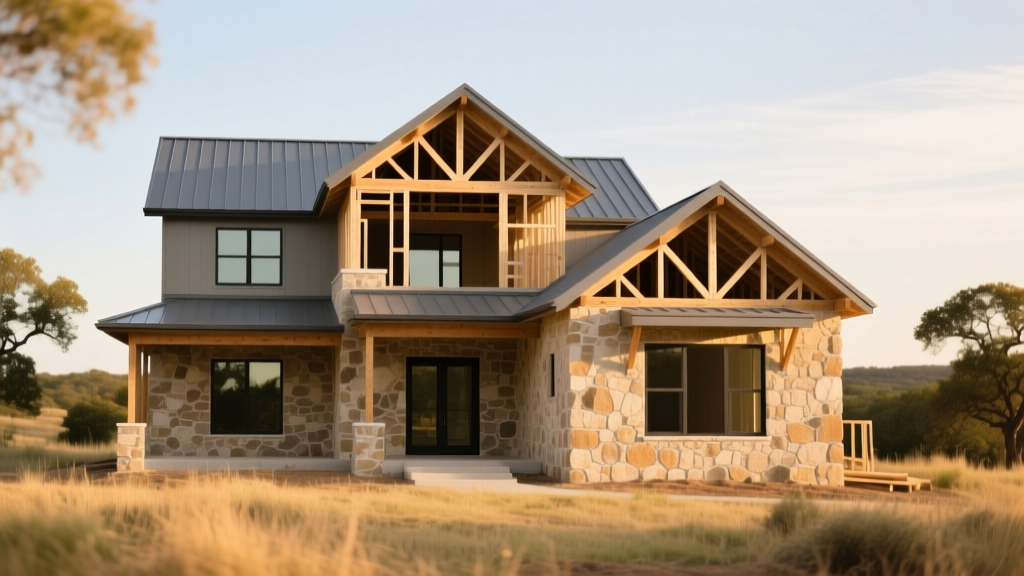
Strategic Framework: How to Optimize Your Texas Build Budget
To keep your cost to build a house in Texas per square foot under control without sacrificing structural integrity, implement the following optimization framework during the pre-construction phase:
Ultimately, accurately forecasting the cost to build a house in Texas per square foot requires treating the land, the local micro-climate, and the specific municipal codes as equal partners to the architectural design. By budgeting for advanced foundation engineering and climate-specific material upgrades upfront, you protect your capital from the costly change orders and structural failures that plague under-researched builds.
Written by
David NakamuraDavid Nakamura is a licensed architect (AIA) and construction technology writer focused on sustainable building methods, mass timber engineering, and high-performance building envelopes. He holds a Master of Architecture from the University of Washington and is a certified Passive House Consultant (CPHC). David spent eight years at the Seattle firm Mithun, where he led the design of three LEED Platinum projects, before founding his own practice specializing in net-zero residential design. He serves on the editorial advisory board of GreenBuilder Magazine and has authored peer-reviewed papers on cross-laminated timber (CLT) connections for the Journal of Structural Engineering. In his spare time, David teaches woodworking at Pratt Fine Arts Center and kayaks the Puget Sound.
More from David Nakamura
View all
Construction Cost
Labor Cost to Build a Deck Per Sq Ft: 2026 Installation Guide
Discover the exact labor cost to build a deck per sq ft in 2026. This installation guide breaks down contractor rates, complexity factors, and hidden fees.
Aug 4, 2026

Construction Cost
How Much Does It Cost to Build a 3 Bedroom House? Financing Guide
Learn exactly how much it costs to build a 3 bedroom house and explore 2026 financing options, construction loan types, and budget frameworks for your build.
Aug 4, 2026

Construction Cost
Cost to Build a Tennis Court: 2026 Guide
How much does it cost to build a tennis court in 2026? Breakdowns for asphalt, concrete, and synthetic surfaces plus fencing and lighting.
Jul 30, 2026