How Much Does a Jetty Cost to Build? 2026 Breakdown
Discover how much a jetty costs to build. Detailed breakdown of riprap, timber, and steel piling costs, plus hidden marine construction fees.

The True Cost of Jetty Construction: Beyond the Linear Foot
Estimating the cost of a jetty requires moving past simple square-footage metrics used in terrestrial construction. Marine environments introduce dynamic hydrodynamic forces, complex subsurface geotechnical profiles, and stringent regulatory hurdles. Whether you are engineering a rubble mound structure to stabilize a tidal inlet or driving open-pile structures for commercial mooring, the financial outlay is dictated by water depth, wave climate, and material availability.
Terminology Check: Jetty vs. Pier vs. Breakwater
Before finalizing your budget, ensure your structural classification aligns with your engineering intent. A jetty projects perpendicular to the shore to influence currents, protect a channel from shoaling, or provide a mooring point. A breakwater typically runs parallel to the shore to create a calm water basin. A pier is strictly an elevated deck structure for loading/unloading. Misclassifying these in permit applications can trigger costly environmental impact reassessments.
2026 Jetty Cost Breakdown by Material and Type
Marine construction costs have stabilized following the supply chain volatility of the early 2020s, but specialized marine equipment and labor remain at a premium. The table below outlines the current baseline costs per linear foot for primary jetty typologies.
| Jetty Type | Primary Materials | Cost per Linear Foot (2026) | Ideal Application |
|---|---|---|---|
| Rubble Mound / Riprap | Armor stone, geotextile, crushed core | $1,800 - $4,500 | Inlet stabilization, tidal channel protection |
| Timber Open-Pile | Greenheart, Ekki, or ACA-treated Pine | $900 - $1,600 | Recreational mooring, low-impact estuaries |
| Steel Pile / Sheet Pile | AZ-series sheet piles, H-piles, epoxy | $1,500 - $3,200 | Heavy commercial berthing, high-current zones |
| Concrete Caisson | Pre-cast marine concrete, tremie seal | $2,500 - $5,500+ | Deep-water ports, extreme wave climates |
Rubble Mound and Riprap Jetties
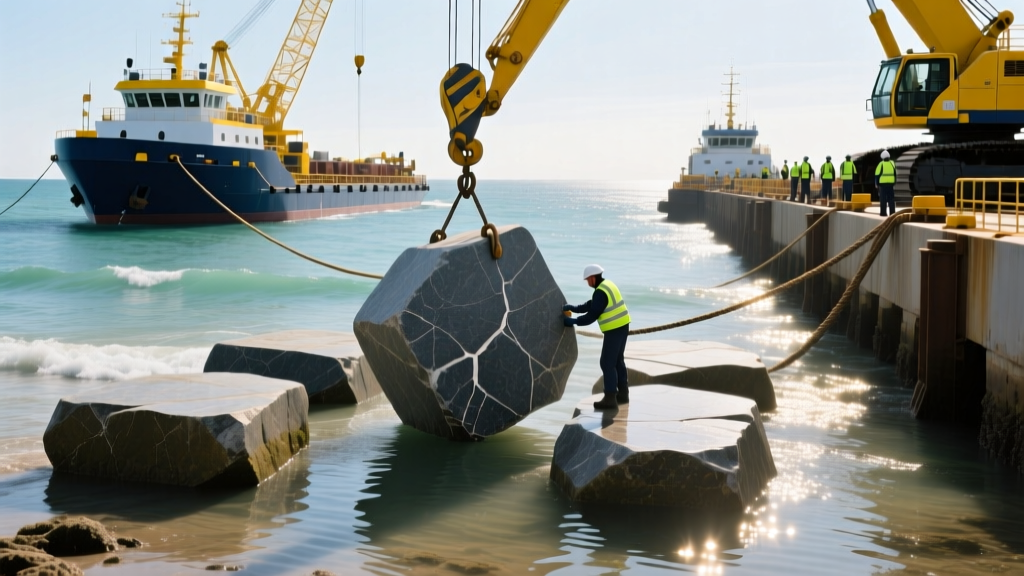
Rubble mound jetties rely on mass and interlocking geometry to dissipate wave energy. The cost is heavily dependent on the availability of Class III or Class IV armor stone (typically 1 to 5 tons per stone) with a specific gravity exceeding 2.65. Engineers utilize the Van der Meer formula to determine exact stone sizing based on significant wave height and structure permeability. If local quarries cannot supply high-density igneous rock like granite or basalt, freight costs for importing armor stone via barge can increase material expenses by 40% to 60%.
Open-Pile Jetties (Timber, Steel, Concrete)
Open-pile structures allow water and sediment to pass through, reducing the hydrodynamic load compared to solid breakwaters. For timber jetties, specifying naturally durable tropical hardwoods like Ekki (Lophira alata) or Greenheart (Ocotea rodiaei) eliminates the need for chemical treatments, though the initial material cost is 30% higher than 2.5 pcf retention ACA-treated Southern Yellow Pine. Steel H-piles require marine-grade epoxy coatings (such as Sherwin-Williams SeaGuard) and cathodic protection systems to mitigate the accelerated corrosion found in the splash zone.
Hidden Cost Drivers in Marine Construction
Linear foot estimates only capture the visible structure. The true financial risk in jetty construction lies in mobilization and subsurface unknowns.
- Marine Equipment Mobilization: Moving a spud barge, a crawler crane, and a vibratory hammer to a coastal site typically costs between $65,000 and $180,000 before work begins. Remote locations requiring ocean-going tugboats will push this to the higher end.
- Geotechnical Surprises: If soil borings reveal a deep layer of unconsolidated organic silt over bedrock, piles may require splicing or the use of specialized rock-socketing drills, adding $200 to $400 per pile in drilling costs.
- Scour Protection: Jetties alter local current velocities, often causing localized scour (erosion) at the structure's toe. Budgeting for a 5-foot wide articulated concrete block (ACB) mattress or additional riprap apron is mandatory to prevent structural undermining.
- Environmental Mitigation: Compensatory mitigation for impacts to submerged aquatic vegetation (SAV) or wetlands can cost $50,000 to over $250,000, depending on the regional mitigation bank credit prices.
Decision Matrix: Matching Jetty Type to Site Conditions
Selecting the wrong structural typology for your specific hydrodynamic and geotechnical environment guarantees premature failure. Use this framework to guide your preliminary engineering discussions.
High Wave Energy & Shallow Bedrock
Recommendation: Rubble Mound / Riprap.
Why: Flexible structure that settles naturally; dissipates wave energy without reflecting it; resistant to overtopping damage.
Deep Water & High Vessel Impact
Recommendation: Steel H-Pile with Fender Systems.
Why: High bending strength to absorb berthing energy; minimal footprint on the seabed; allows deep draft vessel access.
Sensitive Estuary & Low Current
Recommendation: Untreated Hardwood Timber Pile.
Why: Zero chemical leaching into the water column; minimal disruption to benthic habitats; lower equipment footprint.
High Sediment Transport Zone
Recommendation: Open-Pile (Steel or Concrete).
Why: Prevents the interruption of longshore drift; avoids the severe downdrift erosion caused by solid rubble mound jetties.
Navigating the Permitting and Regulatory Gauntlet
In the United States, building a jetty triggers a complex web of federal and state oversight. According to the U.S. Army Corps of Engineers (USACE), any structure placed in navigable waters requires a Section 10 permit under the Rivers and Harbors Act. Furthermore, if the jetty involves discharging fill material (like riprap core) into waters, a Section 404 permit under the Clean Water Act is mandatory.
State-level Coastal Zone Management (CZM) consistency reviews and local Chapter 91 (or equivalent tideland) licenses add 12 to 24 months to the project timeline. Engineering firms typically charge 15% to 22% of the total construction cost for design, hydrodynamic modeling, and permit acquisition. Skipping comprehensive 2D or 3D hydrodynamic modeling (using software like Delft3D or SMS) to save on upfront engineering fees often results in the USACE rejecting the permit due to insufficient data on downdrift erosion impacts.
Real-World Failure Modes and Edge Cases
Understanding how jetties fail is critical for accurate lifecycle cost estimating. The NOAA Office for Coastal Management highlights several common failure vectors that must be engineered against:
- Marine Borer Attack: In warm-water ports, Teredo worms (shipworms) and Limnoria (gribbles) can destroy untreated or poorly treated timber piles in under three years. Always specify a minimum 2.5 pcf retention for ACA treatments, or use physical barriers like Snap-Tite HDPE pile sleeves in the intertidal zone.
- Flank Erosion: If the landward connection (the root) of the jetty is not properly armored, wave energy wrapping around the structure will erode the beach, eventually outflanking the jetty and rendering it useless. Budget for a reinforced concrete tie-in wall or heavy riprap revetment at the shoreline intersection.
- Ice Scour (Northern Climates): In regions subject to winter ice flows, vertical piles are highly susceptible to ice jacking, where freezing water adheres to the pile and lifts it during tidal changes. Incorporating ice collars or driving piles at a slight batter angle mitigates this uplift force.
Expert Tips for Budgeting Your Jetty Project
To ensure your 2026 marine construction budget holds up against reality, implement these strategic contracting and procurement practices:
Procure Long-Lead Items Early: Marine-grade steel sheet piles and specialized tropical hardwoods often have lead times exceeding 6 to 9 months. Secure these materials before finalizing the construction start date to avoid barge demurrage charges, which can exceed $15,000 per day.
Finally, always structure your construction contracts with a clear Geotechnical Baseline Report (GBR). By establishing a contractual baseline for soil conditions, you shift the risk of unforeseen subsurface obstructions (like glacial erratics or undocumented shipwrecks) into a manageable contingency fund rather than facing open-ended change orders mid-construction.
Written by
Sarah WhitfieldSarah Whitfield is a chartered quantity surveyor (MRICS) and construction cost analyst with 15 years of experience in material pricing, procurement strategy, and project budgeting. She earned her degree in Construction Management from the University of Reading (UK) and has worked on projects ranging from $2M custom homes to $180M mixed-use developments across North America and Europe. Sarah currently leads cost estimating for BuildMat Insight, maintaining a proprietary database of 4,000+ material price points updated quarterly. She is a frequent contributor to RSMeans cost data panels and has presented at the International Cost Engineering Council (ICEC) congress. Based in Denver, CO, Sarah is an avid trail runner and volunteer mentor for Women in Construction.
More from Sarah Whitfield
View all
Wood & Lumber
What Are the Different Types of Wood? A Builder's Guide
Compare structural softwoods, finish hardwoods, and engineered lumber. Analyze Janka ratings, MOE values, and 2026 pricing for construction.
Aug 4, 2026

Walls & Panels
Steel Framing vs Wood Framing: Corrosion and Moisture Defense
Compare steel framing vs wood framing for moisture resistance. Learn about galvanized coatings, condensation risks, and corrosion protection strategies.
Jul 21, 2026

Stone & Masonry
How to Cut Stone Veneer: Wet Saw vs Grinder Comparison
Compare the best tools for cutting stone veneer. We review wet saws, angle grinders, and chop saws to help you achieve clean, chip-free cuts.
Jul 21, 2026