How Much Does a Tiny Home Cost to Build? 2026 Money-Saving Guide
Discover exactly how much a tiny home costs to build in 2026. Explore actionable money-saving strategies, material hacks, and exact price breakdowns.

The True Baseline: How Much Does a Tiny Home Cost to Build?
When asking how much does a tiny home cost to build, the answer depends entirely on your labor contribution, material sourcing, and foundation type. In 2026, the national average for a professionally built 200-square-foot Tiny Home on Wheels (THOW) sits between $55,000 and $75,000. However, a disciplined DIY builder utilizing strategic sourcing and simplified systems can drop that figure to $18,000–$28,000 without sacrificing structural integrity or energy efficiency.
According to data derived from the National Association of Home Builders (NAHB) construction cost surveys, specialized small-footprint builds often carry a higher cost-per-square-foot than traditional homes due to the inability to achieve economies of scale on fixed costs like plumbing stacks, electrical panels, and HVAC units. To combat this, you must optimize the variables you can control.
| Build Tier | Cost Per Sq Ft | Total Cost (200 sq ft) | Labor Percentage |
|---|---|---|---|
| DIY Shell (Exterior Only) | $45 - $75 | $9,000 - $15,000 | 5% (Your Sweat Equity) |
| DIY Turnkey (Finished) | $110 - $160 | $22,000 - $32,000 | 10% (Subcontracted Trades) |
| Professional Custom Build | $275 - $375 | $55,000 - $75,000 | 40% - 50% |
| Luxury / Off-Grid Ready | $400+ | $80,000+ | 45%+ |
Chassis and Foundation: Stop Overpaying for the Base
The foundation is the most critical cost variable. If you are building a THOW, the trailer is your foundation. Do not attempt to save money by retrofitting a flatbed utility trailer or welding your own chassis unless you are a certified structural welder. The dynamic torsion forces of highway towing will tear a rigid stick-built house apart if the chassis lacks the proper engineered camber and integrated sub-floor framing.
Trailer Sourcing Strategy
Purchase a dedicated tiny home trailer from manufacturers like Iron Eagle or Tiny Home Base. A heavy-duty 8.5' x 24' dual-axle trailer with a 14,000 lb GVWR typically costs between $6,500 and $8,200. Money-Saving Hack: Order a 'drop-axle' trailer. This lowers the deck height by 4 inches, giving you crucial interior ceiling height without paying for custom engineering or raising the roof profile, which increases wind drag and fuel costs during transport.
Permanent Foundation Alternatives
If you are building on private land, skip the traditional monolithic concrete slab, which requires expensive forming, rebar tying, and pump-truck pours (averaging $8-$12 per square foot). Instead, utilize galvanized helical piers or precast concrete deck blocks. A 200-square-foot footprint can be supported by 12 to 16 helical piers for roughly $2,500 to $3,500 installed, saving thousands on excavation and concrete while allowing the structure to be relocated later.
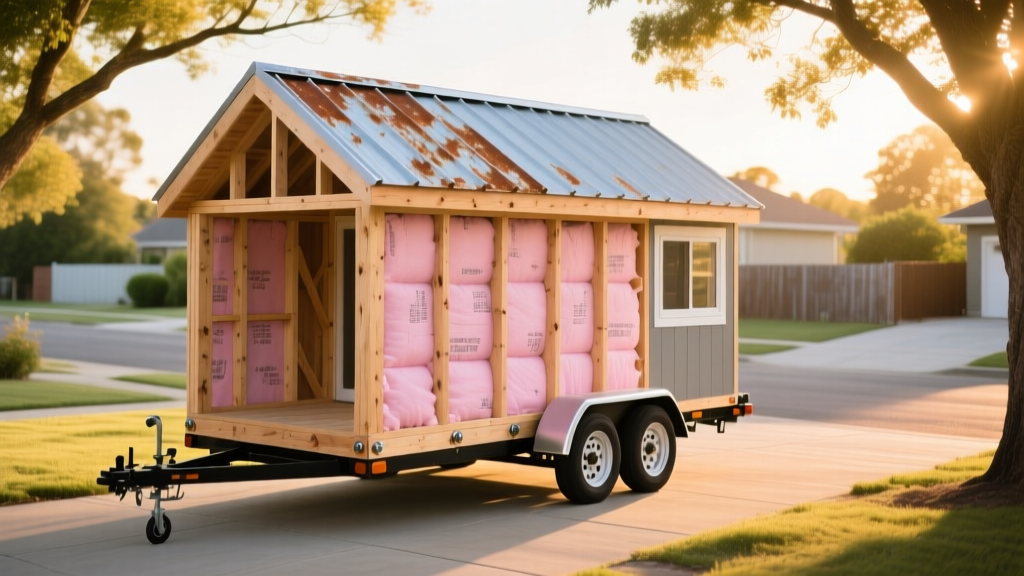
Envelope and Framing: The SIPs vs. Stick-Built Dilemma
Framing represents roughly 18% of your material budget. Traditional 2x4 stick framing is familiar and cheap upfront (approx. $2.50 per linear foot for SPF lumber), but it is heavy, thermally inefficient, and labor-intensive.
A standard 14,000 lb GVWR trailer weighs roughly 3,200 lbs empty. This leaves you with exactly 10,800 lbs of payload for the entire house. Traditional stick framing, plywood sheathing, and asphalt shingles will easily consume 8,000 lbs of that budget before insulation or appliances are added. Overweight trailers face catastrophic tire blowouts and axle bending on the highway.
The Case for Structural Insulated Panels (SIPs)
According to the U.S. Department of Energy, SIPs provide superior insulation and airtightness compared to traditional framing. While a SIP panel kit for a 200-square-foot tiny home costs 15% to 20% more upfront than dimensional lumber (roughly $4,500 vs $3,000), it yields massive secondary savings:
- Labor Reduction: A SIP envelope can be craned and sealed in a single day, saving hundreds of hours of framing, sheathing, and insulating labor.
- Weight Reduction: SIPs utilize OSB skins over expanded polystyrene (EPS) foam, weighing up to 30% less than a fully sheathed and insulated stick-framed wall.
- HVAC Downsizing: The continuous R-24 to R-30 insulation eliminates thermal bridging, allowing you to install a smaller, cheaper mini-split heating system.
Systems and Utilities: The Budget Killers
Plumbing and electrical systems do not scale down linearly with square footage. A tiny home still requires a water heater, a main breaker panel, and a waste management system. Here is how to engineer these systems for maximum cost efficiency.
Plumbing: PEX-A and Composting
Abandon copper and CPVC. Use PEX-A (expansion PEX, such as the Uponor AquaPEX system). PEX-A requires fewer fittings because it bends tightly around corners, reducing material costs by 20% and minimizing leak points. Furthermore, route your plumbing in a 'home-run' manifold configuration to reduce pressure drops.
For waste, bypass the $1,500+ cost of installing a black-water tank, RV macerator pump, and dump valves. Install a high-capacity composting toilet like the Nature's Head ($1,100) or a Cuddy ($800). This eliminates the need for a black water tank, saves 60 lbs of weight, and allows you to park legally in more jurisdictions without requiring a sewer tap.
Electrical: Right-Sizing the Service
Do not install a standard 100-amp residential sub-panel. Most tiny homes operate perfectly on a 30-amp or 50-amp RV-style service panel. A 50-amp Square D QO load center costs around $120, whereas a 100-amp residential panel with main breakers will push $250+. Pair this with a 120/240V split-phase inlet so you can run standard household appliances without tripping the main pedestal breaker.
Strategic Sourcing: Material Hacks for 2026
To keep your build under budget, you must decouple from big-box retail pricing for finish materials.
- Windows: Custom RV radius windows cost $400 to $800 each. Instead, source residential vinyl awning or fixed-pane windows from local architectural salvage yards or Habitat for Humanity ReStores. A standard 24'x36' residential vinyl window costs $90-$140 and offers double-pane Low-E efficiency that outperforms most single-pane RV glass.
- Cabinetry: Avoid custom-built tiny home cabinetry, which carries a premium for 'space-saving' design. Purchase standard 12-inch deep upper kitchen cabinets (designed for pantries) and mount them as base cabinets. This provides deep storage while maintaining a narrow walkway, saving thousands on custom millwork.
- Water Fixtures: Look for EPA WaterSense labeled fixtures. While the upfront cost is similar to standard fixtures, the reduced flow rates (1.2 GPM for faucets, 1.28 GPF for flush toilets) allow you to install a smaller, cheaper 20-gallon freshwater tank and a compact 12V Shurflo water pump, saving both space and weight.
Tiny Home Cost Estimating FAQ
Is it cheaper to buy a pre-owned tiny home or build one?
Buying a used THOW can save 20% to 30% off the original build price. However, the used tiny home market is flooded with poorly constructed, overweight builds that lack proper RVIA or NOAH certification. Building your own allows you to control the weight distribution and insulation quality, ultimately saving money on repairs, towing fuel, and heating costs down the line.
How much does it cost to insure a DIY tiny home?
Insuring a DIY tiny home is notoriously difficult and expensive. Standard homeowners insurance will not cover a house on wheels. You will need specialized THOW insurance (providers like Foremost or Darling), which typically costs $800 to $1,500 annually. To get the lowest rates and ensure coverage, your DIY build must pass a third-party inspection by organizations like the National Organization of Alternative Housing (NOAH), which costs roughly $500 to $800 but is a mandatory investment for financial protection.
What is the most expensive single component of a tiny home?
Excluding the trailer and labor, the HVAC and electrical systems are the most expensive dense components. A high-efficiency ductless mini-split system (like a Mitsubishi or Pioneer 9,000 BTU unit) costs between $650 for the hardware and $1,500 for professional installation. Skimping on insulation to save $500 upfront will force you to buy a larger, more expensive HVAC unit and pay higher electricity bills indefinitely.
Written by
Marcus ChenMarcus Chen is a licensed structural engineer (PE) and building materials analyst with over 12 years of experience across residential, commercial, and industrial construction. He holds a Master of Science in Civil Engineering from UC Berkeley and spent six years at Thornton Tomasetti before transitioning to independent consulting and technical writing. Marcus specializes in material selection for seismic-prone regions, concrete reinforcement strategies, and lifecycle cost analysis. His work has been cited by the American Concrete Institute (ACI) and the Structural Engineers Association of California (SEAOC). When he is not on a job site or at his desk, you will find him hiking the Sierra Nevada or restoring a 1920s craftsman bungalow in Oakland, CA.
More from Marcus Chen
View all
Construction Cost
How Much Did the Eiffel Tower Cost to Build?
How much did the Eiffel Tower cost to build in 1889? We adjust for inflation and compare its budget to modern skyscraper construction.
Aug 4, 2026

Fire Resistance
What Is a Fire Resistant Material? Testing & Certification Guide
Discover what is a fire resistant material through ASTM and UL testing. Learn how fire ratings, certifications, and assemblies work in construction.
Aug 4, 2026

Construction Cost
How Much Did the Burj Khalifa Cost to Build?
How much did the Burj Khalifa cost to build? We break down the $1.5B project and extract 5 money-saving strategies for your next build.
Jul 30, 2026