2026 Square Foot Cost to Build a House by US Region
Discover the 2026 square foot cost to build a house across US regions. Compare labor, material prices, and hidden regional fees to budget accurately.

The National Baseline vs. Regional Reality
When estimating the square foot cost to build a house, relying on a single national average is a critical budgeting error. While national aggregates might suggest a baseline of $175 to $225 per square foot for semi-custom construction, this figure obscures massive geographic disparities. A 2,500-square-foot home that costs $437,500 to build in rural Ohio could easily exceed $850,000 in the San Francisco Bay Area, despite utilizing identical architectural plans and material grades.
Understanding the true square foot cost to build a house requires dissecting the localized variables that drive pricing: union density, freight logistics, municipal impact fees, and climate-specific building codes. According to the National Association of Home Builders (NAHB), labor and material allocations shift dramatically depending on the zip code, making regional price analysis mandatory for accurate pre-construction estimating.
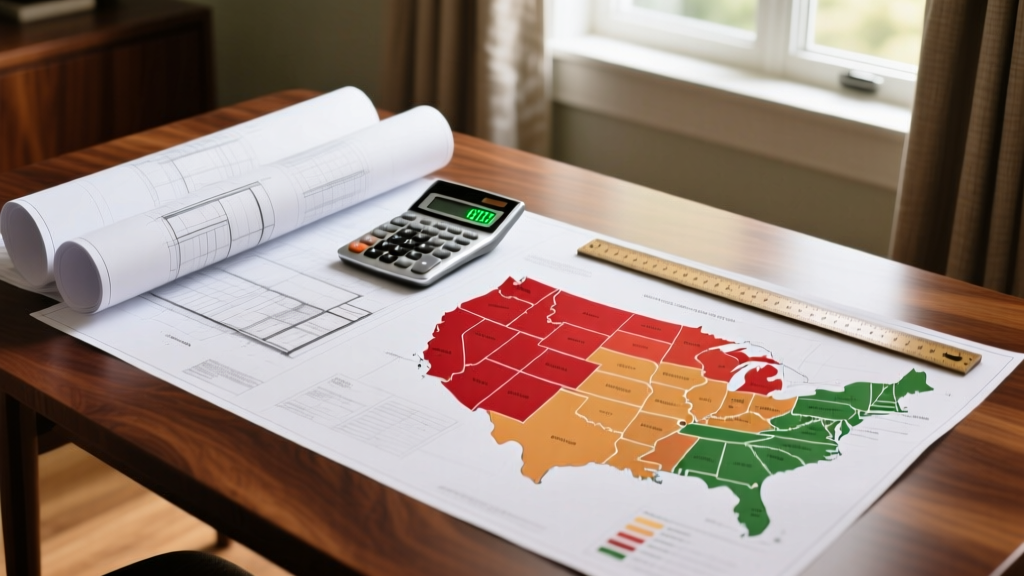
2026 Regional Cost Matrix: Price Per Square Foot
The following matrix breaks down the estimated square foot cost to build a house across five major US regions for 2026. These figures assume a 2,000 to 3,000-square-foot, single-story, semi-custom build on a flat, prepared lot with standard utility access.
| US Region | Low-End (Production/Spec) | Mid-Range (Semi-Custom) | High-End (Custom/Luxury) | Primary Cost Drivers |
|---|---|---|---|---|
| Northeast | $220 - $260 | $275 - $340 | $400+ | High union labor rates, deep frost footings, strict energy codes. |
| Southeast | $165 - $195 | $200 - $265 | $325+ | Slab-on-grade foundations, but coastal HVHZ hurricane mandates spike costs. |
| Midwest | $150 - $180 | $185 - $240 | $290+ | Lowest labor/material costs, offset by deep frost walls and agricultural zoning fees. |
| Southwest | $175 - $210 | $220 - $280 | $350+ | Expansive soil mitigation (post-tension slabs), water scarcity tap fees. |
| West (Pacific) | $280 - $350 | $375 - $480 | $600+ | Title 24 energy mandates, seismic engineering, extreme labor shortages. |
Deconstructing the Regional Variance
To accurately forecast your local square foot cost to build a house, you must isolate the three core variables that create these regional pricing gaps.
1. Labor Market Tightness and Prevailing Wage Laws
Labor typically accounts for 40% to 50% of total construction costs. In states with high union density and strict prevailing wage laws (such as California, New York, and Illinois), framing crews and electricians command significantly higher hourly rates. For example, a journeyman electrician in the Pacific West may bill out at $115 per hour, whereas a non-union equivalent in the Southeast might bill at $65 per hour. This directly inflates the square foot cost to build a house by $30 to $60 in high-labor-cost regions.
2. Material Logistics and Freight Surcharges
Building materials are heavy, and freight costs dictate local pricing. According to U.S. Census Bureau construction data, regional supply chain bottlenecks heavily influence material indices. Consider concrete: a standard 3,000 PSI mix might cost $115 per cubic yard in rural Texas, but the same mix delivered to a constrained urban site in Seattle or Boston can exceed $175 per yard due to batch plant proximity, fuel surcharges, and municipal truck-route restrictions. Similarly, engineered lumber (like LVL beams and I-joists) carries heavy freight penalties when shipped to landlocked or mountainous regions far from Pacific Northwest or Southern yellow pine mills.
3. Code Stringency and Climate Mandates
Local building codes dictate structural and energy requirements that fundamentally alter material takeoffs.
- California (Title 24): Mandates solar PV readiness, high-efficiency HVAC, and advanced insulation (R-38+ ceilings, continuous exterior rigid foam). This adds roughly $18 to $25 per square foot to the baseline cost.
- Florida (HVHZ): High-Velocity Hurricane Zone codes require impact-resistant glazing, concrete block construction (CBS) instead of wood framing, and specialized roof tie-downs. This adds $15 to $22 per square foot in coastal counties.
- Midwest/Northeast: Frost-line requirements dictate that footings must be poured 42 to 48 inches below grade, requiring significantly more excavation and concrete than the slab-on-grade foundations common in the Sunbelt.
Hidden Regional Fees That Inflate Square Foot Costs
When calculating the square foot cost to build a house, amateur estimators often calculate only the 'vertical' construction costs (framing, drywall, roofing) and ignore the 'horizontal' and municipal costs. These hidden fees vary wildly by municipality and can add $20,000 to $75,000 to your total project cost before a single stud is raised.
- Water and Sewer Tap Fees: Connecting to municipal water and sewer can cost as little as $2,500 in a small Midwestern town, but can exceed $25,000 in high-growth Colorado or California municipalities where water rights are heavily restricted.
- School and Park Impact Fees: Many fast-growing jurisdictions charge single-family impact fees to fund local infrastructure. In parts of Texas and the Pacific Northwest, these fees routinely range from $10,000 to $30,000 per lot.
- Geotechnical and Soil Engineering: In the Southwest and parts of the Southeast, expansive clay soils require specialized post-tension slab engineering or drilled pier foundations. A comprehensive geotech report and engineered foundation plan will add $3,500 to $8,000 to your soft costs.
- Fire Sprinkler Mandates: An increasing number of jurisdictions (particularly in California and specific mountain counties prone to wildfires) now mandate residential fire sprinkler systems. This adds approximately $4.50 to $7.00 per square foot to the plumbing and life-safety budget.
Actionable Framework: Adjusting Your Budget for Your Zip Code
To move from a national average to a highly accurate local estimate, apply this four-step adjustment framework to your target square footage.
- Establish the Base Vertical Cost: Start with the national semi-custom baseline of $210 per square foot for 2026. (e.g., 2,500 sq ft x $210 = $525,000).
- Apply the Regional Labor/Material Multiplier: Use the Department of Energy's regional building code maps and local labor indices to adjust. Multiply your base cost by 0.85 for the rural Midwest, 1.0 for the Southeast, 1.25 for the Northeast, and 1.60+ for the Pacific West.
- Add Foundation & Climate Adjustments: If you are building on an expansive soil site or in a hurricane/seismic zone, add a flat 12% to 18% to your adjusted vertical cost to cover engineered foundations, impact glass, or shear wall bracing.
- Calculate Horizontal & Soft Costs Separately: Do not blend site work into your square foot metric. Budget site prep (clearing, grading, well/septic or tap fees, driveway) as a separate line item, typically ranging from $35,000 for a flat, serviced urban lot to $120,000+ for a wooded, rural parcel requiring a septic system and long driveway.
By treating the square foot cost to build a house as a dynamic, region-specific formula rather than a static national metric, you protect your project from catastrophic budget overruns and ensure your financing aligns with the realities of your local construction market.
Written by
David NakamuraDavid Nakamura is a licensed architect (AIA) and construction technology writer focused on sustainable building methods, mass timber engineering, and high-performance building envelopes. He holds a Master of Architecture from the University of Washington and is a certified Passive House Consultant (CPHC). David spent eight years at the Seattle firm Mithun, where he led the design of three LEED Platinum projects, before founding his own practice specializing in net-zero residential design. He serves on the editorial advisory board of GreenBuilder Magazine and has authored peer-reviewed papers on cross-laminated timber (CLT) connections for the Journal of Structural Engineering. In his spare time, David teaches woodworking at Pratt Fine Arts Center and kayaks the Puget Sound.
More from David Nakamura
View all
Construction Cost
Labor Cost to Build a Deck Per Sq Ft: 2026 Installation Guide
Discover the exact labor cost to build a deck per sq ft in 2026. This installation guide breaks down contractor rates, complexity factors, and hidden fees.
Aug 4, 2026

Construction Cost
How Much Does It Cost to Build a 3 Bedroom House? Financing Guide
Learn exactly how much it costs to build a 3 bedroom house and explore 2026 financing options, construction loan types, and budget frameworks for your build.
Aug 4, 2026

Construction Cost
Cost to Build a Tennis Court: 2026 Guide
How much does it cost to build a tennis court in 2026? Breakdowns for asphalt, concrete, and synthetic surfaces plus fencing and lighting.
Jul 30, 2026