How Much Will It Cost to Build a 12x12 Deck in 2026? Full Breakdown
Discover exactly how much it costs to build a 12x12 deck in 2026. We break down material, labor, and hidden expenses for wood, composite, and PVC options.

The True Cost of a 144-Square-Foot Deck
Building a 12x12 deck yields exactly 144 square feet of outdoor living space. While this is considered a standard, manageable footprint for residential construction, pricing in 2026 reflects significant shifts in lumber commodities, composite manufacturing, and specialized labor rates. The total cost to build a 12x12 deck ranges from $3,800 for a basic pressure-treated pine structure built by a professional contractor, up to $14,500 for a premium PVC deck with glass balustrades and integrated lighting.
Quick 2026 Cost Summary (12x12 Deck / 144 sq ft)
- Economy (Pressure-Treated Pine, Pro Build): $3,800 - $5,200
- Mid-Range (Capped Composite, Pro Build): $6,500 - $9,500
- Premium (Advanced PVC, Glass Railings, Pro Build): $10,500 - $14,500
- DIY Material-Only (Pressure-Treated): $1,100 - $1,600
Material Cost Matrix: What You Walk On
The surface material dictates the baseline of your budget, but it also influences the substructure requirements. Heavier composite boards and PVC require tighter joist spacing, which increases framing lumber costs. Below is the 2026 pricing matrix for the decking boards themselves, calculated per square foot.
| Material Type | Brand Examples | Cost per Sq Ft | Total Board Cost (144 sq ft) | Required Joist Spacing |
|---|---|---|---|---|
| Pressure-Treated Pine | YellaWood, Severe Weather | $4.50 - $7.00 | $648 - $1,008 | 16 inches on-center |
| Cedar / Redwood | Clear Cedar, STK Redwood | $9.00 - $15.00 | $1,296 - $2,160 | 16 inches on-center |
| Capped Composite | Trex Transcend, TimberTech Prime | $13.00 - $22.00 | $1,872 - $3,168 | 12 inches on-center |
| Advanced PVC | Azek Landmark, Wolf Serenity | $19.00 - $32.00 | $2,736 - $4,608 | 12 inches on-center |
When evaluating composite options, refer to Trex official composite decking specifications to understand the difference between their Enhance (scalloped, lighter, cheaper) and Transcend (solid, heavier, premium) lines. Scalloped boards are cheaper upfront but require specialized hidden fasteners that grip the specific groove profile, limiting your hardware choices.
Substructure and Framing: The Unseen Expenses
Most homeowners fixate on the deck boards, but the substructure accounts for 35% to 45% of the total material budget. A 12x12 deck attached to a house typically requires a ledger board, two primary support beams, and a minimum of six concrete footings.
Footings and Concrete
Assuming a standard frost line depth of 36 inches, you will need six 10-inch or 12-inch Sonotube forms. Each footing requires roughly two to three 60-pound bags of high-strength concrete mix (like Quikrete 5000). At $6.50 per bag in 2026, concrete costs alone will run around $250 to $300. Do not skimp on footing depth; the International Residential Code (IRC) mandates footings extend below the local frost line to prevent winter heaving from tearing the ledger board off your home.
Framing Lumber and Hardware
For a 12x12 footprint, you will need approximately 450 linear feet of framing lumber. If you are installing composite decking, building codes and manufacturer warranties require joists to be spaced 12 inches on-center (OC) rather than the standard 16 inches OC used for wood. This increases your joist lumber requirement by 33%. Furthermore, every joist must be secured with Simpson Strong-Tie joist hangers (roughly $1.15 each) and structural screws, adding $150 to $200 in specialized hardware that is not required when using traditional toe-nailing (which is no longer code-compliant for ledger attachments).
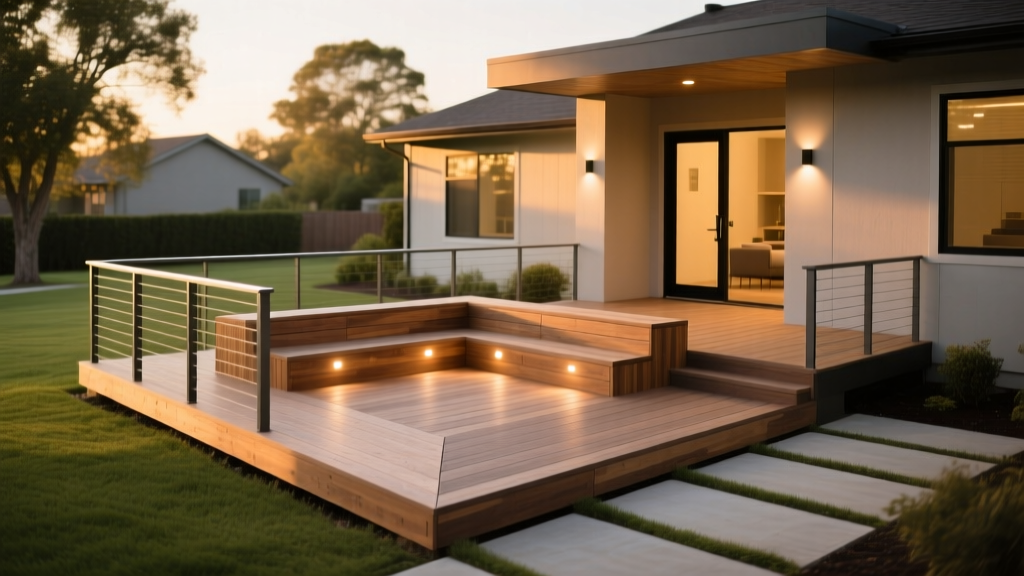
The Railing Trap: Where 12x12 Deck Budgets Break
The most common budgeting error in a 12x12 deck build is underestimating the railing. Assuming your 12-foot side is attached to the house via a ledger board, you have three exposed sides requiring railing: two 12-foot sides and one 12-foot front. That equals 36 linear feet of railing, plus the necessary posts and hardware.
On a large 20x30 deck, the square footage dilutes the linear railing cost. On a compact 12x12 deck, the perimeter-to-area ratio is high. You are paying to enclose 144 square feet with 36 feet of railing. Premium railings can easily cost more than the deck boards themselves.
Here is what 36 linear feet of railing actually costs in 2026:
- Pressure-Treated Wood Balusters: $35 - $55 per linear foot ($1,260 - $1,980 total)
- Composite Rail with Aluminum Balusters: $75 - $110 per linear foot ($2,700 - $3,960 total)
- Tempered Glass Panels with Aluminum Frame: $160 - $250 per linear foot ($5,760 - $9,000 total)
- Stainless Steel Cable Rail: $90 - $140 per linear foot ($3,240 - $5,040 total)
Labor Rates and Professional Installation
If you are hiring a licensed contractor, labor will typically range from $18 to $35 per square foot, depending on your regional market and the complexity of the design. According to Angi national deck cost data, labor accounts for roughly 50% of the final invoice on standard builds. For a 12x12 deck, expect to pay between $2,500 and $5,000 strictly for labor.
Contractors price 12x12 decks higher per square foot than massive 400-square-foot decks. The mobilization cost—bringing tools, setting up concrete mixers, pulling permits, and managing waste removal—is practically identical for a 144-square-foot deck as it is for a 300-square-foot deck. Consequently, the fixed overhead is amortized over fewer square feet, driving up the per-square-foot labor rate.
Hidden Line Items to Fund Before Breaking Ground
To ensure your 12x12 deck budget is fully comprehensive, allocate funds for the following frequently overlooked expenses:
1. Permits and Engineering
Most municipalities require a building permit for any attached deck, regardless of size. Permit fees typically range from $150 to $450. If your soil requires a geotechnical report, or if you are building on a steep slope requiring a retaining wall, structural engineering stamps can add $800 to $1,500.
2. Demolition and Haul-Away
If you are replacing an existing 12x12 structure, demolition and dumpster rental will cost between $600 and $1,100. Old pressure-treated wood cannot be burned or tossed in standard municipal yard waste bins; it must be hauled to a specialized construction debris landfill.
3. Stairs and Landings
A standard 12x12 deck is usually elevated 36 to 48 inches off the ground. Building a code-compliant stair stringer set with a concrete landing pad at the bottom adds $800 to $1,500 in materials and labor. Composite stair treads require specialized nosing boards and hidden fastener clips that are sold in separate, expensive kits.
4. Electrical and Lighting
Running a dedicated 20-amp GFCI circuit from your main panel to the deck for outlets and low-voltage LED post-cap lighting typically costs $800 to $1,400 when hiring a licensed electrician. Plan for this during the framing stage, as drilling through engineered joists or rim boards after the fact can compromise structural integrity.
Final Decision Framework: DIY vs. Pro
Building a 12x12 deck is a highly viable DIY project for an intermediate carpenter. The footprint is small enough to be managed by two people over three weekends. A DIY build using pressure-treated pine will cost roughly $1,400 in materials, saving you $3,000 in labor. However, if you are opting for composite or PVC, the margin for error shrinks to zero. Composite boards require specialized carbide-tipped blades to prevent melting the polymer cap, and hidden fastener systems demand exact 12-inch OC joist alignment. A single miscut PVC board costs upwards of $120 to replace. If you choose premium materials, hire a certified installer to protect the 25-to-50-year manufacturer fade and stain warranties, which are frequently voided if the substructure is not built to exact code specifications.
Written by
David NakamuraDavid Nakamura is a licensed architect (AIA) and construction technology writer focused on sustainable building methods, mass timber engineering, and high-performance building envelopes. He holds a Master of Architecture from the University of Washington and is a certified Passive House Consultant (CPHC). David spent eight years at the Seattle firm Mithun, where he led the design of three LEED Platinum projects, before founding his own practice specializing in net-zero residential design. He serves on the editorial advisory board of GreenBuilder Magazine and has authored peer-reviewed papers on cross-laminated timber (CLT) connections for the Journal of Structural Engineering. In his spare time, David teaches woodworking at Pratt Fine Arts Center and kayaks the Puget Sound.
More from David Nakamura
View all
Construction Cost
Labor Cost to Build a Deck Per Sq Ft: 2026 Installation Guide
Discover the exact labor cost to build a deck per sq ft in 2026. This installation guide breaks down contractor rates, complexity factors, and hidden fees.
Aug 4, 2026

Construction Cost
How Much Does It Cost to Build a 3 Bedroom House? Financing Guide
Learn exactly how much it costs to build a 3 bedroom house and explore 2026 financing options, construction loan types, and budget frameworks for your build.
Aug 4, 2026

Construction Cost
Cost to Build a Tennis Court: 2026 Guide
How much does it cost to build a tennis court in 2026? Breakdowns for asphalt, concrete, and synthetic surfaces plus fencing and lighting.
Jul 30, 2026