How Much It Costs to Build a Deck: 2026 Maintenance & TCO Guide
Discover how much it costs to build a deck in 2026 by factoring in long-term maintenance. Compare 15-year total ownership costs for wood vs. composite.

The Flawed Metric: Why Upfront Pricing Lies
When homeowners research how much it costs to build a deck, contractors and online calculators typically provide a single, upfront per-square-foot estimate. In 2026, that number generally ranges from $18 to $55 per square foot depending on the material. However, evaluating a deck build solely on initial construction costs is a financial trap. A deck is an exterior structure subjected to UV radiation, freeze-thaw cycles, and moisture intrusion. The true financial impact of your build is measured by its Total Cost of Ownership (TCO)—the sum of initial construction plus 15 years of mandatory maintenance, chemical treatments, and structural repairs.
2026 Baseline Construction Costs (The Initial Hit)
Before projecting long-term maintenance, we must establish the 2026 baseline construction costs for a standard 400-square-foot ground-level deck. These figures include materials, standard pressure-treated framing, hidden fasteners, and professional labor.
| Material Grade | Upfront Cost (per sq. ft.) | Total Build (400 sq. ft.) | Expected Lifespan |
|---|---|---|---|
| Pressure-Treated Pine | $18 - $24 | $7,200 - $9,600 | 15 - 20 years |
| Western Red Cedar | $26 - $34 | $10,400 - $13,600 | 20 - 25 years |
| Capped Composite | $38 - $48 | $15,200 - $19,200 | 25 - 30+ years |
| Cellular PVC | $45 - $58 | $18,000 - $23,200 | 30+ years |
The Maintenance Ledger: Material-by-Material Upkeep
According to the North American Decking and Railing Association (NADRA), failure to adhere to strict maintenance schedules is the primary cause of premature deck failure, particularly regarding wood rot and structural fastener corrosion. Here is the exact maintenance ledger for the most common decking materials.
Pressure-Treated Lumber (The High-Friction Asset)
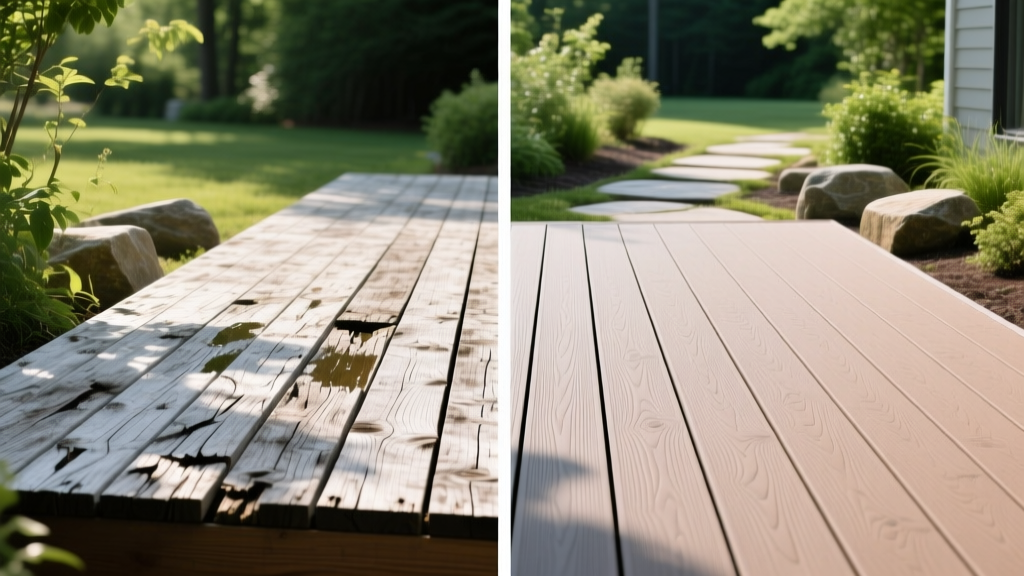
Pressure-treated (PT) pine is infused with alkaline copper quaternary (ACQ) or copper azole to resist rot, but this treatment does nothing to prevent UV degradation, warping, or surface checking (splitting). To maintain a PT deck, you must execute a three-step restoration process every 2 to 3 years:
- Stripping & Brightening ($0.25/sq. ft.): Removing oxidized stain and alkaline buildup using oxalic acid-based brighteners.
- Sanding ($1.20/sq. ft.): Required every 6 years to remove deep splinters and open the wood pores. According to the USDA Forest Products Laboratory, sanding past the treated outer layer of PT wood exposes untreated fibers, accelerating localized decay if not immediately resealed.
- Sealing/Staining ($0.50/sq. ft.): High-quality penetrating oils like Defy Extreme or Penofin cost roughly $65 to $85 per gallon, covering 150 square feet. For a 400 sq. ft. deck, material costs alone are $175 per application.
Annualized Maintenance Cost: $350 - $450 (Professional) or 12-16 hours of intense DIY labor per cycle.
Capped Composite & Cellular PVC (The Low-Friction Asset)
Modern capped composites (e.g., Trex Transcend, TimberTech AZEK) feature a polyethylene or PVC shell that completely encapsulates the wood-flour core. This shell is impervious to moisture and UV fading, eliminating the need for sanding and sealing.
- Routine Cleaning ($0.10/sq. ft.): Biannual washing with a mild surfactant.
- Tannin & Mold Removal ($0.15/sq. ft.): If organic debris sits on the boards, tannins can leach and cause staining. Specialized oxygenated cleaners like Corte Clean ($30 per bottle) are required to lift these stains without voiding the manufacturer warranty.
Annualized Maintenance Cost: $80 - $120 (Professional) or 2-3 hours of light DIY labor.
Tropical Hardwoods (The Specialty Asset)
Ipe, Cumaru, and Tigerwood are incredibly dense (Janka hardness ratings over 3,500 lbf) and naturally rot-resistant. However, they will turn a silvery-gray within six months if exposed to UV light. If you wish to maintain the rich mahogany tones, you must apply specialized hardwood oils (like Messmer’s UV Plus for Hardwoods) annually. Because hardwoods are so dense, they do not absorb oil easily; application requires wiping off excess residue by hand, making it the most labor-intensive maintenance routine in the industry.
15-Year Total Cost of Ownership (TCO) Matrix
To truly understand how much it costs to build a deck, we must project the 15-year TCO for a 400-square-foot structure. This matrix includes initial build costs, out-of-pocket professional maintenance, and a DIY Time Valuation (calculating your lost weekend hours at a conservative $30/hour rate).
| Cost Variable (15 Years) | PT Pine (400 sq. ft.) | Capped Composite (400 sq. ft.) |
|---|---|---|
| Initial Build Cost | $8,400 | $16,800 |
| Out-of-Pocket Maintenance (Pro) | $3,850 (7 cycles + 1 sanding) | $1,200 (Biannual washes) |
| Board Replacement/Repairs | $450 (Warping/splitting) | $0 |
| Total Cash Expenditure | $12,700 | $18,000 |
| DIY Time Valuation (If self-maintained) | $2,520 (84 hours total) | $360 (12 hours total) |
| True Cost (Cash + Time Value) | $15,220 | $18,360 |
Data context: While the composite deck still commands a premium, the cash gap shrinks from $8,400 on day one to just $5,300 by year 15. When your personal time is factored into the equation, the composite deck costs merely $3,140 more over a decade and a half—a premium of roughly $17 per month for a zero-maintenance outdoor living space.
Hidden Structural Maintenance: Framing & Fasteners
Most cost guides ignore the substructure, but the framing is where catastrophic maintenance costs originate. The Remodeling Magazine Cost vs. Value Report frequently notes that structural repairs destroy ROI. To mitigate long-term framing maintenance, you must invest in specific preventative materials during the initial build:
- Butyl Joist Tape: Standard PT joists will rot from the top down as water pools in the screw holes. Applying a butyl flashing tape (e.g., Trex Protect, approx. $35 per 50-ft roll) over every joist before laying deck boards adds $150 to the initial build but extends framing life from 15 years to 30+ years.
- Hidden Fasteners vs. Face Screws: Face screws cost $40 for a box of 1,000, but they create 1,000 moisture-entry points into the wood or composite. Hidden clip systems (e.g., Trex Hideaway, approx. $85 per 50 sq. ft. box) cost $680 for a 400 sq. ft. deck. This upfront premium prevents water pooling, eliminates the need to re-drive popped screws annually, and stops composite boards from splitting.
Strategic Decision Framework: Which Build Fits Your Profile?
Use this if/then matrix to determine which material aligns with your financial and lifestyle parameters.
The Budget-Conscious / High-Sweat Equity Profile
Choose: Pressure-Treated Pine.
Condition: You must commit to a strict 24-month maintenance cycle. If you skip a year, the wood will check (crack), trap moisture, and require a $1,200 professional drum-sanding rescue. This is only the 'cheaper' option if you value your weekend labor at $0/hour.
The Long-Term Asset / Low-Friction Profile
Choose: Capped Composite (Mid-Tier).
Condition: You plan to stay in the home for 7+ years. The 7-year break-even point makes composite the superior financial choice for long-term homeowners. Opt for a scalloped-bottom composite board to reduce material weight and cost without sacrificing structural rigidity.
The Luxury / Architectural Profile
Choose: Cellular PVC or Tropical Hardwood.
Condition: You are building near saltwater (PVC is impervious to salt corrosion) or you desire the authentic grain of Ipe and are willing to pay a specialized contractor $1.50/sq. ft. annually for hardwood oiling. Avoid PVC in high-heat, direct-sun southern exposures, as the material can soften and sag under extreme thermal loads.
Final Assessment: Shifting the Cost Paradigm
Answering the question of how much it costs to build a deck requires shifting from a 'Day 1' mindset to a 'Year 15' mindset. A $9,000 wood deck that demands $400 in chemicals and 15 hours of back-breaking labor every other spring is a depreciating liability. A $17,000 composite deck that requires nothing more than a garden hose and a bottle of oxygenated cleaner is a stable, appreciating extension of your home's square footage. Allocate your budget not just for the lumber, but for the decades of upkeep that follow.
Written by
Elena RodriguezElena Rodriguez is a civil engineer and technical writer specializing in concrete technology, masonry systems, and ASTM/ACI compliance. She earned her B.S. in Civil Engineering from Texas A&M University and spent a decade at a materials testing laboratory, performing over 2,000 concrete compressive strength tests and masonry prism evaluations. Elena is an ACI-certified Field Testing Technician (Grade I) and a member of ASTM Committee C12 on Natural Building Stone. She currently consults on forensic engineering cases involving concrete failures and moisture intrusion. Based in San Antonio, TX, Elena is a proud member of the Society of Women Engineers (SWE) and coaches her daughter's FIRST Robotics team.
More from Elena Rodriguez
View all
Walls & Panels
Cost Analysis: Light Gauge Steel Framing Advantages and Disadvantages
Evaluate light gauge steel framing advantages and disadvantages through a strict cost analysis lens, comparing material, labor, and lifecycle expenses.
Aug 4, 2026

Walls & Panels
Gypsum Board Types: Exact Specifications, Thickness & Dimensions
Compare standard, Type X, and moisture-resistant gypsum board types. Get exact specifications, thicknesses, dimensions, and ASTM standards for your project.
Aug 4, 2026

Fire Resistance
Best Fire-Resistant Outdoor Decking Materials: 2026 Buyer Guide
Discover the best fire-resistant outdoor decking materials for 2026. Compare Class A PVC, aluminum, and hardwood options for WUI compliance and safety.
Aug 4, 2026