Evaluating Composite Deck Boards: Key Performance Specs & Ratings
Decode composite deck boards performance ratings. Compare slip resistance, fire ratings, fade warranties, and structural spans for top brands.
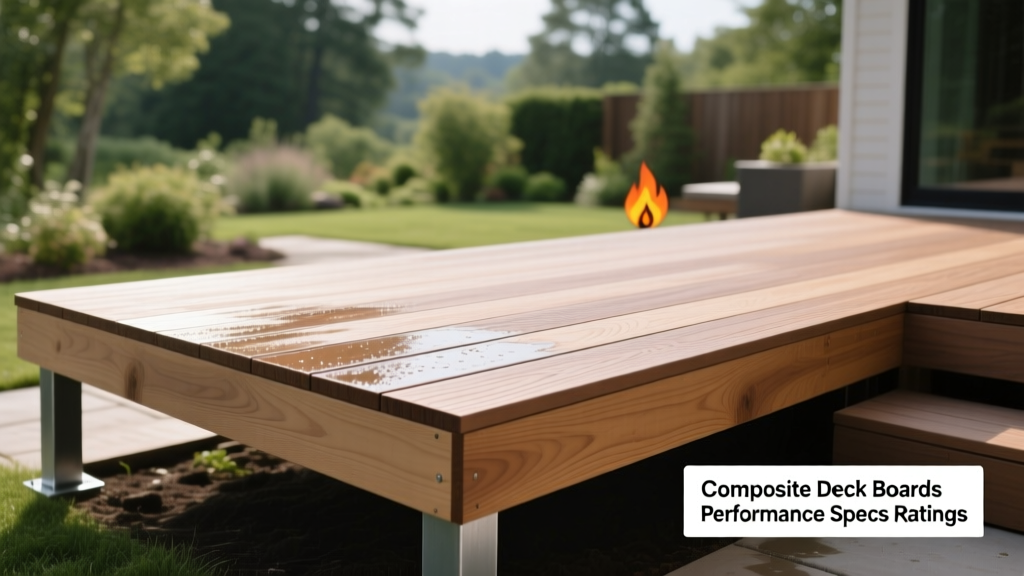
Core Material Composition & Density Metrics
Selecting composite deck boards requires looking beyond color swatches and texture samples. The true longevity, structural integrity, and safety of your outdoor space depend on the underlying performance specifications. Modern composite boards are primarily divided into two material categories: High-Density Polyethylene (HDPE) blends and Polyvinyl Chloride (PVC) cellular foams.
HDPE Mineral-Filled Composites
Standard capped composite deck boards, such as the Trex Transcend Lineage, utilize an HDPE core heavily loaded with mineral fillers (typically calcium carbonate or fly ash). This mineral loading increases the board's density to approximately 55 to 60 lbs per cubic foot. While this provides excellent rigidity and a realistic wood-like heft, it also increases the thermal mass, meaning the boards retain heat longer in direct sunlight. The protective polymer cap on these boards is typically 2mm to 3mm thick, engineered to block UV degradation and moisture intrusion.
PVC Cellular Foam Composites
Advanced PVC composite deck boards, like TimberTech Advanced PVC, use a different chemical approach. By utilizing a cellular foam core, manufacturers reduce the board density to roughly 35 to 40 lbs per cubic foot. This lower density makes PVC boards significantly lighter and easier to install, while the inherent chemical structure of PVC provides superior resistance to moisture absorption and mold growth without relying as heavily on mineral fillers.
Structural Load & Joist Span Requirements
The structural performance of composite deck boards is governed by deflection limits under concentrated loads. Building codes generally require a maximum deflection of L/360 under a 300-pound concentrated point load. When installing 5.5-inch wide composite boards on a 16-inch OC frame, the actual unsupported span is 14.5 inches. Under the 300-pound test, the board must not deflect more than 0.04 inches.
| Installation Pattern | Maximum Joist Spacing (OC) | Deflection Limit | Required Blocking |
|---|---|---|---|
| Perpendicular (90°) | 16 inches | L/360 @ 300 lbs | Mid-span blocking recommended |
| Diagonal (45°) | 12 inches | L/360 @ 300 lbs | Required at all joist intersections |
| Stair Treads (12" wide) | 12 inches (Stringer spacing) | L/360 @ 300 lbs | Rigid riser backing required |
Fire & Flame Spread Ratings
Fire performance is a critical specification, particularly for homes in wildfire-prone regions. Composite deck boards are tested under ASTM E84 (Standard Test Method for Surface Burning Characteristics of Building Materials) to determine their Flame Spread Index (FSI) and Smoke Developed Index (SDI).
- Class A Rating (FSI 0-25): Premium capped composites and advanced PVC boards typically achieve a Class A rating, meaning they resist flame spread exceptionally well and self-extinguish quickly once the ignition source is removed.
- Class B Rating (FSI 26-75): Some mid-tier or older generation uncapped composites fall into this category, offering moderate fire resistance.
- Class C Rating (FSI 76-200): Basic wood-plastic composites with high wood-flour content may only achieve Class C, making them unsuitable for high-risk fire zones.
For projects in California or other states with strict Wildland-Urban Interface (WUI) codes, composite deck boards must be listed on the state's approved materials roster. You can verify specific product approvals through the California OSFM WUI Products database. Even with a Class A rating, WUI compliance often mandates the use of non-combustible sub-structure materials or specific fire-retardant joist tapes.
Slip Resistance & Traction Metrics
Slip resistance is measured using the Static Coefficient of Friction (SCOF). The Americans with Disabilities Act (ADA) recommends a minimum SCOF of 0.60 for flat walking surfaces and 0.80 for ramps. When evaluating composite deck boards, you must look at both dry and wet SCOF ratings.
High-performance capped composites utilize micro-embossed wood grain textures that mechanically grip footwear. Top-tier boards consistently achieve a dry SCOF of 0.72 to 0.78, and a wet SCOF of 0.62 to 0.68, keeping them safely above the ADA threshold even during heavy rain. Conversely, boards with high-gloss polymer caps or deeply embossed grooves that trap standing water can see their wet SCOF drop to 0.45, creating a severe slip hazard. Always request the ASTM D2394 test results from the manufacturer if the deck will be installed near a pool or in a high-precipitation climate.
Thermal Expansion & Fastener Specifications
Unlike pressure-treated lumber, which expands and contracts primarily across its width due to moisture, composite deck boards expand and contract longitudinally (along their length) due to temperature fluctuations. The standard thermal expansion rate for HDPE composites is approximately 1/8 inch per 10 feet of board length for every 40°F change in temperature.
If you install a 20-foot run of composite boards on a 90°F day, and the winter temperature drops to 10°F (an 80°F delta), the board will contract by roughly 1/4 inch. If the fasteners do not allow for this movement, the boards will buckle, warp, or pull the screws through the polymer cap.
To manage this, manufacturers mandate the use of specialized hidden fastener systems (such as the Trex Hideaway or TimberTech CONCEALoc systems). These clips secure the board to the joist while allowing lateral sliding. When using face screws, you must pre-drill holes that are 1/16 inch wider than the screw shank to create a thermal expansion sleeve, and you must leave a strict 1/4-inch gap at all butt joints and end walls.
Warranty Matrix: Fade, Stain, and Structural
Warranties on composite deck boards are highly segmented. A "50-year warranty" does not mean the entire board is covered for 50 years. Manufacturers separate structural integrity from cosmetic fade and stain resistance. Below is a comparison of the premium tiers from leading manufacturers.
| Brand & Product Line | Structural Warranty | Fade & Stain Warranty | Transferability |
|---|---|---|---|
| Trex Transcend Lineage | 50 Years | 50 Years (Limited Fade) | One-time transfer within 5 years |
| TimberTech Landmark (Advanced PVC) | Lifetime (50 Years proration) | 50 Years (Limited Fade) | One-time transfer within 5 years |
| Fiberon Promenade (PVC) | 50 Years | 50 Years (Limited Fade) | One-time transfer within 5 years |
Specification Insight: Read the fade warranty carefully. Most "50-year fade warranties" are prorated and only guarantee that the board will not fade beyond a specific Delta E (color difference) threshold—usually a Delta E of 5.0 or less. A Delta E of 5.0 is noticeable to the human eye, meaning the board is guaranteed not to fade drastically, but it is not guaranteed to look brand new.
Frequently Asked Questions on Composite Specifications
Can composite deck boards be routed for custom edges?
Yes, but only specific product lines. Solid-core HDPE composites and solid PVC boards can be routed using standard carbide router bits to create custom bullnose or picture-frame edges. However, scalloped-bottom boards (which feature hollowed-out channels underneath to reduce weight and material costs) cannot be routed, as the bit will break through the thin bottom webbing. Always check the board's cross-section profile before specifying routed edges in your design.
Do composite boards meet ICC-ES AC174 standards?
Premium composite deck boards are tested and certified under ICC-ES AC174 (Acceptance Criteria for Deck Board Span Ratings). When submitting plans for a commercial build or a multi-family residential project, the building inspector will require the manufacturer's ICC-ES Evaluation Report (ESR). Ensure the specific product line you are purchasing has an active, non-expired ESR number listed on the manufacturer's technical data sheet.
How does the modulus of rupture (MOR) compare to wood?
The Modulus of Rupture (MOR) measures the maximum stress a material can withstand before breaking. Pressure-treated Southern Yellow Pine typically has an MOR of 10,000 to 12,000 psi. High-quality mineral-filled composite deck boards generally exhibit an MOR between 5,500 and 7,500 psi. While composites have a lower absolute breaking point than dense wood, their superior resistance to moisture rot, insect degradation, and checking ensures their structural capacity remains stable over decades, whereas wood's MOR degrades rapidly as it weathers.