Build to Last: 10x10 Deck Material List for Maximum Lifespan
Discover the ultimate 10x10 deck material list optimized for a 50-year lifespan. Compare framing, composite decking, and corrosion-resistant hardware.

The 10x10 Deck Material List: A System Approach to Longevity
When planning a 100-square-foot (10x10) outdoor structure, most builders and homeowners focus exclusively on the surface material. However, a deck is an interconnected structural system. If your composite decking is rated for 50 years but your pressure-treated pine joists succumb to moisture rot in 15 years, the entire structure fails prematurely. Building a truly durable 10x10 deck requires a holistic material list where the substructure, fasteners, and surface boards share a matching lifecycle. This guide details the exact material specifications, quantities, and structural upgrades required to achieve a multi-generational lifespan for a standard 10x10 footprint.
| System Component | Standard Material (15-20 yr lifespan) | Longevity Upgrade (40-50+ yr lifespan) | Primary Failure Mode |
|---|---|---|---|
| Substructure Framing | Standard #2 Pressure-Treated Pine | UC4B Ground-Contact PT + Joist Tape or Aluminum Framing | Moisture trapping, top-edge rot |
| Surface Decking | Uncapped Wood-Plastic Composite | Capped Polymer or Advanced PVC (e.g., TimberTech Landmark) | UV degradation, staining, core swelling |
| Structural Fasteners | Hot-Dipped Galvanized (G90) | G185 ZMAX or 316 Stainless Steel | Galvanic corrosion from copper azole treatments |
| Post Bases | Standard painted steel brackets | Elevated standoff bases with concealed hardware | Wicking moisture from concrete footings |
Substructure: Solving the 15-Year Rot Bottleneck
The most common point of catastrophic failure in deck construction is the substructure. Standard pressure-treated (PT) lumber is typically rated for UC4A (above-ground contact). When horizontal joists are exposed to constant rain, snow melt, and debris accumulation, the top edge of the joist remains perpetually damp, leading to fungal decay long before the 40-year warranty on your composite decking expires.
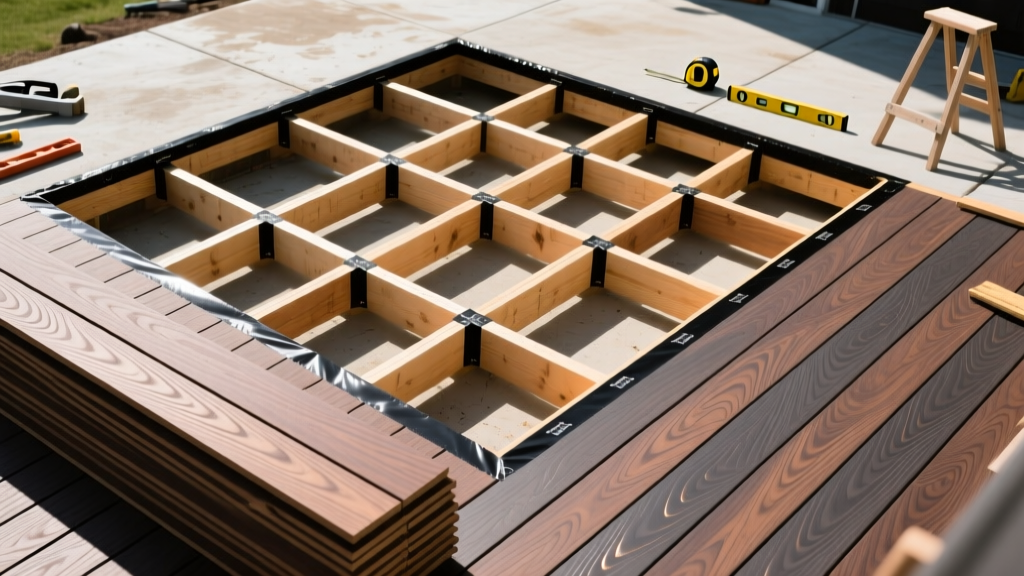
To align the framing lifespan with high-end composite decking, you must implement a two-step defense. First, specify UC4B heavy-duty treated lumber for all joists and beams. Second, apply a butyl-based flashing tape (such as Trex Protect or TimberTech Deck Drainage System) to the top edge of every joist before laying the deck boards. This tape seals the screw penetrations and prevents water from pooling on the horizontal wood surfaces, effectively doubling the framing lifespan.
Decking Surface: Capped Polymer vs. Advanced PVC
For a 10x10 deck, the surface area is small enough that upgrading to premium, ultra-durable materials will not break the budget, while offering massive dividends in lifespan and maintenance reduction. In 2026, the market is dominated by two high-durability categories:
1. Capped Wood-Plastic Composite (WPC)
Products like Trex Transcend Lineage feature a high-performance polyurethane shell completely encasing a recycled wood-fiber core. The cap resists UV fading and prevents moisture from reaching the organic core. However, WPC boards are susceptible to thermal expansion and can retain heat in direct, unshaded southern exposures.
2. Advanced PVC (Polyvinyl Chloride)
For absolute maximum durability, advanced PVC boards like TimberTech Advanced PVC (Landmark Collection) contain zero organic wood fibers. Because there is no wood flour in the core or cap, PVC is entirely impervious to mold, mildew, and water absorption. PVC also features superior scratch resistance and reflects more solar heat than dark-colored WPC, making it the superior choice for a 50-year lifespan in harsh climates.
The Exact 10x10 Deck Material List (Quantity Takeoff)
The following takeoff assumes a freestanding or ledger-attached 10x10 deck with joists spaced 16 inches on-center (OC), utilizing 5.5-inch wide face deck boards. This list prioritizes structural redundancy and corrosion resistance.
Framing & Structural Components
- Posts: (4) 6x6x8 UC4B Pressure-Treated Southern Pine. (6x6 provides superior load distribution and resists twisting better than 4x4s over decades).
- Beams: (2) 2x10x10 UC4B PT Lumber (doubled up to form two 2-ply beams).
- Joists: (11) 2x8x10 UC4B PT Lumber (spaced 16" OC for 10-foot span).
- Rim Joists: (2) 2x8x10 UC4B PT Lumber.
- Joist Tape: (3 rolls) 2-inch wide butyl flashing tape (approx. 225 linear feet total coverage).
Surface & Trim Components
- Deck Boards: (15) 16-foot Capped Polymer or Advanced PVC boards (5.5" face width). This yields 132 sq ft of coverage, accounting for a 10% waste factor and rip cuts.
- Fascia/Trim: (4) 12-foot PVC fascia boards (11.25" width) to conceal the rim joists.
Hardware & Fasteners
- Post Bases: (4) Simpson Strong-Tie ABA66Z adjustable post bases with 1-inch standoff to prevent concrete wicking.
- Joist Hangers: (22) Simpson Strong-Tie LUS28Z hangers (G185 zinc coating).
- Structural Screws: (1 box) Simpson Strong-Tie SDWS22300 (3" structural screws) for beam-to-post and joist-to-beam connections.
- Deck Screws: (1 box) 316 Stainless Steel hidden fastener clips or color-matched stainless steel top-drive screws (approx. 450 count).
Hardware: The Hidden Point of Failure
The most overlooked element in any deck material list is the metallurgy of the fasteners. Modern pressure-treated lumber is preserved using Micronized Copper Azole (MCA) or Alkaline Copper Quaternary (ACQ). These treatments contain high levels of copper, which acts as a cathode when in contact with standard galvanized steel (the anode), triggering rapid galvanic corrosion.
"Using standard G90 galvanized fasteners with modern copper-based wood treatments will result in severe hardware degradation within 5 to 7 years. For a 50-year deck, you must specify G185 (ZMAX) coatings or, ideally, 316 marine-grade stainless steel for all surface fasteners." — Simpson Strong-Tie Corrosion Resistance Guidelines
For a 10x10 deck, the cost difference between standard galvanized screws and 316 stainless steel is roughly $80 to $120. Given that replacing rusted fasteners requires pulling up the entire deck surface, 316 stainless steel is a non-negotiable requirement for a high-durability build.
Lifecycle Cost vs. Initial Material Cost
Building a 10x10 deck for maximum longevity requires a higher initial capital outlay. However, when evaluated over a 25-year lifecycle, the longevity-optimized material list actually costs less per year of service life due to the elimination of sealing, staining, and premature substructure replacement.
| Material Strategy | Initial Material Cost (10x10) | 25-Year Maintenance Cost | Expected Lifespan | Cost Per Year of Life |
|---|---|---|---|---|
| Standard PT Pine (All Wood) | $1,200 - $1,500 | $2,500 (Staining/Sealing every 2 yrs) | 15 - 20 Years | $185 - $200 / yr |
| Standard WPC + PT Framing | $3,000 - $3,800 | $800 (Cleaning only) | 20 - 25 Years (Framing fails first) | $152 - $184 / yr |
| Advanced PVC + Taped UC4B Framing + SS Hardware | $5,500 - $6,500 | $300 (Soap and water wash) | 40 - 50+ Years | $116 - $136 / yr |
By treating the 10x10 deck material list as a unified, interdependent system rather than a collection of isolated parts, you eliminate the weak links that traditionally force early tear-downs. Specify UC4B lumber, apply butyl joist tape, select zero-organic PVC decking, and mandate 316 stainless steel hardware to ensure your outdoor space outlasts the mortgage on the home it is attached to.
Written by
James ThorntonJames Thornton is a construction industry veteran with 25 years of hands-on experience in wood framing, lumber grading, and residential building codes. He started as a framing carpenter in rural Oregon, earned his ICC Residential Building Inspector certification, and eventually became a senior plan reviewer for the City of Portland Bureau of Development Services. James holds a B.S. in Wood Science & Technology from Oregon State University and is a certified lumber grader through the West Coast Lumber Inspection Bureau (WCLIB). He has inspected over 3,000 residential construction sites and authored the city's internal guide on advanced framing techniques (2x6 at 24" O.C.). James lives in Bend, OR, where he builds custom timber-frame cabins and competes in lumberjack sports.
More from James Thornton
View all
Insulation
Best Home Insulation Materials: Complete 2026 Guide
Compare top home insulation materials for 2026. Find R-values, installed costs per square foot, and best uses for fiberglass, spray foam, and mineral wool.
Aug 4, 2026

Sustainable Building
Certify Your Green Building Material for LEED and WELL
Step-by-step guide to certifying a green building material for LEED v5 and WELL v2. Master EPDs, HPDs, and VOC limits for 2026 project specifications.
Aug 4, 2026

Stone & Masonry
Veneer Stacked Stone Panels: Interior Design & Style Showcase
Discover how veneer stacked stone panels transform interiors. Explore modern design profiles, material pairings, and technical installation specs.
Aug 4, 2026