Best Composite Deck Skirting Panels & Brands for 2026
Compare top composite deck skirting brands for 2026. Deep dive into Trex, TimberTech, and Deckorators panels, pricing, and ventilation specs.
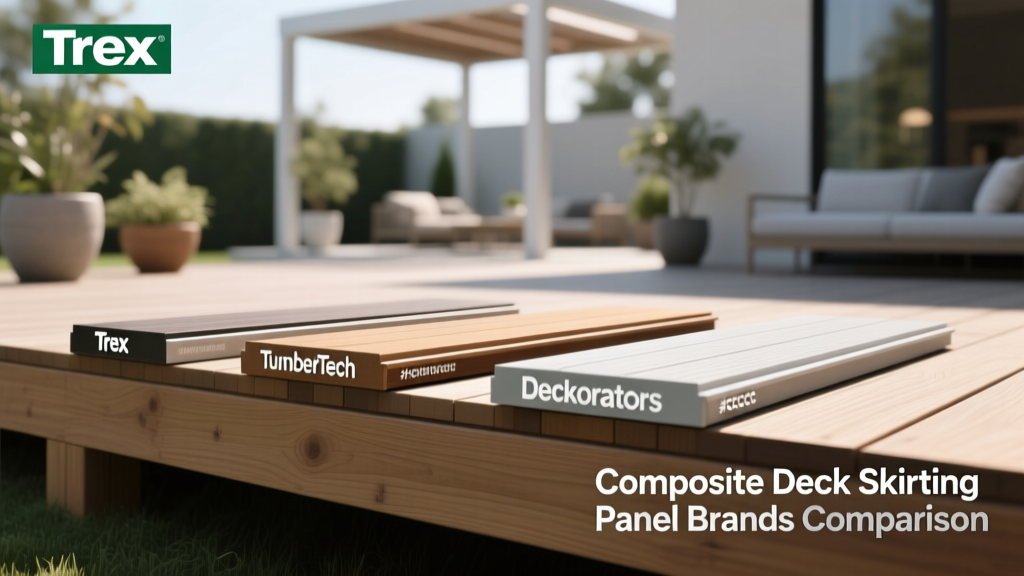
The Engineering Reality of Composite Deck Skirting
Deck skirting serves three critical functions: concealing structural framing, deterring pest intrusion, and managing under-deck moisture. However, enclosing a deck with composite materials introduces significant thermodynamic and hygroscopic challenges. Unlike natural wood, composite decking and fascia boards are highly susceptible to thermal expansion and moisture entrapment. If installed without precise clearances and adequate cross-ventilation, composite skirting will warp, buckle, or trap enough humidity to rot the pressure-treated wooden joists above it.
This deep-dive analyzes the leading composite deck skirting solutions available in 2026, evaluating specific product lines from Trex, TimberTech, and Deckorators. We break down exact material specifications, hidden fastening compatibility, and the critical ventilation mathematics required to keep your substructure intact.
Brand Deep-Dive: Trex Fascia & Skirting Solutions
Trex does not manufacture a standalone "skirting panel" product. Instead, the industry standard for Trex skirting utilizes their 12-inch wide Fascia boards (available in the Select, Enhance, and Transcend lines) installed horizontally or vertically.
Product Specs & Installation Tolerances
Trex Fascia boards measure 0.60 inches thick and 12 inches wide. Because composite materials expand and contract primarily along their length, Trex mandates strict gapping protocols. According to the official Trex installation guidelines, installers must leave a minimum 3/16-inch gap at all butt joints and a 1/4-inch gap at inside corners to accommodate thermal expansion.
Composite fascia must never make direct contact with soil. Moisture wicking from the ground will cause the bottom edge of the skirting to swell and delaminate. Maintain a strict 2-inch minimum clearance between the bottom of the Trex fascia and the final grade. Use a pressure-treated 2x4 mudsill or a poured concrete curb to bridge this gap.
Brand Deep-Dive: TimberTech Skirting & Cortex System
TimberTech approaches skirting with a focus on aesthetic continuity, utilizing their AZEK (PVC) and PRO (capped composite) trim and fascia boards. The standout advantage of the TimberTech ecosystem for skirting applications is the Cortex Hidden Fastening System.
Eliminating Face Fasteners on Vertical Planes
When skirting a deck, face-nailing or face-screwing composite boards leaves visible, unsightly holes that collect dirt and moisture. TimberTech's Cortex system utilizes specialized collated screws that drive flush into the composite, followed by a color-matched composite plug. For skirting applications, this yields a seamless, fastener-free appearance. TimberTech PRO fascia boards are slightly thicker at 0.75 inches, offering superior rigidity for long, horizontal skirting runs without the need for intermediate vertical nailers every 24 inches.
Brand Deep-Dive: Deckorators Lattice & Skirting Panels
For builders who prefer dedicated skirting panels over heavy fascia boards, Deckorators offers specialized composite lattice and vented skirting systems. Their Classic and Privacy Lattice panels are engineered specifically for vertical applications and under-deck enclosures.
- Material Composition: Mineral-based composite (MBC), which exhibits virtually zero thermal expansion compared to traditional wood-plastic composites (WPC).
- Dimensions: Available in 4x8 foot panels, making them significantly faster to install on large, multi-level decks compared to cutting individual 16-foot fascia boards.
- Ventilation Integration: The lattice design inherently provides massive net-free ventilation area, entirely bypassing the complex math required for solid fascia skirting.
Head-to-Head Comparison Matrix
| Brand | Primary Skirting Product | Thickness | Avg. Cost / LF (2026) | Hidden Fastener Compatible |
|---|---|---|---|---|
| Trex | Select / Enhance Fascia | 0.60" | $4.80 - $5.40 | Yes (Trex Hideaway) |
| TimberTech | PRO / AZEK Trim & Fascia | 0.75" | $5.90 - $7.20 | Yes (Cortex Plugs) |
| Deckorators | MBC Lattice Panels | 0.50" | $3.20 - $4.10 (per sq ft) | No (Face mount) |
Critical Installation Variables: Ventilation & Code Compliance
The most common failure mode in composite deck skirting is not the material itself, but the microclimate it creates. Enclosing a deck without adequate airflow traps evaporating ground moisture, leading to severe joist decay and mold proliferation on the underside of the deck boards.
The American Wood Council's DCA 6 Prescriptive Residential Deck Construction Guide and the International Residential Code (IRC) mandate specific ventilation ratios for enclosed under-deck spaces.
The 1/150 Ventilation Rule
For decks skirted with solid composite fascia, you must provide a minimum of 1 square foot of net-free ventilation area for every 150 square feet of enclosed deck space (a 1/150 ratio). Furthermore, this ventilation must be cross-distributed to prevent dead-air pockets.
- Calculate Deck Area: A 20x20 foot deck equals 400 square feet.
- Determine Required Ventilation: 400 / 150 = 2.67 square feet of net-free ventilation.
- Convert to Square Inches: 2.67 sq ft x 144 = 384 square inches of open vent space.
- Distribution: This 384 sq in must be split between the top of the skirting (rim joist gap) and the bottom (grade clearance), ensuring air can flow in one side and out the other.
If you are using solid Trex or TimberTech fascia, you must integrate dedicated composite vent grilles (typically 16x8 inches, yielding roughly 50 sq inches of net-free area each) at 8-foot intervals along the skirting perimeter to meet code.
Step-by-Step Framing for Skirting Attachment
Never attach composite skirting directly to the pressure-treated rim joist or hang it solely from the deck floor joists. The framing must be independent to allow for differential movement and grade settling.
- Install Vertical Nailers: Attach pressure-treated 2x4 nailers vertically to the rim joist or concrete piers using structural screws (e.g., Simpson Strong-Tie SDWS). Space these nailers a maximum of 24 inches on center.
- Establish the Grade Gap: Cut the bottom of the 2x4 nailers so they terminate exactly 2 inches above the finished soil grade. This prevents the wood from wicking moisture and provides the mandatory clearance for the composite skirting.
- Add Horizontal Blocking: For skirts taller than 24 inches, install horizontal pressure-treated 2x4 blocking between the vertical nailers at the mid-point to prevent the composite fascia from bowing outward under wind loads.
- Fasten the Skirting: Secure the composite fascia to the nailers using manufacturer-approved stainless steel or coated composite deck screws, pre-drilling to prevent mushrooming at the surface.
Cost Breakdown: Material vs. Labor
When budgeting for composite deck skirting in 2026, contractors and homeowners must account for both the premium material costs and the additional labor required for framing nailers and cutting ventilation grilles. For a standard 400-square-foot deck with an 80-linear-foot perimeter and an average 24-inch skirt height:
- Material Cost (Composite Fascia): 160 linear feet of material (accounting for 10% waste) at an average of $5.50/LF = $880.
- Framing Lumber & Fasteners: Pressure-treated 2x4s, structural screws, and hidden fasteners = $250.
- Ventilation Grilles: 10 composite vent inserts at $35 each = $350.
- Labor: Skirting installation requires precise miter cuts and leveling over uneven terrain. Expect labor costs of $12 to $18 per linear foot, totaling $960 to $1,440.
Total Estimated Project Cost: $2,440 to $2,920 for a fully enclosed, code-compliant composite skirt on a 400 sq ft deck.
Expert Verdict: Which Brand Should You Choose?
The optimal brand depends entirely on your design priorities and labor budget. If your priority is a seamless, high-end aesthetic with no visible fasteners, TimberTech PRO paired with the Cortex hidden fastening system is the undisputed leader, despite the premium price point. If you are managing a tighter budget and prioritize rapid installation with zero ventilation math, Deckorators MBC Lattice panels offer superior dimensional stability and inherent airflow. For builders already locked into the Trex decking ecosystem, utilizing Trex Select Fascia remains a highly durable, code-compliant choice, provided you strictly adhere to the 3/16-inch gapping and 1/150 ventilation ratios.