Composite Decking Material vs Wood & PVC: Cost and Performance Guide
Compare capped composite decking material, mineral-based boards, and PVC. Explore 2026 costs, thermal expansion, and structural framing requirements.

The 2026 Landscape of Decking Materials
The market for outdoor flooring has fractured into highly specialized categories. When evaluating a composite decking material for a new build or renovation, the decision is no longer a simple binary between wood and plastic. Modern engineering has introduced mineral-based composites (MBC), advanced capped polymers (PVC), and high-density wood-plastic composites (WPC). Each material reacts differently to thermal expansion, moisture ingress, and structural loading. Selecting the wrong profile for your specific microclimate or joist spacing can lead to warped boards, popped fasteners, and premature cap delamination.
Quick Decision Framework
- Choose Capped WPC if you want a natural wood aesthetic, have standard 16-inch on-center (OC) framing, and prioritize budget-to-performance ratio.
- Choose Mineral-Based Composite (MBC) if you are building near water (docks, pool surrounds) and need zero moisture absorption and maximum dimensional stability.
- Choose Capped PVC if you require ultra-lightweight boards for complex elevated structures and demand the highest resistance to staining and fading.
Core Material Breakdown: WPC vs. MBC vs. PVC
Capped Wood-Plastic Composite (WPC)
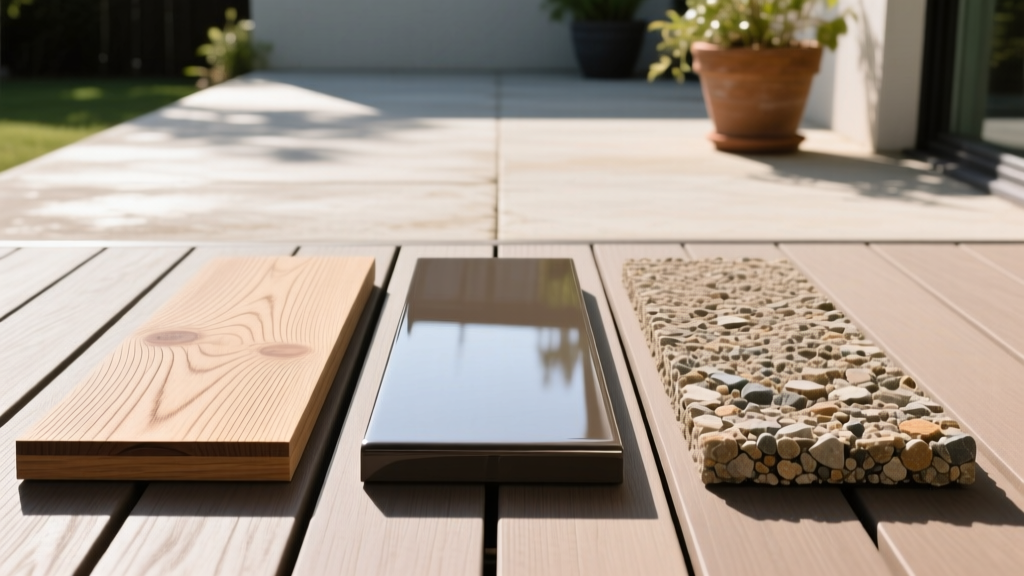
Traditional composite decking material relies on a core blend of wood flour (sawdust) and recycled polyethylene (PE) or high-density polyethylene (HDPE), wrapped in a protective polymer cap. Premium lines like Trex Transcend Lineage and TimberTech Legacy use a multi-layered co-extruded cap that includes UV inhibitors and scratch-resistant metallic oxides. The primary vulnerability of WPC is the exposed core at the cut ends. If water infiltrates the uncapped ends, the wood flour can swell, leading to 'mushrooming' at the edges. Installers must seal end cuts with specialized end-cap wax or proprietary sealants in ground-contact or high-humidity applications.
Mineral-Based Composite (MBC)
Pioneered by brands like Deckorators, MBC replaces the wood flour in the core with calcium carbonate and other advanced minerals. This structural shift eliminates organic matter entirely. Because there is no wood fiber, MBC exhibits virtually zero moisture absorption and negligible thermal expansion. This allows certain MBC profiles to span 24 inches OC on straight joist layouts, compared to the 16-inch OC requirement for most WPC and PVC boards, directly reducing framing lumber costs.
Capped Polymer (PVC)
PVC boards, such as TimberTech Advanced PVC (formerly AZEK), contain no wood or mineral fillers. The core is a cellular PVC foam, making the boards exceptionally light—roughly 30% lighter than WPC. However, cellular PVC is highly susceptible to thermal expansion and contraction. A 20-foot PVC board can expand or contract up to 1/8 inch for every 10°F change in temperature. Installers must strictly follow manufacturer guidelines for gap spacing and use specialized crush-blocks at butt joints to prevent buckling during summer heat spikes.
Head-to-Head Performance Matrix
| Feature | Capped WPC | Mineral-Based (MBC) | Capped PVC | Pressure-Treated Wood |
|---|---|---|---|---|
| Avg. Material Cost (per sq. ft.) | $6.50 - $9.50 | $7.50 - $10.50 | $9.00 - $13.00 | $2.50 - $4.00 |
| Moisture Absorption | Low (Core vulnerable at cuts) | Near Zero | Zero | High (Requires sealing) |
| Thermal Expansion (per 10°F) | ~1/32 inch | Negligible | ~1/8 inch | Minimal (Swells with moisture) |
| Max Straight Joist Span | 16 inches OC | 24 inches OC (Select lines) | 16 inches OC | 16 inches OC |
| Weight (per 16ft board) | ~65 lbs | ~50 lbs | ~35 lbs | ~45 lbs |
True Cost of Ownership: Material, Framing, and Labor
Evaluating the price of a composite decking material requires looking beyond the per-square-foot board cost. The structural framing and labor requirements drastically alter the final budget.
- Framing Adjustments: WPC boards are dense and heavy. If you are building a diagonal pattern (45-degree angle), standard 16-inch OC joist spacing must be reduced to 12-inch OC to prevent sagging. This increases pressure-treated framing lumber costs by approximately 15-20%. Conversely, utilizing an MBC product that permits 24-inch OC spacing on straight layouts can reduce joist material and labor by up to 30%.
- Fastener Systems: Hidden fastener systems (like Trex Hideaway or Tiger Claw) add $1.50 to $2.50 per square foot to the material budget. However, they are mandatory for grooved composite boards to maintain warranty compliance and prevent surface screw pops caused by thermal movement.
- Labor Premiums: Composite and PVC installations require specialized carbide-tipped saw blades with fewer teeth (typically 30 to 40 teeth) to prevent the plastic cap from melting and fusing back together during cuts. Expect contractor labor rates for composite installations to run 20% to 35% higher than standard wood decking due to the precision required for hidden fasteners and expansion gapping.
Installation Edge Cases and Structural Gotchas
Even experienced carpenters make critical errors when transitioning from wood to synthetic materials. The North American Decking and Railing Association (NADRA) frequently highlights improper gapping and fastening as the primary causes of synthetic deck failure.
"The most common failure in PVC and WPC decking is not the board itself, but the installer treating it like wood. Failing to account for longitudinal thermal expansion in PVC, or driving face screws too close to the board ends without pre-drilling, will cause micro-fractures in the polymer cap that lead to delamination within three years."
Static Electricity in PVC: Cellular PVC boards are notorious for generating static charges, particularly in dry, low-humidity climates. This can result in uncomfortable shocks for homeowners and pets. To mitigate this, installers must ground the deck structure using copper grounding wire woven through the aluminum joists or apply specialized anti-static coatings post-installation.
Heat Retention and Barefoot Comfort: Darker composite decking materials absorb significant solar radiation. On a 95°F day, a dark walnut WPC board can reach surface temperatures of 155°F, making it unwalkable barefoot. If building an unshaded pool deck, specify light-colored, PVC-capped boards or mineral-based composites with proprietary heat-reflective pigment technology (such as TimberTech's CoolDeck or MoistureShield's CoolDeck), which can reduce surface temperatures by up to 35%.
Wildfire (WUI) and Code Compliance Considerations
For homes located in Wildland-Urban Interface (WUI) zones, building codes strictly regulate exterior combustible materials. Standard WPC boards contain wood flour and polyethylene, both of which are highly combustible and generally fail WUI testing. If you are building in California, Colorado, or other fire-prone regions, you must verify the specific product's inclusion on the approved materials list. The California Office of the State Fire Marshal maintains a public WUI Products directory that explicitly lists approved decking assemblies. In many WUI zones, only heavy timber, specific fire-retardant-treated wood, or specialized non-combustible mineral/aluminum decking systems are permitted.
Final Verdict: Matching Material to Microclimate
There is no universal 'best' composite decking material; there is only the correct material for your specific structural and environmental parameters. Review the manufacturer installation guidelines meticulously before purchasing. If your project involves ground-level docks, high moisture, or strict dimensional stability requirements, mineral-based composite is the superior engineering choice. For elevated, complex structures where weight is a primary concern, capped PVC offers the best strength-to-weight ratio, provided you engineer the framing to accommodate its thermal expansion. For standard residential backyards with traditional framing, high-end capped WPC remains the most cost-effective balance of aesthetics, durability, and lifecycle value.
Written by
Sarah WhitfieldSarah Whitfield is a chartered quantity surveyor (MRICS) and construction cost analyst with 15 years of experience in material pricing, procurement strategy, and project budgeting. She earned her degree in Construction Management from the University of Reading (UK) and has worked on projects ranging from $2M custom homes to $180M mixed-use developments across North America and Europe. Sarah currently leads cost estimating for BuildMat Insight, maintaining a proprietary database of 4,000+ material price points updated quarterly. She is a frequent contributor to RSMeans cost data panels and has presented at the International Cost Engineering Council (ICEC) congress. Based in Denver, CO, Sarah is an avid trail runner and volunteer mentor for Women in Construction.
More from Sarah Whitfield
View all
Wood & Lumber
What Are the Different Types of Wood? A Builder's Guide
Compare structural softwoods, finish hardwoods, and engineered lumber. Analyze Janka ratings, MOE values, and 2026 pricing for construction.
Aug 4, 2026

Walls & Panels
Steel Framing vs Wood Framing: Corrosion and Moisture Defense
Compare steel framing vs wood framing for moisture resistance. Learn about galvanized coatings, condensation risks, and corrosion protection strategies.
Jul 21, 2026

Stone & Masonry
How to Cut Stone Veneer: Wet Saw vs Grinder Comparison
Compare the best tools for cutting stone veneer. We review wet saws, angle grinders, and chop saws to help you achieve clean, chip-free cuts.
Jul 21, 2026