Cost to Build a Trex Deck: 2026 Planning & Budget Guide
Plan your budget accurately with our 2026 guide to the cost to build a Trex deck. Breakdowns of material tiers, substructure, and hidden design costs.
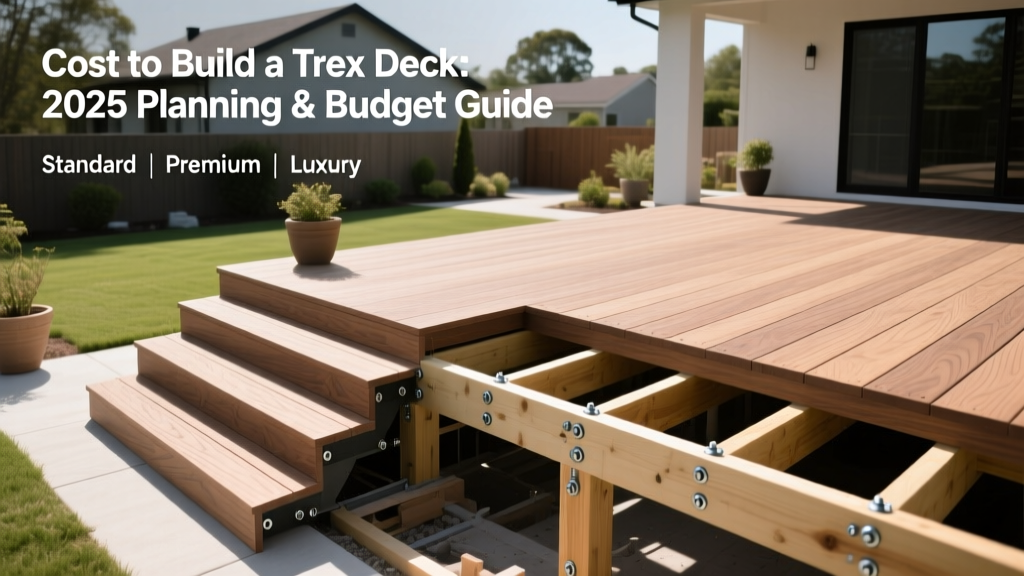
The Financial Reality of Trex Deck Planning
Calculating the true cost to build a Trex deck requires moving beyond simple square-footage multipliers. While basic material estimates often cite $10 to $15 per square foot, the reality of a fully engineered, code-compliant composite deck in 2026 pushes the total installed cost to between $30 and $65 per square foot. The variance depends entirely on your design complexity, substructure choices, and the specific Trex product tier you select.
Composite decking represents a significant upfront capital expenditure compared to pressure-treated pine, but it eliminates annual sealing and staining costs. According to Angi's deck construction cost data, homeowners who opt for premium composite materials typically recoup 60% to 70% of the project cost in added property value, while saving an average of $450 annually on maintenance. To plan effectively, you must deconstruct the budget into material tiers, structural requirements, and design-driven labor premiums.
Quick Budget Baseline (Per Square Foot)
- Entry-Level (Trex Enhance): $28 - $38 installed
- Mid-Tier (Trex Select): $35 - $45 installed
- Premium (Trex Transcend): $42 - $55 installed
- Ultra-Premium (Transcend Lineage): $50 - $65+ installed
Note: These ranges assume a standard single-level, ground-to-deck height of under 4 feet, with a pressure-treated wood substructure.
2026 Trex Product Line Cost Matrix
Trex segments its official decking lines into distinct tiers, each with varying cap thicknesses, scratch resistance, and aesthetic depth. When budgeting, you must account for the decking boards, the hidden fastening system, and the fascia boards required to cover the rim joists.
| Product Line | Board Cost (per sq ft) | Fastener Cost | Total Material Cost | Best Use Case |
|---|---|---|---|---|
| Enhance Basics/Naturals | $6.50 - $8.00 | $1.20 / sq ft | $9.50 - $11.50 | Budget-conscious builds, simple layouts |
| Select | $8.50 - $10.50 | $1.20 / sq ft | $11.50 - $14.00 | High-traffic areas, superior stain resistance |
| Transcend | $11.00 - $13.50 | $1.50 / sq ft | $14.50 - $18.00 | Luxury homes, deep wood-grain aesthetics |
| Transcend Lineage | $14.00 - $17.00 | $1.50 / sq ft | $18.00 - $22.00 | Full sun exposure (heat-mitigating tech) |
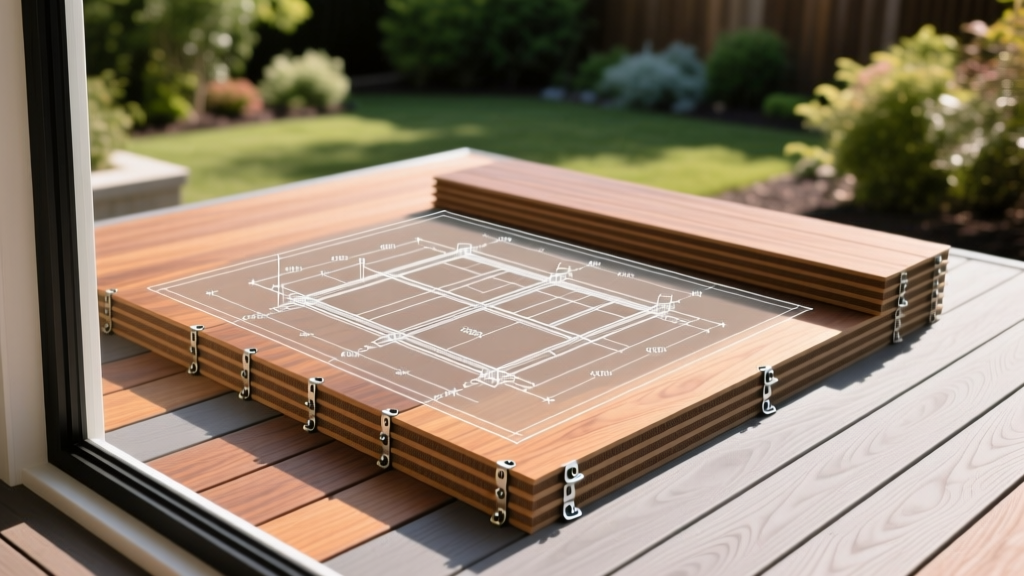
Design Variables That Dictate Your Final Budget
The most common planning error is assuming a 400-square-foot deck will simply cost 400 times the square-foot rate. Architectural design choices trigger exponential increases in both material waste and specialized labor.
Diagonal vs. Straight Lay Patterns
Laying composite boards diagonally (at a 45-degree angle) creates a premium visual effect, but it fundamentally alters your structural requirements. According to North American Decking and Railing Association (NADRA) guidelines and Trex engineering specs, diagonal installations require joists to be spaced at 12 inches on-center (OC) rather than the standard 16 inches OC. This increases your substructure lumber costs by roughly 30% and generates 15% to 20% more composite waste due to angled off-cuts.
Picture Framing and Fascia Detailing
Picture framing involves running a perimeter border of boards parallel to the deck edge, which hides the end-grain of the field boards. This design requires:
- Additional blocking (cross-joists) beneath every seam to support the border boards.
- Mitered corner cuts, which demand high-precision saws and increase installation time by 15-20 hours for an average-sized deck.
- Purchase of dedicated Trex fascia boards (typically $35-$45 per 12-foot length) to wrap the rim joists, as standard decking boards are not rated for vertical fascia installation.
Curves and Radii
Composite decking cannot be cold-bent like PVC or aluminum. To achieve curved deck edges or radius stairs, contractors must use specialized heat blankets to soften the Trex boards and clamp them to custom-built jigs. Expect labor rates for curved composite work to be 50% to 80% higher than straight runs, with a minimum add-on of $1,500 to $3,000 for the jig fabrication and heating process alone.
Substructure and Framing: Where Budgets Fail
Homeowners often fixate on the composite surface and neglect the framing beneath. A Trex deck will easily outlast a standard pressure-treated pine substructure, leading to a catastrophic failure where the $15,000 surface collapses on a $4,000 rotting frame.
Warning: The Joist Tape Mandate
If you use a traditional pressure-treated wood substructure, applying butyl flashing tape (such as Trex Protect) to the top of every joist is non-negotiable. The tape prevents moisture from pooling between the composite board and the wood joist, which is the primary cause of premature joist rot. Budget approximately $0.60 to $0.85 per linear foot for high-quality butyl tape. For a 400 sq ft deck, this adds $250-$400 to your material costs but protects the structural integrity for decades.
For planners seeking a true 'lifetime' deck, upgrading to a light-gauge galvanized steel framing system (like Trex Elevate) adds $8 to $12 per square foot to the total project cost. Steel framing allows for wider joist spacing (up to 24 inches OC for some composite profiles), which partially offsets the higher material cost by reducing the total number of joists and footings required.
Permitting, Engineering, and Site Prep
The cost to build a Trex deck extends into the dirt before a single board is laid. Municipal building departments require permits for any deck attached to a home or elevated more than 30 inches above grade. Permit fees typically range from $150 to $600, but the associated site prep can be far more expensive.
If your local building inspector requires a geotechnical soil test due to expansive clay or poor load-bearing capacity, you may be forced to abandon standard poured concrete sonotubes in favor of helical piers. Helical piers are steel shafts screwed deep into the earth to reach stable bedrock or load-bearing strata. While a standard concrete footing might cost $150 to $250 to pour, a professionally installed helical pier system costs $350 to $600 per pier. For a deck requiring 12 footings, this single site-condition variable can add $3,000 to your baseline budget.
Pre-Construction Budgeting Checklist
Use this framework to finalize your design and lock in accurate contractor bids:
- Define the Load Path: Determine if your deck will hold a hot tub or heavy outdoor kitchen. If so, upgrade from 2x8 to 2x10 or 2x12 joists and decrease spacing to 12 inches OC, regardless of the decking brand's minimum span requirements.
- Calculate Fastener Volume: Trex Hideaway hidden fasteners are sold in buckets covering 50 square feet (approx. $75-$85 per bucket). Always order 10% extra to account for broken clips and starter-clip requirements along the perimeter.
- Factor in Railing Premiums: Trex composite railing systems (like Transcend or Select) cost between $45 and $85 per linear foot. If your deck design includes multiple angles or stair runs, the railing cost can easily equal 30% of your total decking surface cost.
- Verify Contractor Certification: Only hire contractors listed in the TrexPro network. Using an uncertified builder who fails to follow the manufacturer's gapping and fastening guidelines will instantly void the 25-year limited warranty.
Accurately forecasting the cost to build a Trex deck requires treating the project as a holistic structural system rather than a simple surface upgrade. By mapping out your substructure needs, accounting for design-driven labor premiums, and selecting the precise material tier for your climate and usage, you can finalize a budget that withstands both the elements and the realities of modern construction pricing.
Written by
Marcus ChenMarcus Chen is a licensed structural engineer (PE) and building materials analyst with over 12 years of experience across residential, commercial, and industrial construction. He holds a Master of Science in Civil Engineering from UC Berkeley and spent six years at Thornton Tomasetti before transitioning to independent consulting and technical writing. Marcus specializes in material selection for seismic-prone regions, concrete reinforcement strategies, and lifecycle cost analysis. His work has been cited by the American Concrete Institute (ACI) and the Structural Engineers Association of California (SEAOC). When he is not on a job site or at his desk, you will find him hiking the Sierra Nevada or restoring a 1920s craftsman bungalow in Oakland, CA.
More from Marcus Chen
View all
Construction Cost
How Much Did the Eiffel Tower Cost to Build?
How much did the Eiffel Tower cost to build in 1889? We adjust for inflation and compare its budget to modern skyscraper construction.
Aug 4, 2026

Fire Resistance
What Is a Fire Resistant Material? Testing & Certification Guide
Discover what is a fire resistant material through ASTM and UL testing. Learn how fire ratings, certifications, and assemblies work in construction.
Aug 4, 2026

Construction Cost
How Much Did the Burj Khalifa Cost to Build?
How much did the Burj Khalifa cost to build? We break down the $1.5B project and extract 5 money-saving strategies for your next build.
Jul 30, 2026