Best Deck Materials Options for 2026: Wood, Composite & PVC
Compare the top deck materials options for 2026. We break down costs, lifespans, and maintenance for pressure-treated wood, composite, and PVC decking.

The 2026 Decking Landscape: Beyond Basic Pressure-Treated Lumber
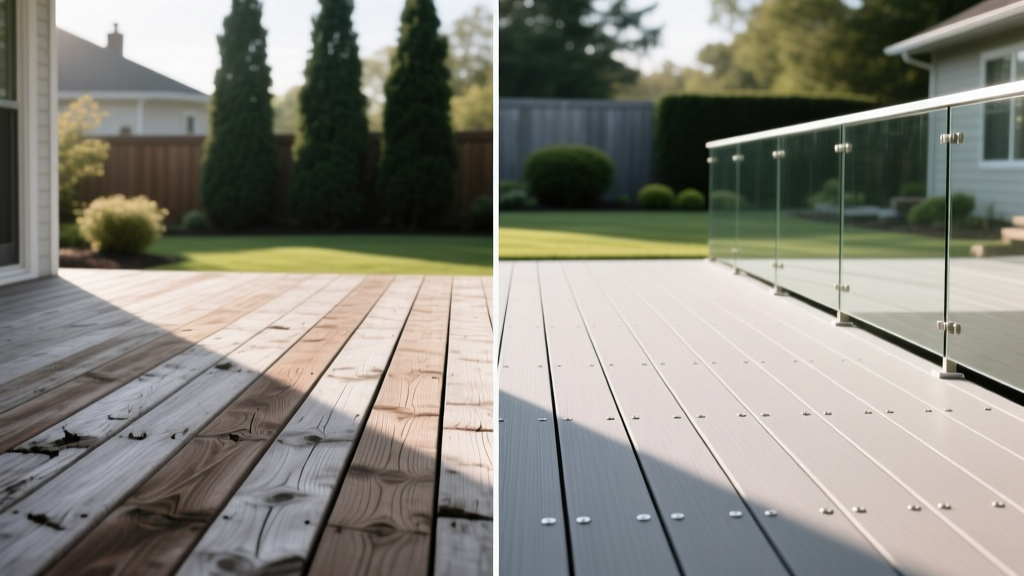
When evaluating deck materials options for a new build or renovation, the decision extends far beyond initial material costs. The modern decking market has fractured into three distinct tiers: chemically treated softwoods, capped wood-plastic composites, and advanced cellular PVC. Each category possesses unique structural properties, thermal expansion coefficients, and lifecycle maintenance requirements. Choosing the wrong material for your specific climate and usage pattern can result in premature failure, such as joist rot, board cupping, or excessive thermal expansion.
• Pressure-Treated Pine: $3.50 - $5.50
• Capped Composite: $8.50 - $11.50
• Advanced Cellular PVC: $11.00 - $14.50
Pressure-Treated Wood: The Budget Baseline
Pressure-treated Southern Yellow Pine (SYP) remains the most common entry-point for deck framing and decking. However, the chemical treatments have evolved. Older ACQ (Alkaline Copper Quaternary) treatments were highly corrosive to standard aluminum flashing and galvanized hardware. Today, the industry standard is MCA-C (Micronized Copper Azole), which is significantly less corrosive but still requires hot-dipped galvanized or stainless steel fasteners.
Real-World Performance & Failure Modes
The primary failure mode for pressure-treated decking is dimensional instability. As the wood dries and undergoes seasonal moisture cycling, it is prone to checking (surface cracking), cupping, and twisting. According to research from the USDA Forest Products Laboratory, wood in ground-contact or poorly ventilated deck assemblies is highly susceptible to fungal decay if moisture content consistently exceeds 20%.
- Pros: Lowest upfront cost; readily available; structural framing can double as decking material; easily cut and routed on-site.
- Cons: Requires annual or bi-annual sealing ($1.50 - $2.50 per sq. ft.); high risk of splintering over time; prone to warping if not properly kiln-dried after treatment (KDAT).
2026 Pricing & Lifecycle Costs
While the material cost sits at $3.50 to $5.50 per square foot, the 10-year lifecycle cost narrows the gap with composite options. Factoring in bi-annual power washing, sanding, and application of a high-quality penetrating oil sealer (such as Armstrong Clark or TWP 100 series), the maintenance adds roughly $1.25 per square foot annually over a 15-year lifespan.
Capped Wood-Composite: The Market Dominator
Capped composite decking combines a core of recycled wood fibers and high-density polyethylene (HDPE) with a protective polymer shell. This category dominates the mid-to-high-end residential market. When reviewing composite deck materials options, the critical distinction lies in the capping technology: 3-sided versus 4-sided caps.
Capping Technology: 3-Sided vs. 4-Sided
Early composites were uncapped, leading to severe mold and mildew infiltration in the porous wood-fiber core. Modern boards feature a co-extruded polymer cap.
- 3-Sided Caps: Leave the bottom exposed to allow moisture escape. Ideal for low-clearance decks where airflow is restricted, preventing trapped moisture from causing the core to swell and delaminate.
- 4-Sided Caps: Fully encase the board. Superior for stain and scratch resistance but require strict adherence to manufacturer joist spacing (usually 16 inches on-center maximum) to prevent sagging, as the rigid cap can mask core deflection until failure occurs.
Top Tier Models: Trex Transcend Lineage vs. TimberTech Prime+
Trex Transcend Lineage ($10.50 - $11.50/sq ft) utilizes a heat-mitigating technology in its polymer cap that reflects UV radiation, keeping the surface up to 30°F cooler than traditional dark composites. TimberTech Prime+ Collection ($8.50 - $9.50/sq ft) features a scalloped bottom profile, which reduces material weight, improves airflow, and lowers the overall carbon footprint of the board, though it sacrifices some structural rigidity compared to solid-core alternatives.
Composite boards expand and contract primarily along their length. Under ASTM D7032 testing standards (ASTM International), composite decking can expand up to 1/8 inch per 10 linear feet across a 50°F temperature swing. Always leave a 1/4-inch gap at board ends and use slotted hidden fasteners to allow for this movement. Butt-jointing composite boards end-to-end will result in buckling during peak summer heat.
Advanced PVC Decking: The Zero-Maintenance Premium
Cellular PVC decking contains no wood fibers, making it entirely impervious to rot, mold, and insect damage. It is the undisputed choice for coastal builds, saltwater environments, and ground-level or dock applications where moisture is constant.
Heat Retention & Expansion Challenges
The trade-off for zero moisture absorption is thermal volatility. PVC has a higher coefficient of linear thermal expansion than composite—often reaching 3/16 inch per 10 feet. Installers must use specialized fastening systems, such as the Cortex PVC hidden fastener system, which allows the board to slide laterally across the joist.
Furthermore, PVC retains heat. Dark-colored PVC boards (like AZEK Landmark in 'Hawaiian Charcoal') can reach surface temperatures of 150°F to 160°F in direct 90° sunlight, making them uncomfortable for bare feet. If your deck lacks a pergola or awning, stick to light-colored PVC options like 'Coastal Bluff' or 'French Oak'.
AZEK Landmark vs. Wolf Serenity
AZEK Landmark ($12.50 - $14.50/sq ft) uses proprietary Alloy Armour Technology, a multi-layered polymer blend that significantly improves impact resistance and color retention compared to first-generation PVC. Wolf Serenity ($11.00 - $12.50/sq ft) offers a highly realistic wood-grain embossing and a solid-core feel, though its surface cap is slightly more prone to scuffing during the installation process.
Head-to-Head Comparison Matrix
| Feature | Pressure-Treated Pine | Capped Composite | Advanced Cellular PVC |
|---|---|---|---|
| Material Cost (Sq. Ft.) | $3.50 - $5.50 | $8.50 - $11.50 | $11.00 - $14.50 |
| Lifespan | 10 - 15 Years | 25 - 30 Years | 30 - 50+ Years |
| Maintenance | High (Annual Sealing) | Low (Soap & Water) | Zero (Rinse Only) |
| Moisture Resistance | Low (Absorbs Water) | High (Core Protected) | Absolute (Impervious) |
| Thermal Expansion | Minimal | Moderate (1/8" / 10ft) | High (3/16" / 10ft) |
| Best Application | Budget Builds, Framing | Standard Residential | Coastal, Docks, Ground-Level |
The Hidden Costs: Framing, Fasteners, and Labor
Comparing deck materials options solely on the price of the deck boards leads to severe budget miscalculations. The substructure and fastening systems drastically alter the final invoice.
- Joist Protection Tape: When installing composite or PVC over pressure-treated pine joists, the decking will outlast the joists by decades. Applying a butyl-based flashing tape (like Trex Protect or G-Tape) to the top of every joist costs roughly $0.60 per linear foot but prevents water intrusion and joist rot. This is non-negotiable for modern builds.
- Fastening Systems: Face-screwing composite boards with standard deck screws creates entry points for moisture and ruins the aesthetic. Using a hidden fastener system (such as Simpson Strong-Tie CB44 or TimberTech CONCEALoc) adds $1.50 to $2.25 per square foot to the material cost but provides a clean, splinter-free surface.
- Labor Differentials: While wood is fast to cut and nail, composite and PVC require specialized carbide-tipped blades to prevent melting the polymer edges. Furthermore, routing grooves into composite boards for hidden fasteners adds labor time. Expect contractor installation rates for composite/PVC to be 15% to 25% higher than for wood.
Decision Framework: Which Option Fits Your Build?
Use this practical framework to finalize your material selection based on your specific site conditions and financial goals:
- Your total project budget is strictly capped under $15 per square foot installed.
- You are building the structural framing and want a uniform material palette.
- You do not mind dedicating a weekend every two years to sanding and sealing.
- You want the highest return on investment (ROI) at resale, as composite decks consistently recoup 60-70% of their cost according to recent remodeling impact reports.
- The deck is elevated with adequate cross-ventilation underneath.
- You desire realistic wood-grain textures without the lifecycle maintenance of natural timber.
- The deck is located within 1 mile of a saltwater coastline.
- You are building a low-clearance or ground-level deck where soil moisture and poor airflow would destroy wood or uncapped composites.
- You are integrating the deck around a pool where constant chlorine splashing will degrade wood fibers.
"The most expensive deck is the one you have to rebuild in eight years because you paired a premium PVC surface with untreated pine joists in a high-moisture environment. Always design the substructure to match the lifespan of your decking material."
Written by
Sarah WhitfieldSarah Whitfield is a chartered quantity surveyor (MRICS) and construction cost analyst with 15 years of experience in material pricing, procurement strategy, and project budgeting. She earned her degree in Construction Management from the University of Reading (UK) and has worked on projects ranging from $2M custom homes to $180M mixed-use developments across North America and Europe. Sarah currently leads cost estimating for BuildMat Insight, maintaining a proprietary database of 4,000+ material price points updated quarterly. She is a frequent contributor to RSMeans cost data panels and has presented at the International Cost Engineering Council (ICEC) congress. Based in Denver, CO, Sarah is an avid trail runner and volunteer mentor for Women in Construction.
More from Sarah Whitfield
View all
Wood & Lumber
What Are the Different Types of Wood? A Builder's Guide
Compare structural softwoods, finish hardwoods, and engineered lumber. Analyze Janka ratings, MOE values, and 2026 pricing for construction.
Aug 4, 2026

Walls & Panels
Steel Framing vs Wood Framing: Corrosion and Moisture Defense
Compare steel framing vs wood framing for moisture resistance. Learn about galvanized coatings, condensation risks, and corrosion protection strategies.
Jul 21, 2026

Stone & Masonry
How to Cut Stone Veneer: Wet Saw vs Grinder Comparison
Compare the best tools for cutting stone veneer. We review wet saws, angle grinders, and chop saws to help you achieve clean, chip-free cuts.
Jul 21, 2026