How Much Will It Cost to Build a Deck in 2026? (Lifespan vs Price)
Discover how much it will cost to build a deck in 2026. We compare upfront material pricing against lifespan and long-term ROI for wood, composite, and PVC.

The True Cost Equation: Upfront Price vs. Lifetime Value
When evaluating how much will it cost to build a deck, most homeowners fixate on the initial contractor invoice. In 2026, a standard 200-square-foot deck ranges from $5,400 for basic pressure-treated pine to $19,600 for premium PVC with aluminum framing. However, measuring cost solely by the initial build price is a fundamental financial error in outdoor construction. The true metric for evaluating decking materials is the Cost Per Year of Service (CPYS).
A deck is a long-term structural asset exposed to UV radiation, freeze-thaw cycles, and biological decay. A cheaper wood deck that requires $800 in annual maintenance and rots in 12 years ultimately costs significantly more per year than a capped composite deck that lasts 35 years with zero structural maintenance. To make an informed decision, we must map the 2026 material costs directly against their verified lifespans and long-term durability profiles.
2026 Decking Material Cost & Lifespan Matrix
The following matrix breaks down current installed costs (materials, substructure, and labor) alongside the expected functional lifespan of the deck boards. Note that these lifespans assume proper installation, including adequate ventilation and hidden fastener systems that prevent moisture trapping.
| Material Tier | Specific Product Examples (2026) | Installed Cost (per sq. ft.) | Expected Board Lifespan | Cost Per Year of Service |
|---|---|---|---|---|
| Pressure-Treated Pine | Standard SYP (Southern Yellow Pine) | $27 - $36 | 10 - 15 Years | $2.16 - $2.40 |
| Cedar / Redwood | Clear Western Red Cedar | $42 - $58 | 15 - 20 Years | $2.33 - $2.80 |
| Capped Composite | Trex Transcend Lineage, TimberTech Pro | $65 - $85 | 25 - 30 Years | $2.40 - $2.83 |
| Premium PVC | AZEK Vintage, Wolf Serenity | $88 - $115 | 35 - 50+ Years | $2.17 - $2.51 |
Note: The Cost Per Year of Service calculation factors in the initial board cost divided by the median lifespan, excluding substructure replacement and routine maintenance, which are detailed below.
The Hidden Financial Drain of Short-Lived Decks
The raw material cost is only half the financial story. The durability of your chosen material dictates a compounding schedule of maintenance and eventual replacement costs that drastically alter the real-world answer to how much it will cost to build a deck over its lifetime.
Maintenance Compounding Over 20 Years
Wood decking (pine, cedar, and redwood) is highly porous. To prevent UV graying, splintering, and moisture intrusion, wood requires penetrating oil or solid acrylic stains. In 2026, professional deck staining costs between $3.50 and $5.50 per square foot. For a 200-square-foot deck, a single staining event costs roughly $900. Because wood requires refinishing every 2 to 3 years, a 20-year lifecycle demands at least seven staining cycles. This adds $6,300 in mandatory maintenance to the initial build cost. Capped composites and PVC, by contrast, require only occasional soap-and-water cleaning, reducing 20-year maintenance costs to near zero.
Biological Failure Modes and Edge Cases
Wood decks rarely fail from simple old age; they fail from specific biological and mechanical edge cases. The most common failure point in wood decking is the end-grain. When deck boards are cut during installation, the exposed end-grain acts like a bundle of microscopic straws, wicking moisture directly into the board's core. Without specialized end-grain sealer (like TimberSaver), this leads to localized cupping, checking, and eventual fungal decay. According to the USDA Forest Products Laboratory, moisture content fluctuations above 20% in wood consistently trigger brown rot fungi, drastically shortening the deck's structural integrity.
Maximizing Substructure Lifespan: The Unsung Hero
A critical mistake homeowners make when calculating deck costs is focusing entirely on the surface boards while ignoring the substructure. Putting a 30-year PVC deck board on a 12-year pressure-treated pine joist system guarantees a catastrophic financial bottleneck when the joists rot out from the inside.
If you are using traditional pressure-treated wood framing, you must apply a high-quality butyl joist tape (such as G-Tape or Trex Protect) to the top of every joist and beam before laying the deck boards. This creates a waterproof barrier over the screw holes and prevents water from pooling on the joist tops, effectively extending the substructure lifespan from 15 years to 25+ years.
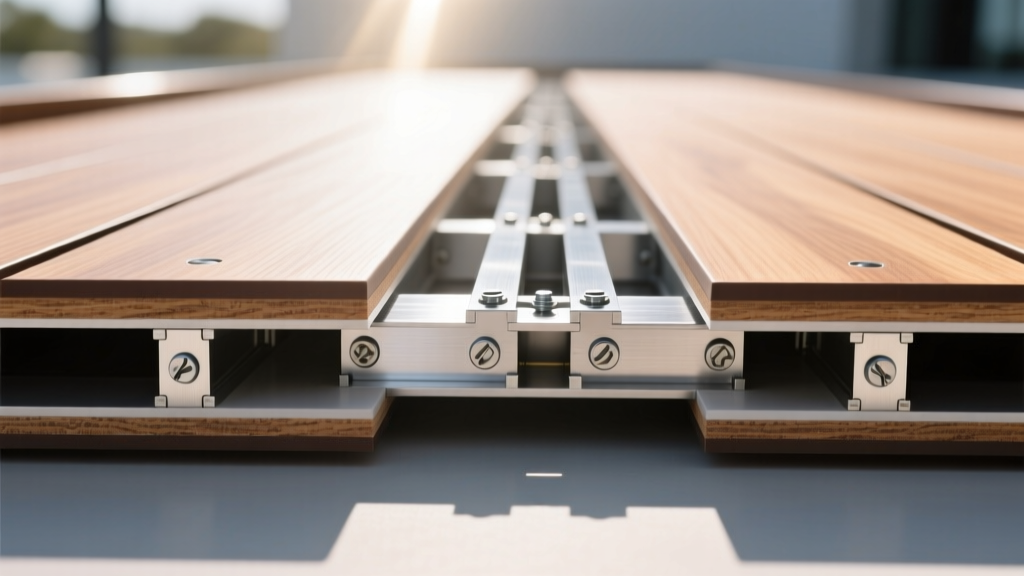
For homeowners seeking true parity between surface and substructure lifespans, light-gauge steel or aluminum framing systems (like Trex Elevations or Deckorators Structural Aluminum) are the 2026 standard for premium builds. While aluminum framing adds roughly $14 to $22 per square foot to the initial build cost, it is entirely impervious to rot, warping, and insect damage, easily matching the 50-year lifespan of premium PVC decking.
Durability Decision Framework: Which Material Fits Your Timeline?
Selecting the right material requires aligning the deck's durability with your personal timeline for the property. Use this framework to guide your investment:
- The 5-to-10 Year Horizon (Selling Soon): Opt for Pressure-Treated Pine or Cedar. According to Remodeling Magazine's Cost vs. Value data, wood deck additions consistently yield a high return on investment at resale (often recouping 70-80% of costs). You avoid the premium upfront cost of composites, as the next homeowner will inherit the maintenance cycle.
- The 15-to-20 Year Horizon (Mid-Term Ownership): Choose Capped Composite. The mid-tier composite lines offer excellent UV resistance and fade warranties. The break-even point where composite becomes cheaper than wood (factoring in maintenance) usually occurs around year 8. By year 15, the composite deck has paid for its initial premium.
- The 30+ Year Horizon (Forever Home): Invest in Premium PVC and Aluminum Framing. If you never want to sand, stain, or replace a splintered board again, cellular PVC combined with a rust-proof metal substructure is the ultimate 'build it and forget it' solution. The American Wood Council notes that while alternative materials have higher embodied energy, their extreme longevity eliminates the recurring harvesting and chemical treatment impacts of wood replacements.
Frequently Asked Questions
Does a more expensive deck material always guarantee a longer lifespan?
Not necessarily. The lifespan of any decking material is dictated more by installation quality than raw material cost. A premium PVC deck installed with inadequate ground clearance (less than 12 inches of ventilated air space) or with face-screws that puncture the protective polymer cap will suffer from trapped moisture and premature degradation. Proper hidden fastener systems and adherence to manufacturer spacing guidelines are non-negotiable for maximizing lifespan.
How does climate affect the cost-to-lifespan ratio?
Climate drastically shifts the durability math. In high-moisture, coastal, or heavy-snow regions, wood decking lifespans can be reduced by up to 40% due to constant wet-dry cycling and salt exposure. In these environments, the CPYS of wood spikes dramatically, making capped composites and PVC vastly superior financial choices. Conversely, in arid, low-humidity desert climates, wood decking can last significantly longer with minimal rot risk, though UV degradation and thermal expansion remain persistent challenges for both wood and uncapped composites.
Are there any hidden costs associated with composite or PVC decking?
Yes. While surface maintenance is negligible, composite and PVC boards expand and contract significantly with temperature changes compared to wood. This requires specialized hidden fastener clips that allow for lateral movement, which are more expensive than standard deck screws. Additionally, if a board is damaged, composite and PVC colors can fade slightly over a decade, meaning a single replacement board might not perfectly match the rest of the deck, sometimes necessitating a multi-board swap to maintain visual uniformity.
Written by
Elena RodriguezElena Rodriguez is a civil engineer and technical writer specializing in concrete technology, masonry systems, and ASTM/ACI compliance. She earned her B.S. in Civil Engineering from Texas A&M University and spent a decade at a materials testing laboratory, performing over 2,000 concrete compressive strength tests and masonry prism evaluations. Elena is an ACI-certified Field Testing Technician (Grade I) and a member of ASTM Committee C12 on Natural Building Stone. She currently consults on forensic engineering cases involving concrete failures and moisture intrusion. Based in San Antonio, TX, Elena is a proud member of the Society of Women Engineers (SWE) and coaches her daughter's FIRST Robotics team.
More from Elena Rodriguez
View all
Walls & Panels
Cost Analysis: Light Gauge Steel Framing Advantages and Disadvantages
Evaluate light gauge steel framing advantages and disadvantages through a strict cost analysis lens, comparing material, labor, and lifecycle expenses.
Aug 4, 2026

Walls & Panels
Gypsum Board Types: Exact Specifications, Thickness & Dimensions
Compare standard, Type X, and moisture-resistant gypsum board types. Get exact specifications, thicknesses, dimensions, and ASTM standards for your project.
Aug 4, 2026

Fire Resistance
Best Fire-Resistant Outdoor Decking Materials: 2026 Buyer Guide
Discover the best fire-resistant outdoor decking materials for 2026. Compare Class A PVC, aluminum, and hardwood options for WUI compliance and safety.
Aug 4, 2026