How Much Does It Cost to Build a Parking Deck? 2026 Durability Guide
Discover how much it costs to build a parking deck in 2026. Compare lifecycle costs, material durability, and structural lifespan for CIP, precast, and steel.

The True Cost of a Parking Deck: Initial vs. Lifecycle Pricing
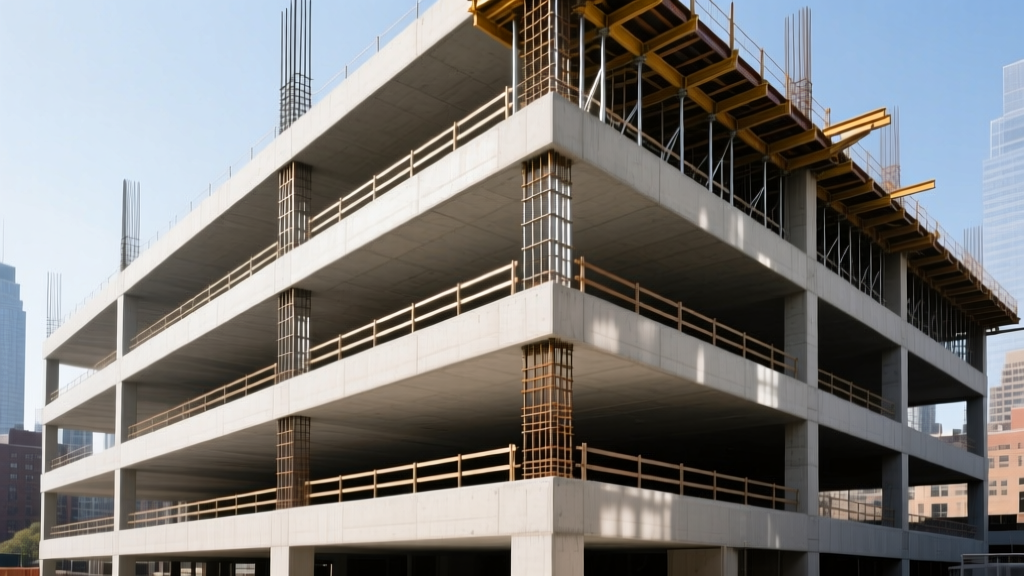
When evaluating how much does it cost to build a parking deck, developers and structural engineers must look far beyond the initial capital expenditure. In 2026, the baseline construction cost for a multi-level parking structure ranges from $25,000 to $45,000 per parking stall, heavily dependent on the structural system, regional labor rates, and site-specific geotechnical conditions. However, a parking deck is a highly aggressive environment. De-icing salts, vehicular exhaust, and thermal cycling subject the structure to severe degradation. Evaluating cost strictly on a per-stall construction basis ignores the 50-year lifecycle maintenance, which can easily double the initial investment if the wrong materials are specified.
This guide breaks down the structural options for parking decks, analyzing their initial costs, expected lifespans, and critical durability failure modes to help you engineer a structure that minimizes long-term capital drain.
Material Breakdown: Durability, Lifespan, and Pricing
Cast-in-Place (CIP) Post-Tensioned Concrete
Cast-in-place post-tensioned (PT) concrete remains the dominant structural system for parking decks in North America. By tensioning high-strength steel tendons after the concrete cures, the slab is placed in compression, which inherently limits crack widths and restricts the ingress of water and chloride ions.
- Initial Cost: $25,000 – $32,000 per stall.
- Expected Lifespan: 50 to 75+ years.
- Durability Profile: Excellent, provided the concrete cover over the PT tendons is strictly maintained. The primary vulnerability is tendon corrosion at the anchorages or where the slab profile dips, bringing the tendons too close to the surface.
Precast Concrete Systems (Double Tees and Hollow Core)
Precast systems utilize off-site manufactured concrete elements, drastically reducing erection time and eliminating the need for extensive on-site formwork. However, the durability of a precast deck relies entirely on the connections and the topping slab.
- Initial Cost: $28,000 – $38,000 per stall.
- Expected Lifespan: 40 to 60 years.
- Durability Profile: Moderate to High. The precast members themselves are highly durable due to controlled factory curing. The failure point is the field-cast joints and sealants. If a structural concrete topping slab is omitted to save costs, the exposed joints will leak, leading to rapid corrosion of the connection hardware and underlying support beams.
Structural Steel Framing
Steel-framed parking decks offer long spans and open sightlines but introduce severe maintenance liabilities in environments where de-icing salts are used. Steel requires a composite concrete topping slab to distribute vehicular loads and protect the beams.
- Initial Cost: $32,000 – $45,000 per stall.
- Expected Lifespan: 30 to 50 years.
- Durability Profile: Low to Moderate. Steel is highly susceptible to chloride-induced corrosion. Furthermore, structural steel requires fireproofing (intumescent paint or cementitious spray), which degrades over time and requires costly reapplication. According to the Association for Materials Protection and Performance (AMPP), corrosion of structural steel in aggressive environments remains one of the highest lifecycle cost drivers in commercial infrastructure.
Structural System Comparison Matrix
| Structural System | Initial Cost (Per Stall) | 50-Year Maintenance Cost | Expected Lifespan | Primary Vulnerability |
|---|---|---|---|---|
| CIP Post-Tensioned | $25k - $32k | Low ($1.5M - $2.5M) | 50 - 75+ Years | PT Tendon Corrosion |
| Precast (with Topping) | $28k - $38k | Medium ($2.5M - $4.0M) | 40 - 60 Years | Joint Sealant Failure |
| Structural Steel | $32k - $45k | High ($4.5M - $7.0M+) | 30 - 50 Years | Beam Corrosion & Fireproofing |
Critical Failure Modes and Engineering Solutions
To maximize the lifespan of a parking deck, engineers must design specifically against known failure mechanisms. The Portland Cement Association emphasizes that concrete durability in aggressive environments relies on minimizing permeability and maximizing protective cover.
1. Chloride Ion Ingress and Rebar Corrosion
When vehicles track in de-icing salts, chloride ions penetrate the concrete matrix. Once the chloride threshold at the depth of the rebar reaches approximately 1.2 to 2.0 lbs per cubic yard of concrete, the passive oxide layer protecting the steel breaks down, initiating rapid corrosion. As the steel rusts, it expands up to six times its original volume, causing the concrete cover to spall and delaminate.
Engineering Solution: Specify a low water-to-cement ratio (w/c) of 0.40 or less for the deck concrete to reduce permeability. Incorporate Migrating Corrosion Inhibitors (MCIs) into the concrete mix design. MCIs vaporize and migrate through the concrete pores, forming a protective monomolecular layer on the embedded steel.
2. Post-Tensioning Tendon Rupture
Unlike standard rebar, a ruptured post-tensioning tendon can cause catastrophic, progressive slab failure. Water infiltration through unsealed cracks or failed pour-back strips can corrode the highly stressed strands.
Engineering Solution: Mandate a minimum of 2.5 inches of concrete cover over the top of the PT tendons at their high points. Specify fully encapsulated, grease-filled, epoxy-coated PT tendons rather than bare strands. Ensure all pour-back strips and blockouts are filled with non-shrink, high-strength grout and sealed with a high-performance polyurethane joint sealant.
Deferring joint sealant replacement is the most common financial error in parking deck ownership. Joint sealants typically have a lifespan of 10 to 15 years. If a $150,000 sealant replacement is deferred, water will infiltrate the substructure. This routinely results in $1.5M+ in structural concrete repairs within five years due to widespread rebar corrosion and spalling.
2026 Material Specifications for Maximum Longevity
When drafting project specifications, rely on established industry standards to ensure material performance. The American Concrete Institute (ACI) provides rigorous frameworks for structural design and durability.
- Concrete Compressive Strength: Specify a minimum of 5,000 psi at 28 days for all exposed deck slabs. For precast double tees, specify 6,000 psi to handle initial handling stresses and long-term deflection.
- Topping Slab Adhesion: If applying a concrete topping over precast planks, require pull-off testing per ASTM C1583 to ensure a minimum tensile strength of 150 psi between the topping and the substrate, preventing delamination under vehicular shear forces.
- Joint Sealants: Do not use standard silicone or cheap urethanes for deck expansion joints. Specify self-leveling, traffic-grade polyurethane sealants tested to ASTM C920 (Type M, Grade P, Class 25 or higher) to withstand continuous vehicular abrasion and thermal expansion.
- Waterproofing Membranes: For below-grade or podium-level parking decks, apply a hot-applied rubberized asphalt membrane (minimum 215 mils thick) over a structural slab, protected by a 2-inch concrete wearing course.
Frequently Asked Questions
Is it cheaper to build a precast or cast-in-place parking deck?
Cast-in-place (CIP) post-tensioned concrete is generally 10% to 15% cheaper in initial construction costs compared to precast systems, primarily because precast requires heavy crane mobilization and transportation logistics. However, precast can be erected 30% faster, which may offset initial costs through reduced construction loan interest and earlier revenue generation.
How often does a concrete parking deck need to be sealed?
Exposed concrete surfaces should be treated with a penetrating silane or siloxane water repellent every 5 to 7 years. Unlike surface coatings that wear away under tire traffic, penetrating sealers react chemically within the concrete pores to create a hydrophobic barrier, significantly slowing chloride ingress without altering the deck's skid resistance.
What is the maximum lifespan of a steel-framed parking garage?
With aggressive, scheduled maintenance—including reapplication of intumescent fireproofing, epoxy injection of concrete topping cracks, and galvanic anode replacement—a steel-framed deck can reach 50 years. In coastal or heavy snow-belt regions, however, the lifecycle cost of maintaining steel often makes it economically unviable compared to concrete alternatives.
Written by
Sarah WhitfieldSarah Whitfield is a chartered quantity surveyor (MRICS) and construction cost analyst with 15 years of experience in material pricing, procurement strategy, and project budgeting. She earned her degree in Construction Management from the University of Reading (UK) and has worked on projects ranging from $2M custom homes to $180M mixed-use developments across North America and Europe. Sarah currently leads cost estimating for BuildMat Insight, maintaining a proprietary database of 4,000+ material price points updated quarterly. She is a frequent contributor to RSMeans cost data panels and has presented at the International Cost Engineering Council (ICEC) congress. Based in Denver, CO, Sarah is an avid trail runner and volunteer mentor for Women in Construction.
More from Sarah Whitfield
View all
Wood & Lumber
What Are the Different Types of Wood? A Builder's Guide
Compare structural softwoods, finish hardwoods, and engineered lumber. Analyze Janka ratings, MOE values, and 2026 pricing for construction.
Aug 4, 2026

Walls & Panels
Steel Framing vs Wood Framing: Corrosion and Moisture Defense
Compare steel framing vs wood framing for moisture resistance. Learn about galvanized coatings, condensation risks, and corrosion protection strategies.
Jul 21, 2026

Stone & Masonry
How to Cut Stone Veneer: Wet Saw vs Grinder Comparison
Compare the best tools for cutting stone veneer. We review wet saws, angle grinders, and chop saws to help you achieve clean, chip-free cuts.
Jul 21, 2026