Durable Deck Building Materials List: Lifespan and Decay Guide
Discover the ultimate deck building materials list focused on durability. Compare lifespans, decay resistance, and costs for wood, composite, and PVC.

The True Cost of Deck Longevity: Lifecycle Analysis
When homeowners request a deck building materials list, they typically focus entirely on the surface boards. However, structural failure data reveals a different reality. According to the National Association of Home Builders (NAHB), the average lifespan of a wood deck is 15 to 20 years, but this is rarely due to the surface boards wearing out. Substructure rot, galvanic corrosion of fasteners, and inadequate flashing account for over 70% of premature deck teardowns. To build a deck that genuinely lasts 30 to 50 years, your materials list must address the entire assembly from the concrete footing to the screw head.
Substructure Framing: The Hidden Lifespan Bottleneck
Your surface decking is only as durable as the joists supporting it. Upgrading the substructure is the single most effective way to extend the life of your outdoor space. As of 2026, light-gauge steel and structural aluminum are becoming standard for high-end, low-maintenance builds.
| Framing Material | Expected Lifespan | Cost per Linear Ft (2026) | Primary Failure Mode |
|---|---|---|---|
| #2 SYP Pressure-Treated (UC4A) | 20–25 years | $1.80 – $2.50 | Warping, twisting, and rot at end-cuts |
| G90 Galvanized Steel Studs | 50+ years | $4.50 – $6.00 | Moisture trapping if top flanges are uncapped |
| 6061-T6 Aluminum Joists | 75+ years | $9.50 – $13.00 | Galvanic corrosion when paired with steel screws |
Surface Decking: Decay Resistance & UV Stability
When selecting the visible layers of your deck, you must balance biological decay resistance with ultraviolet (UV) stability. The USDA Forest Products Laboratory provides extensive data on natural wood durability, but modern manufacturing has introduced engineered alternatives that outperform natural timber in specific microclimates.
Tropical Hardwoods (Ipe and Cumaru)
Ipe (Handroanthus spp.) remains the gold standard for natural decking, boasting a Janka hardness rating of 3,680 lbf and a specific gravity of 1.04. Its natural oils make it virtually impervious to rot and insect infestation. However, Ipe is highly susceptible to UV graying. To maintain its lifespan and structural integrity, end-grains must be sealed immediately during installation with a wax-based sealer like Anchorseal to prevent checking (splitting). Cumaru (Dipteryx odorata) offers a similar lifespan (Janka 3,540 lbf) at roughly 20% less cost, though it exhibits higher tangential shrinkage during seasonal humidity shifts.
Capped Polymer vs. Capped Composite
Not all synthetic boards are created equal. Traditional wood-plastic composites (WPC) feature a wood-flour core that can absorb moisture if the outer cap is scratched or breached, leading to swelling and mold. For maximum durability, specify capped polymer (PVC) boards, such as TimberTech Advanced PVC or AZEK Landmark. PVC contains zero organic wood fibers, resulting in a 0% water absorption rate per ASTM D570 testing standards. This makes PVC the mandatory choice for ground-level decks, pool surrounds, or heavily shaded areas where organic debris accumulates.
Thermally Modified Wood
Thermal modification alters the cellular structure of domestic woods (like Ash or Pine) by baking them in an oxygen-deprived environment at 420°F. This process caramelizes the hemicellulose, removing the sugars that fungi and insects feed on. Brands like Thermory and Kebony achieve Class 1 biological durability (the highest rating, matching tropical hardwoods) without the use of chemical preservatives. Expect a 25- to 30-year lifespan, provided the boards are face-fastened with proper drainage gaps, as thermal wood is slightly more brittle than untreated timber.
Fasteners and Hardware: The Galvanic Corrosion Threat
A $15,000 decking surface will fail if held together by $50 worth of substandard screws. Galvanic corrosion occurs when dissimilar metals interact in the presence of an electrolyte (rainwater or humidity). The modern deck building materials list must explicitly define hardware grades based on the environment.
- Inland / Standard Environments: 304-grade stainless steel screws are the minimum requirement. Avoid standard zinc-plated or ceramic-coated deck screws, which will rust and stain composite or wood boards within 3 to 5 years.
- Coastal / Salt-Spray Zones: You must specify 316-grade marine stainless steel. The addition of molybdenum in 316 SS provides critical resistance to chloride pitting.
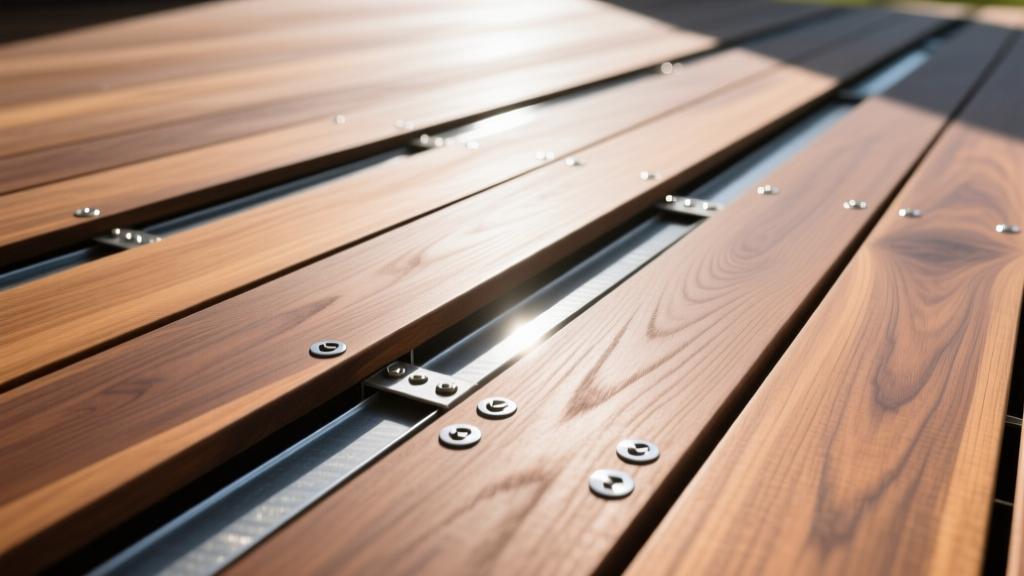
- Hidden Fastener Systems: For composite and PVC, use stainless steel hidden clips (e.g., Trex Universal or TimberTech CONCEALoc). If using aluminum joists, ensure the clips feature a factory-applied neoprene or PVC barrier to prevent direct metal-to-metal contact between the steel clip and aluminum joist.
Decision Matrix: Matching Materials to Microclimates
Durability is not absolute; it is relative to the environment. Use this matrix to finalize your deck building materials list based on your specific site conditions.
| Microclimate | Optimal Surface Material | Required Substructure | Mandatory Hardware |
|---|---|---|---|
| Coastal / Salt Air | Capped PVC (no wood flour) | 6061-T6 Aluminum Joists | 316 Marine SS with neoprene washers |
| Heavy Shade / Forest | Thermally Modified Ash | G90 Steel or UC4B PT Pine | 304 SS face screws (promotes drying) |
| High UV / Arid Desert | Light-colored Capped Composite | G90 Steel (prevents heat warping) | 304 SS hidden clips (allows expansion) |
| Ground-Level / Poolside | Capped PVC (slip-resistant texture) | Aluminum or Concrete Sleepers | 316 SS or polymer-headed screws |
Maintenance Schedules to Hit Maximum Advertised Lifespans
No material is truly 'maintenance-free.' To achieve the 25- to 50-year lifespans advertised by premium manufacturers, you must adhere to a strict maintenance protocol. Neglecting these steps voids most manufacturer warranties against fading and staining.
- Bi-Annual Deep Cleaning (Spring & Fall): Use a specialized composite or PVC deck cleaner (like Resist Mist or TimberTech Deck Cleaner) to remove organic biofilm. Avoid pressure washers over 1,500 PSI, which can etch the protective polymer cap and expose the core to UV degradation.
- Annual Gap Clearance: Use a specialized spacing tool or a putty knife to clear the 3/16-inch gaps between composite boards. Packed debris retains moisture, leading to localized mold growth and restricting the thermal expansion/contraction cycle, which can cause boards to buckle.
- Hardwood Oiling (Every 18-24 Months): If you chose Ipe or Cumaru and wish to maintain the original brown/red hue, apply a penetrating oil-based UV inhibitor (such as Ipe Oil or Messmer's UV Plus). If left untreated, the wood will not rot, but it will weather to a silvery-gray patina within 12 months.
- Substructure Inspection (Every 3 Years): Lift a few surface boards to inspect the joist tape and flashing. Ensure butyl joist tape has not peeled back, exposing the wood or steel to standing water.
Building a permanent outdoor living space requires looking past the aesthetic appeal of the surface boards. By specifying UC4A framing, 316 stainless steel hardware, and moisture-impervious PVC or thermally modified surfaces, your deck building materials list will transform a standard 15-year backyard project into a multi-generational architectural asset.
Written by
Elena RodriguezElena Rodriguez is a civil engineer and technical writer specializing in concrete technology, masonry systems, and ASTM/ACI compliance. She earned her B.S. in Civil Engineering from Texas A&M University and spent a decade at a materials testing laboratory, performing over 2,000 concrete compressive strength tests and masonry prism evaluations. Elena is an ACI-certified Field Testing Technician (Grade I) and a member of ASTM Committee C12 on Natural Building Stone. She currently consults on forensic engineering cases involving concrete failures and moisture intrusion. Based in San Antonio, TX, Elena is a proud member of the Society of Women Engineers (SWE) and coaches her daughter's FIRST Robotics team.
More from Elena Rodriguez
View all
Walls & Panels
Cost Analysis: Light Gauge Steel Framing Advantages and Disadvantages
Evaluate light gauge steel framing advantages and disadvantages through a strict cost analysis lens, comparing material, labor, and lifecycle expenses.
Aug 4, 2026

Walls & Panels
Gypsum Board Types: Exact Specifications, Thickness & Dimensions
Compare standard, Type X, and moisture-resistant gypsum board types. Get exact specifications, thicknesses, dimensions, and ASTM standards for your project.
Aug 4, 2026

Fire Resistance
Best Fire-Resistant Outdoor Decking Materials: 2026 Buyer Guide
Discover the best fire-resistant outdoor decking materials for 2026. Compare Class A PVC, aluminum, and hardwood options for WUI compliance and safety.
Aug 4, 2026