Exact Materials Needed to Build a Deck: A Pro's Installation Checklist
Discover the exact materials needed to build a deck, from footings and framing lumber to composite boards and hidden fasteners, with pro tips.

Substructure and Footing Materials
The longevity of any deck is dictated by what sits below ground and directly above it. Skipping proper footing materials or using inadequate concrete mixes leads to frost heave and structural sagging. For a standard freestanding or attached deck, the substructure materials must be rated for ground contact or protected by physical barriers.
Concrete and Formwork
- Sonotubes (Concrete Forms): 8-inch or 10-inch diameter heavy-duty cardboard forms. Use 10-inch for decks supporting heavy loads like hot tubs or multi-level structures.
- Concrete Mix: High-strength mix like Quikrete 5000 or Quikrete Fast-Setting Concrete. Fast-setting is ideal for post anchors as it cures in 20-40 minutes, allowing you to begin framing the same day.
- Gravel Base: 3/4-inch crushed stone or washed gravel. A 4-to-6-inch compacted gravel base at the bottom of the footing hole provides drainage and prevents frost from gripping the bottom of the concrete.
Post Bases and Anchors
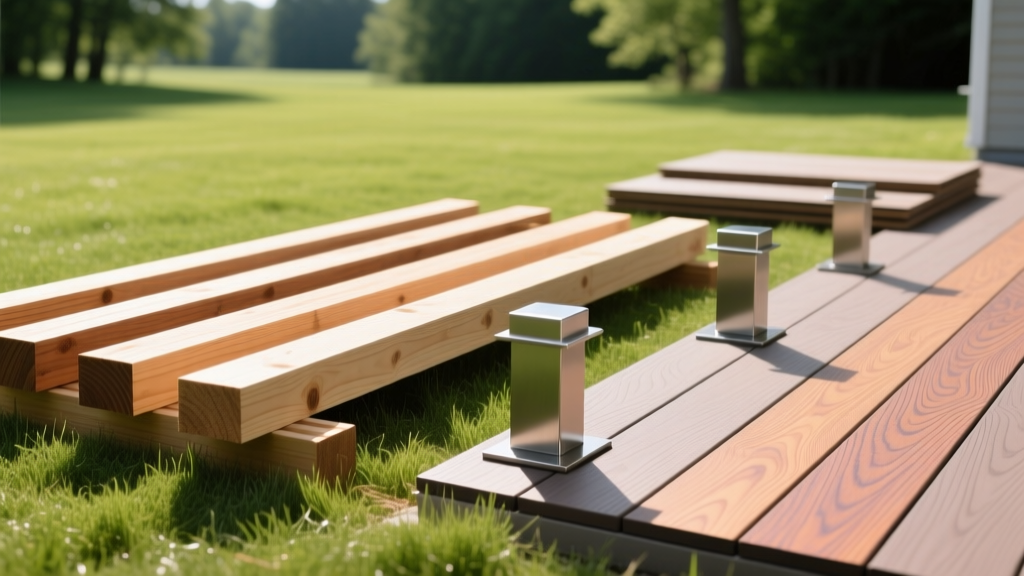
Wood posts should never be buried directly in concrete, as this traps moisture and accelerates rot. Instead, use elevated post bases that keep the wood at least one inch above the concrete surface.
- Elevated Post Bases: Simpson Strong-Tie ABU44Z (Adjustable Post Base) or ABA44Z. The 'Z' denotes ZMAX coating, which is mandatory for use with modern pressure-treated lumber.
- Anchor Bolts/J-Bolts: 1/2-inch x 6-inch hot-dipped galvanized J-bolts, embedded into the wet concrete to secure the post base.
Framing Lumber and Structural Hardware
The framing skeleton carries the live and dead loads of the deck. According to the American Wood Council's DCA 6 Prescriptive Residential Wood Deck Construction Guide, material selection must align with local span tables and load requirements.
Lumber Selection
- Beams and Joists: #2 Grade or better Pressure-Treated (PT) Southern Yellow Pine (SYP) or Douglas Fir. For ground-clearance framing (less than 18 inches from soil), you must specify UC4A (Ground Contact) treatment levels rather than standard UC3B (Above Ground).
- Ledger Board (For Attached Decks): 2x10 or 2x12 PT lumber, matching the depth of your floor joists. Must be paired with self-adhering flashing membrane to prevent water intrusion into the home's rim joist.
Joist Protection and Flashing
Water pooling on top of horizontal joists is the primary cause of premature framing failure, especially when using composite decking which traps moisture against the wood.
- Joist Tape: Butyl-based flashing tape (e.g., Trex Protect or Grace Vycor Deck Flashing). Butyl is superior to asphalt-based tapes because it does not bleed through or degrade when exposed to the UV radiation and heat trapped beneath composite boards.
- Ledger Flashing: Z-flashing (aluminum or galvanized) paired with a peel-and-stick bituminous membrane to create a continuous water barrier between the house and the ledger board.
Decking Boards and Fastening Systems
The surface materials define the aesthetic and maintenance requirements of the outdoor space. The Trex Installation Guidelines and similar manufacturer specs dictate precise fastener requirements to maintain product warranties.
Decking Materials
- Capped Composite Decking: Boards featuring a polymer shell (e.g., Trex Transcend, TimberTech Pro). These require specific hidden fastener systems and cannot be face-screwed without specialized composite screws that prevent 'mushrooming' of the material.
- Advanced PVC Decking: 100% polyvinyl chloride boards (e.g., Azek Landmark). PVC expands and contracts significantly more than wood or composite, requiring wider gap tolerances at butt joints (typically 1/8-inch per 10 feet of board length at 70°F).
- Pressure-Treated Wood: 5/4x6 radius-edge decking. Requires pre-drilling for end-grain fastening to prevent splitting and must be sealed with a penetrating oil-based stain within 30 days of installation.
Fasteners and Clips
| Fastener Type | Application | Material/Coating Requirement |
|---|---|---|
| 3-inch Structural Screws | Joist hangers, beam-to-post connections | ZMAX (G185) or Stainless Steel |
| 1.5-inch Joist Hanger Nails | Securing hangers to ledger/beams | Hot-Dipped Galvanized (HDG) |
| Hidden Fastener Clips | Grooved composite/PVC decking | Stainless Steel or Glass-Filled Nylon |
| 1/2-inch Lag Screws | Ledger board to house rim joist | Hot-Dipped Galvanized |
Railings, Stairs, and Finishing Elements
Railings and stairs require specialized materials to meet International Residential Code (IRC) safety standards, specifically regarding baluster spacing (maximum 4-inch sphere rule) and graspable handrail profiles.
Stair Stringers and Treads
- Stringer Lumber: 2x12 PT lumber, #1 grade or better. The 'throat' of the stringer (the remaining wood after cutting the rise and run) must be at least 3.5 inches thick to maintain structural integrity.
- Stair Treads: 5/4x6 composite stair treads or two 2x6 PT boards per step. If using composite, you must use specific stair nosing profiles to cover the exposed edge of the board.
- Stringer Connectors: Simpson Strong-Tie LSC (Adjustable Stringer Connector) to securely attach the stringer to the deck rim joist without relying solely on toe-nailing.
Railing Components
- Post Sleeves and Skirts: If using composite railing systems, 4x4 PT posts must be sleeved with the manufacturer's matching composite or PVC sleeves. Include post skirts and internal blocking to prevent the sleeve from crushing under lateral load.
- Balusters: Aluminum round or square balusters (e.g., 3/4-inch diameter). Aluminum is preferred over wood for balusters as it eliminates warping and requires zero maintenance. Ensure you purchase 10% extra to account for cutting errors on angled stair sections.
Material Quantity Estimator (10x10 Deck)
Use the following baseline estimator for a standard 100-square-foot (10x10) freestanding deck with 36-inch height. Adjust quantities based on local span tables and specific design loads.
| Material Category | Item Specification | Estimated Quantity |
|---|---|---|
| Footings | 10-inch Sonotubes & 80lb Concrete Mix | 4 tubes / 18 bags |
| Posts | 4x4 PT Lumber (Ground Contact) | 4 (8-foot lengths) |
| Beams | 2x10 PT Lumber (Doubled) | 4 (10-foot lengths) |
| Joists | 2x8 PT Lumber (16" on center) | 9 (10-foot lengths) |
| Decking | Grooved Composite Boards (16-foot) | 45 boards (+5% waste) |
| Fascia | Composite Fascia Boards (12-inch) | 4 (12-foot lengths) |
Installation Insight: When ordering composite decking, ensure all boards come from the same manufacturing lot number. Dye lots can vary slightly in color, and mixing lots on a single continuous deck surface will result in visible banding once the sun hits the boards at an angle.
Written by
Elena RodriguezElena Rodriguez is a civil engineer and technical writer specializing in concrete technology, masonry systems, and ASTM/ACI compliance. She earned her B.S. in Civil Engineering from Texas A&M University and spent a decade at a materials testing laboratory, performing over 2,000 concrete compressive strength tests and masonry prism evaluations. Elena is an ACI-certified Field Testing Technician (Grade I) and a member of ASTM Committee C12 on Natural Building Stone. She currently consults on forensic engineering cases involving concrete failures and moisture intrusion. Based in San Antonio, TX, Elena is a proud member of the Society of Women Engineers (SWE) and coaches her daughter's FIRST Robotics team.
More from Elena Rodriguez
View all
Walls & Panels
Cost Analysis: Light Gauge Steel Framing Advantages and Disadvantages
Evaluate light gauge steel framing advantages and disadvantages through a strict cost analysis lens, comparing material, labor, and lifecycle expenses.
Aug 4, 2026

Walls & Panels
Gypsum Board Types: Exact Specifications, Thickness & Dimensions
Compare standard, Type X, and moisture-resistant gypsum board types. Get exact specifications, thicknesses, dimensions, and ASTM standards for your project.
Aug 4, 2026

Fire Resistance
Best Fire-Resistant Outdoor Decking Materials: 2026 Buyer Guide
Discover the best fire-resistant outdoor decking materials for 2026. Compare Class A PVC, aluminum, and hardwood options for WUI compliance and safety.
Aug 4, 2026