Deck Gate Load Ratings: IRC Compliance & Hardware Specs
Master deck gate performance ratings. Compare IRC guardrail codes, hinge weight capacities, and composite vs aluminum frame specs to prevent sag.
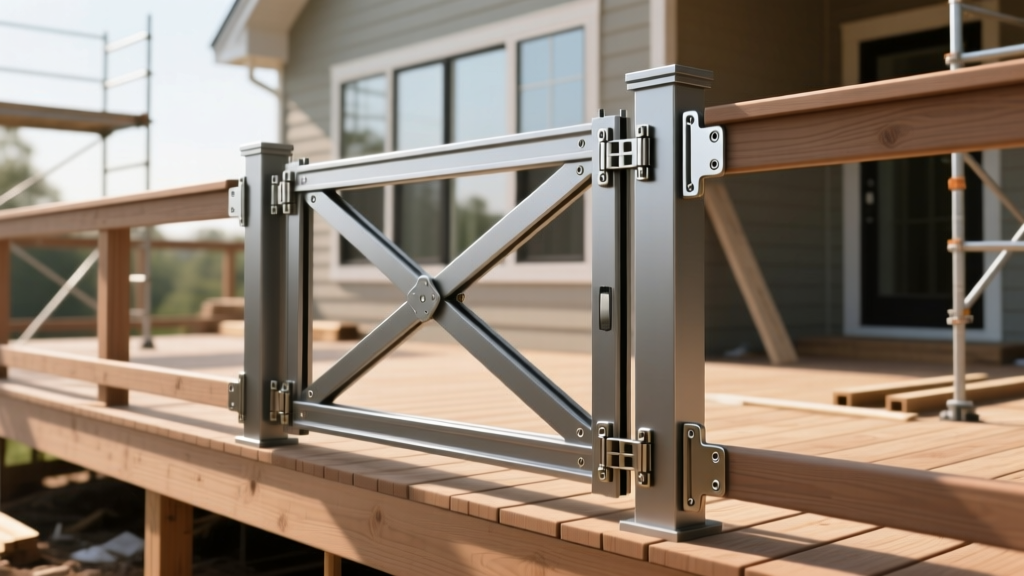
International Residential Code (IRC) Guardrail & Gate Mandates
A deck gate is not merely an access point; it is a critical structural component of your deck’s guardrail system. When a gate fails under load, it compromises the entire safety envelope of the elevated outdoor space. The International Residential Code (IRC) Section R312.1 establishes strict performance baselines that every deck gate must meet to pass municipal inspections and ensure occupant safety.
Concentrated Load Requirements
Under IRC specifications, the top rail of a deck gate must withstand a concentrated load of 200 pounds (890 N) applied in any outward or downward direction. This simulates the force of an adult falling or leaning heavily against the gate. Furthermore, the infill components (balusters, mesh, or horizontal cables) must resist a concentrated load of 200 pounds applied on an area of one square foot. Gates constructed with undersized composite balusters or poorly anchored aluminum pickets frequently fail this infill test during structural audits.
The 4-Inch Sphere Rule
To prevent child entrapment, the IRC mandates that no opening in the lower portion of the guardrail or gate may allow the passage of a 4-inch diameter sphere. For the triangular opening formed by the riser, tread, and bottom rail of a gate installed on a stair landing, the sphere restriction tightens to 6 inches. When specifying composite or aluminum gate kits, verify that the manufacturer’s infill spacing is precisely 3.5 inches to account for material expansion without violating the 4-inch maximum threshold.
Material Frame Specifications: Composite vs. Aluminum vs. Wood
The structural integrity of a deck gate is dictated by the Modulus of Elasticity (MOE) and the coefficient of thermal expansion of the framing material. Selecting the wrong material for high-exposure or wide-span applications guarantees premature parallelogram racking (sagging).
| Material Type | Modulus of Elasticity (MOE) | Thermal Expansion (per 10ft / 100°F) | Sag Susceptibility | Max Recommended Width |
|---|---|---|---|---|
| Structural Aluminum (e.g., Fortress AL13) | ~10,000,000 psi | ~0.015 inches | Extremely Low | 60 inches |
| Wood-Plastic Composite (WPC) | ~1,500,000 psi | ~0.125 inches (1/8") | High (Requires internal steel armature) | 42 inches |
| PVC / Cellular PVC | ~2,000,000 psi | ~0.100 inches | Moderate to High | 48 inches |
| Dense Hardwood (Ipe / Cumaru) | ~2,500,000 psi | Negligible (Swells with moisture) | Low (If joinery is mortise & tenon) | 48 inches |
According to ASTM D7032 standards for Wood-Plastic Composites, WPC guardrail components must be tested for long-term creep. Because composite materials exhibit viscoelastic behavior, a 48-inch wide composite gate will permanently deform under its own weight over a 5-year period unless reinforced with an internal steel or aluminum sub-frame. Always specify composite gate kits that include a co-extruded aluminum core or mandate the insertion of a 1.5-inch square steel tube inside the hollow composite top and bottom rails.
Hinge & Latch Load Ratings: The Anti-Sag Framework
The most common failure mode in deck gates is latch misalignment caused by hinge-side deflection and frame racking. Standard architectural hinges are rated for interior doors and lack the shear strength for exterior, wind-loaded deck gates.
Adjustable Tension Hinges
For gates up to 48 inches wide, specify self-adjusting polymer-and-stainless-steel hybrid hinges, such as the TruClose Heavy Duty series. These hinges feature an internal torsion spring that allows you to dial in the tension using a standard hex key, compensating for minor frame shifts. Look for a published shear load rating of at least 132 lbs per pair. For privacy gates with solid composite infill that act as wind sails, upgrade to a three-hinge configuration to distribute the lateral wind load, which can exceed 20 lbs per square foot during severe weather events.
Drop Rods and Structural Blocking
For any deck gate exceeding 42 inches in width, a latch-side drop rod is mandatory. The drop rod must be a minimum of 1/2-inch diameter galvanized or stainless steel. When engaged, the rod transfers the dead load of the gate directly into the deck joist system, entirely bypassing the hinges.
Installation Specification: Do not drill the drop rod receiver hole directly into the surface decking boards. Decking boards lack the structural mass to resist the repetitive impact and shear force of a 60-lb gate slamming shut. You must install a 2x6 pressure-treated blocking member flush between the deck joists directly beneath the latch strike zone, and drill the 5/8-inch receiver hole through the decking and 1.5 inches into the blocking.
Clearance & Tolerance Specifications for Year-Round Performance
Outdoor environments subject deck gates to extreme temperature and moisture fluctuations. Failing to calculate material-specific tolerances during installation will result in gates that bind in the summer or swing wide open in the winter.
- Composite Gates (WPC): Maintain a strict 3/8-inch gap on the hinge side and a 1/2-inch gap on the latch side. WPC expands primarily in length. If installed tightly in 40°F spring weather, a 42-inch composite gate will expand by nearly 1/8 inch in 95°F summer heat, causing it to bind against the latch post.
- Aluminum Gates: Aluminum is highly dimensionally stable regarding thermal expansion in the context of a 4-foot span. A uniform 1/4-inch gap on all sides is sufficient for clearance and aesthetic symmetry.
- Hardwood Gates: Wood expands primarily in width (tangentially and radially), not length. Maintain a 1/4-inch top and bottom clearance to accommodate moisture-driven swelling during high-humidity summer months, while keeping side gaps at 3/16 inch.
Frost Heave Considerations for Ground-Level Gates
If your deck gate transitions to a ground-level landing or a stair stringer that rests on a concrete pad, you must account for frost heave. In climates where the frost line exceeds 36 inches, independent concrete footings for the gate’s latch-post can heave up to 1/2 inch relative to the main deck structure. Install an adjustable strike plate with a 1.5-inch vertical capture slot to ensure the latch remains engaged even if the landing pad shifts during the freeze-thaw cycle.
Step-by-Step Hardware Sizing Matrix
Use the following decision framework to specify the correct hardware based on your exact gate dimensions and material choice. This matrix aligns with best practices endorsed by the North American Deck and Railing Association (NADRA) for structural longevity.
- Measure the Rough Opening: Determine the exact distance between the hinge post and latch post. Subtract the material-specific clearance (e.g., 3/4" total for WPC) to find the actual gate build width.
- Calculate Dead Load: Weigh the assembled gate. Solid privacy composite gates often weigh 60-85 lbs, whereas aluminum picket gates weigh 25-40 lbs.
- Select Hinge Class:
- Under 45 lbs & under 42" wide: Standard 2-pack adjustable polymer/steel hinges (e.g., LokkLatch Deluxe).
- 45 lbs to 90 lbs or up to 60" wide: Heavy-duty 3-pack metal hinges with sealed ball bearings and through-bolt backing plates.
- Specify the Latch: Use a magnetic or mechanical latch with a minimum 1-inch throw. For WPC gates subject to thermal expansion, select a latch with a 3/4-inch deep catch housing to prevent the bolt from bottoming out and failing to engage when the gate expands in high heat.
- Mandate a Drop Pin: If the gate width is >42" OR the dead load is >50 lbs, install a 1/2" steel drop rod on the latch side, anchored into structural joist blocking.
Expert Insight: The lifespan of a deck gate is rarely determined by the frame material; it is almost entirely dictated by the fasteners. Always specify Type 304 or Type 316 stainless steel hardware. Zinc-plated or powder-coated carbon steel screws will develop surface rust within 24 months in coastal or high-humidity environments, leading to galvanic corrosion when in direct contact with aluminum gate frames or pressure-treated wood.