Best Deck Railing Material Options: Wood, Composite, Metal, and Glass
Compare the best deck railing material options. Explore costs, durability, and maintenance for wood, composite, aluminum, and glass railings.

Selecting the right deck railing material dictates not only the visual profile of your outdoor space but also the long-term structural maintenance and overall budget of the build. While decking boards often claim the lion's share of the budget, the railing system typically accounts for 20% to 35% of total project costs. In 2026, advancements in co-extruded polymers, powder-coated aluminum extrusions, and structural silicone glazing have shifted the performance baselines for these materials.
The Deck Railing Material Matrix
Before evaluating individual materials, review this comparative matrix detailing installed costs, lifecycle expectations, and structural characteristics.
| Material Category | Installed Cost (per linear ft.) | Expected Lifespan | Maintenance Level | Structural Weight / Framing Impact |
|---|---|---|---|---|
| Pressure-Treated Pine | $18 - $28 | 10 - 15 years | High (Annual sealing) | Light / Standard framing |
| Capped Composite / PVC | $40 - $75 | 25 - 30 years | Low (Soap and water) | Medium / Requires internal steel core |
| Aluminum Picket | $45 - $85 | 30+ years | Very Low | Light / Standard framing |
| Stainless Steel Cable | $65 - $120 | 25+ years | Low (Tension checks) | High / Requires reinforced posts |
| Tempered Glass (Framed/Base) | $160 - $350+ | 20 - 30 years | Medium (Glass cleaning) | Very Heavy / Requires engineered rim joists |
Wood Railings: Traditional Aesthetics with High Upkeep
Wood remains the baseline for deck railing material, primarily utilizing Pressure-Treated (PT) Southern Yellow Pine, Western Red Cedar, or tropical hardwoods like Ipe. The primary failure mode for wood railings is moisture intrusion at the end-grains and post-to-deck connections.
Material-Specific Considerations
- Pressure-Treated Pine ($18-$28/lf): Economical but prone to checking, twisting, and splintering as it cures. Requires annual application of penetrating oil-based sealers (e.g., Cabot Australian Timber Oil) to prevent UV degradation and water ingress.
- Western Red Cedar ($30-$45/lf): Naturally rot-resistant due to high tannin content. Critical Detail: You must use hot-dipped galvanized or stainless steel fasteners. Standard zinc-plated screws will react with cedar tannins, causing severe black streaking and premature fastener corrosion.
- Ipe and Tropical Hardwoods ($60-$95/lf): Extremely dense (Janka hardness of 3,680 lbf) and naturally impervious to rot. However, Ipe requires pre-drilling for every fastener and specialized carbide-tipped saw blades. End-grains must be sealed immediately upon cutting using a product like Anchorseal to prevent checking.
Composite and PVC Railings: The Low-Maintenance Standard
Modern composite and PVC railings have largely solved the fading and staining issues of early-generation products. Current market leaders like Trex Signature and AZEK Premier utilize a dense cellular PVC or wood-plastic composite (WPC) core wrapped in a co-extruded polymer shell.
Composite materials lack the tensile strength to span 6 to 8 feet between posts without sagging. High-end composite railing systems incorporate a continuous internal aluminum or galvanized steel reinforcement arm. When pricing composite railing material, verify that the manufacturer's structural arm is included in the linear foot cost, as some budget brands sell the composite sleeve and metal core as separate, expensive SKUs.
While composite railings resist rot and insects, they are susceptible to thermal expansion. A 16-foot run of dark-colored composite railing can expand up to 1/4 inch in direct summer sunlight. Installers must follow manufacturer-specified gapping protocols at the rail-to-post brackets to prevent buckling.
Aluminum and Cable Railings: Maximizing Sightlines
For decks overlooking scenic properties, minimizing visual obstruction is paramount. Aluminum and cable systems achieve this while offering superior structural longevity.
Powder-Coated Aluminum Pickets
Aluminum railings (e.g., Deckorators Aluminum or Key-Link) are extruded from 6063-T5 aluminum alloy and finished with an AAMA 2604 architectural-grade powder coating. This finish resists chalking and UV fading for decades. Aluminum picket systems are lightweight, making them ideal for second-story decks where dead load reduction is a structural priority.
Stainless Steel Cable Systems
Cable railings utilize 1/8-inch or 3/16-inch 316-grade marine stainless steel wire. Code Warning: The International Residential Code (IRC) prohibits guardrails with horizontal members that facilitate climbing (the "ladder effect"). While the 2021 IRC Chapter 3 does not explicitly ban horizontal cables, many local Authorities Having Jurisdiction (AHJs) interpret them as a climbing hazard. Always verify local code enforcement before specifying horizontal cable runs. If horizontal cables are rejected, vertical cable orientations with top and bottom tensioning rails are universally code-compliant.
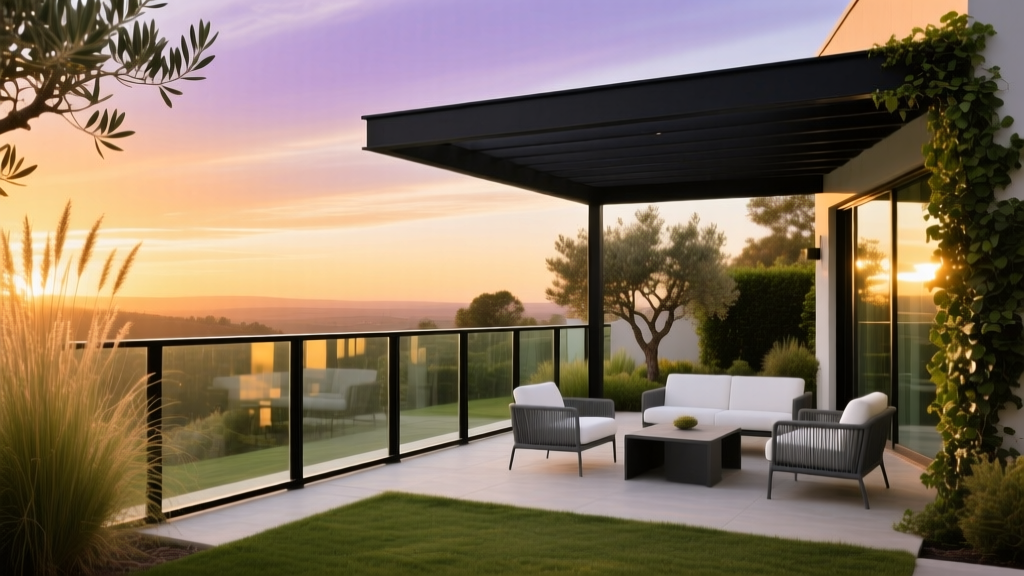
Glass Railings: Premium Unobstructed Views
Glass is the ultimate deck railing material for preserving panoramic views. Systems typically utilize 3/8-inch or 1/2-inch tempered safety glass, though laminated tempered glass (two panes bonded with a PVB interlayer) is required in some high-wind or commercial jurisdictions.
Framing and Mounting Methodologies
- Base Shoe (U-Channel): The glass is set into an aluminum U-channel bolted to the deck rim joist and secured with structural silicone or a dry-glaze wedge system. This requires a perfectly level rim joist; any deviation will cause stress fractures in the tempered glass.
- Standoff Spigots (Clamps): Glass panels are clamped between stainless steel spigots mounted to the deck surface. This allows water to drain freely beneath the glass, making it ideal for flat roofs or waterproofed deck membranes.
- Fascia-Mounted Channels: The base shoe is bolted to the exterior face of the fascia board. This maximizes the deck's usable square footage but requires heavy structural blocking behind the fascia to handle the 200 lb. concentrated load requirement.
Large expanses of clear glass reflect the sky and surrounding trees, creating a severe bird-strike hazard. For decks near wooded areas or migratory flyways, specify glass with a fritted pattern, UV-reflective coating, or apply exterior tensioned cables spaced 4 inches apart to break up the reflection.
Structural Framing and IRC Code Compliance
The best deck railing material will fail catastrophically if the underlying post attachment is inadequate. According to the American Wood Council's DCA 6 guide, deck guardrails must withstand a 200-pound concentrated load applied in any direction at the top rail, and a 50-pound load on intermediate balusters.
The 4-Inch Sphere Rule
IRC Section R312.1.2 mandates that guardrails must not have any openings that allow the passage of a 4-inch diameter sphere. This dictates that standard pickets or glass standoff gaps must be spaced at 3.5 inches or less to account for material swelling and manufacturing tolerances.
Post Anchoring Mechanics
Never attach railing posts to the deck rim joist using only lag screws. The leverage exerted on a 36-inch or 42-inch post will easily strip lag threads from the end-grain of a rim joist. Instead, use structural through-bolts (1/2-inch galvanized carriage bolts) paired with structural washers, or install specialized steel tension ties (such as the Simpson Strong-Tie DTT2Z) that anchor the post directly to the interior deck joists. For a deeper dive into structural fastening, review Fine Homebuilding's deck code breakdown.
Decision Framework: Selecting Your Material
Use this practical framework to finalize your deck railing material selection based on your specific project constraints:
- If budget is the primary constraint: Choose Pressure-Treated Pine, but upgrade the post caps to copper or aluminum to prevent the most common water-intrusion failure points.
- If you want zero maintenance but have a mid-range budget: Choose Capped Composite with square aluminum balusters. It mimics the look of wood without the annual sealing requirement.
- If maximizing a specific view is critical: Choose Frameless Glass with a base-shoe mount. Budget an additional $500-$1,000 for professional structural silicone glazing and annual hard-water spot removal if near the coast.
- If building in a high-wind or coastal salt-spray zone: Choose 316-grade Stainless Steel Cable or Marine-Grade Aluminum. Avoid standard powder-coated steel or composite, which will pit, chalk, or corrode in saline environments.
Written by
Priya KapoorPriya Kapoor is a real estate market analyst and construction economics researcher with expertise in housing affordability, development feasibility, and infrastructure investment. She holds a Master of Regional Planning from Cornell University and previously worked as a senior analyst at CBRE's Investment Properties group, where she modeled returns for $4B in mixed-use development pipelines. Priya now runs an independent research practice advising developers, municipalities, and REITs on construction cost forecasting and market timing. She publishes the quarterly "BuildMat Market Pulse" report tracking material price indices across 12 commodity categories. Based in Austin, TX, Priya serves on the board of Habitat for Humanity Austin and is a marathon runner.
More from Priya Kapoor
View all
Construction Cost
Cost to Build a 1600 Sq Ft Home in 2026: Full Breakdown
Accurate 2026 cost to build a 1600 sq ft home—material, labor, and regional pricing breakdowns included. Plan your budget with real-time estimates.
Aug 11, 2026

Wood & Lumber
Name the Types of Wood for Pressure Treatment and Preservation
Learn how to name the types of wood best suited for pressure treatment. Compare species treatability, chemical retention levels, and 2026 preservation costs.
Aug 4, 2026

Stone & Masonry
Stone Veneer Suppliers Lindenhurst: 2026 Cost Analysis
Analyze 2026 stone veneer costs in Lindenhurst, NY. Compare local supplier pricing, delivery fees, and Suffolk County installation labor rates.
Aug 4, 2026