Choosing Dock Decking Materials: A Site-Specific Selection Framework
Master our 4-pillar selection framework for dock decking materials. Compare aluminum, PVC, and composite costs, joist specs, and marine durability.
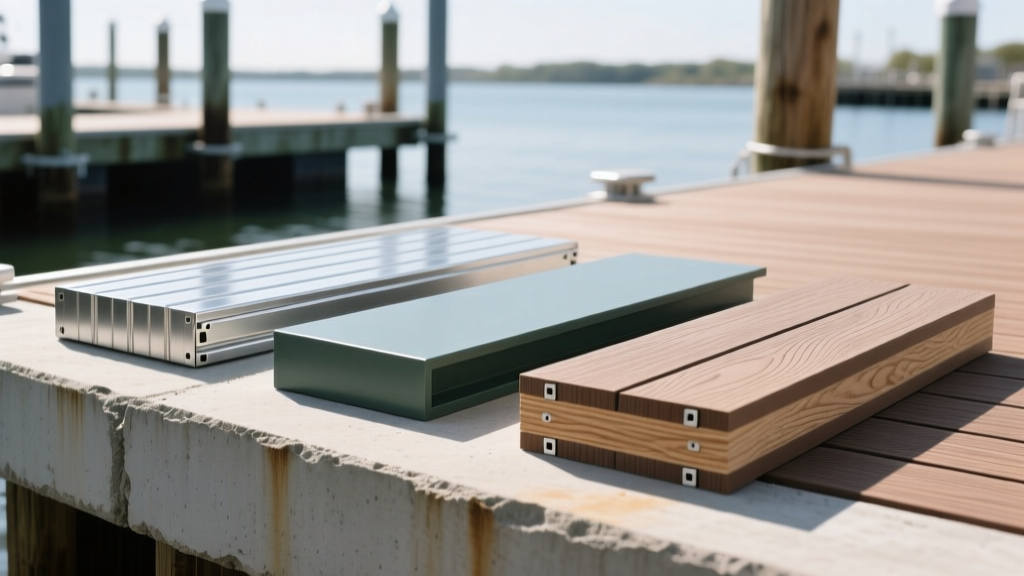
The 4-Pillar Dock Material Selection Framework
Dock environments subject building materials to 360-degree moisture exposure, intense UV degradation, mechanical wave stress, and seasonal ice heave. Standard patio decking profiles routinely fail in these conditions due to water absorption, thermal buckling, and fastener corrosion. Selecting the correct dock decking materials requires moving beyond basic aesthetics and applying a rigorous, site-specific engineering framework.
Before evaluating specific product lines, run your project parameters through these four foundational pillars:
Pillar 1: Hydro-Exposure & Water Absorption (ASTM D570)
Docks are constantly exposed to splash zones, submersion, and high humidity. The USDA Forest Products Laboratory emphasizes that moisture absorption is the primary catalyst for biological decay and dimensional instability. Materials must be evaluated on their water absorption rates. Uncapped wood-plastic composites can absorb up to 5% of their weight in water, leading to swelling and mold. Marine-grade aluminum and fully capped cellular PVC absorb less than 0.5%, making them impervious to rot and structural degradation.
Pillar 2: Coefficient of Linear Thermal Expansion (CLTE)
Docks lack the thermal mass of ground-level patios, meaning they experience rapid temperature fluctuations. PVC and composite materials expand and contract significantly with temperature shifts. For example, a 20-foot PVC board can expand up to 3/8 of an inch across a 40°F temperature swing. Aluminum exhibits a much lower CLTE, requiring fewer expansion gaps and reducing the risk of fastener sheer or board buckling during peak summer heat.
Pillar 3: Dynamic Load & Point Bearing
Unlike static residential decks, docks endure dynamic loads from wave action, boat cleats, and concentrated point loads from heavy marine equipment. The American Boat & Yacht Council (ABYC) guidelines suggest that dock surfaces must withstand shifting weight distributions without excessive deflection. Material stiffness (Modulus of Elasticity) dictates required joist spacing; weaker materials require tighter framing to prevent sagging under dynamic marine loads.
Pillar 4: Maintenance & Biological Resistance
Freshwater and saltwater environments promote rapid algae and biofilm growth, creating severe slip hazards. The selection framework must account for the owner's willingness to perform maintenance. Textured surfaces trap organic matter, while smooth, non-porous surfaces allow for easy cleaning but may lack wet traction.
Dock Decking Materials: Performance & Cost Matrix
The following matrix breaks down the primary material categories used in modern marine construction, reflecting current market pricing and structural specifications.
| Material Category | Estimated Cost (per sq. ft.) | Max Joist Spacing | Heat Retention | Slip Resistance (Wet) |
|---|---|---|---|---|
| Marine Aluminum (e.g., Wahoo DryDeck) | $16.00 - $24.00 | 24" O.C. | Low (Dissipates heat) | High (with grit strips) |
| Cellular PVC (e.g., AZEK Landmark) | $10.00 - $15.00 | 12" O.C. | Moderate | Moderate |
| Capped Composite (e.g., Trex Transcend) | $8.00 - $13.00 | 16" O.C. | High (Absorbs heat) | High (Embossed grain) |
| Tropical Hardwood (Ipe, Cumaru) | $14.00 - $20.00 | 16" O.C. | Moderate | Low (when wet/smooth) |
| Pressure-Treated Pine (Marine Grade) | $4.00 - $7.00 | 16" O.C. | Low | High (when rough) |
Environmental Matching: Saltwater vs. Freshwater vs. Ice
The chemical composition of the water body dictates fastener and material compatibility. Applying a freshwater material specification to a saltwater environment will result in catastrophic galvanic corrosion within 24 to 36 months.
Saltwater & Brackish Environments
Salt acts as an aggressive electrolyte. In these zones, you must specify 316-grade marine stainless steel for all hidden fasteners, screws, and structural connectors. Avoid using standard pressure-treated lumber framing directly beneath aluminum decking without a physical barrier. The copper and alkaline compounds in modern ACQ and MCQ pressure treatments react violently with aluminum, causing galvanic corrosion. Always apply a butyl-based joist tape (like Trex Protect or Wahoo Deck Tape) to the top of every joist before laying aluminum boards.
Freeze-Thaw & Ice Heave Zones
In northern climates, ice expansion can exert thousands of pounds of lateral pressure on dock pilings and framing.
Never rigidly fasten dock decking to framing in regions with severe ice heave. Utilize slotted fastener holes or specialized sliding hidden clips that allow the entire dock surface to shift up to 1/2 inch laterally without snapping the fasteners or buckling the boards. Alternatively, design the dock in modular 10x10 sections that can be unbolted and removed before the first hard freeze.
Structural Framing & Fastener Specifications
The longevity of your dock decking materials is entirely dependent on the substructure. Marine environments accelerate the decay of standard framing lumber.
Joist Spacing & Deflection Limits
Because docks lack cross-bracing and are subject to torsional twisting from wave action, framing must be over-engineered compared to residential decks.
- Aluminum Decking: Can span up to 24 inches on center (O.C.) due to the high tensile strength and integrated ribbing of extruded marine profiles.
- PVC & Composite: Must be framed at 12 inches O.C. for commercial docks or 16 inches O.C. for residential use. PVC becomes highly flexible at temperatures exceeding 90°F; wider joist spacing will result in visible sagging between joists underfoot.
- Wood Decking: Standard 16 inches O.C. is acceptable, provided the wood is kiln-dried after treatment (KDAT) to minimize cupping.
Hidden Fasteners vs. Top-Down Screws
While hidden clip systems provide a clean aesthetic, they are generally discouraged for floating docks or high-wave environments. If a board is damaged by a boat impact, hidden clips require removing all adjacent boards to access the damaged piece. For working docks and high-traffic marina slips, top-down fastening with 316 stainless steel trim-head screws is the superior functional choice, allowing for individual board replacement in under five minutes.
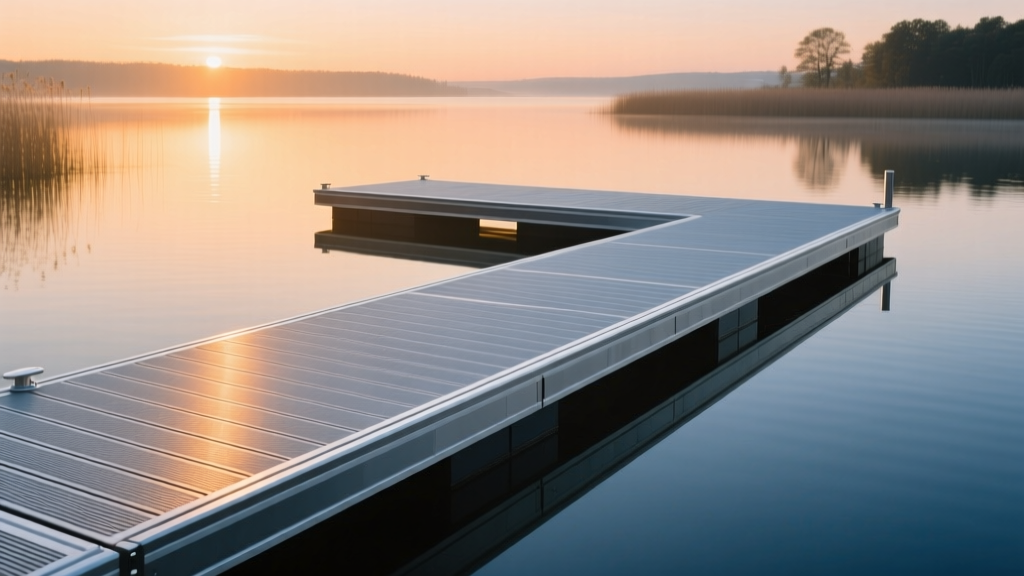
Real-World Failure Modes & Mitigation
Understanding how dock decking materials fail in the field allows you to engineer out these risks during the planning phase.
- Thermal Buckling in Composites: Installers frequently butt composite boards tightly together, ignoring manufacturer expansion gaps. On a south-facing dock in July, surface temperatures can exceed 140°F. Without a minimum 1/8-inch expansion gap every 16 feet, the boards will compress and buckle upward, creating a severe trip hazard. Mitigation: Always use breaker boards (perpendicular framing joints) every 12 to 16 feet to reset expansion runs.
- Micro-Splintering in Uncapped Composites: Early-generation or budget-tier composite decking relies on a wood-flour core. When exposed to constant moisture and UV, the surface layer degrades, exposing microscopic wood fibers that splinter and harbor black mold. Mitigation: Specify only fully capped polymer or mineral-based composites with a minimum 25-year fade and stain warranty.
- Algae Slip Hazards on Hardwoods: Dense tropical hardwoods like Ipe are naturally rot-resistant, but their smooth surface becomes dangerously slick when coated in freshwater algae. Mitigation: If using hardwood, specify a wire-brushed or heavily grooved profile, and commit to an annual application of a marine-grade, non-toxic anti-slip penetrating oil.
Quick Decision Tree: Which Material Should You Specify?
- If budget is secondary and zero-maintenance is required: Extruded Marine Aluminum (with integrated drainage channels).
- If building in a saltwater tidal zone: Cellular PVC with 316 SS top-down screws (avoids galvanic corrosion risks of aluminum).
- If maximizing budget on a freshwater residential dock: Capped Wood-Composite over 12" O.C. pressure-treated joists with joist tape.
- If building a heavy-duty commercial marina slip: Heavy-gauge aluminum or fiberglass grating for maximum load-bearing and water flow-through.
By applying this site-specific framework, you eliminate the guesswork from marine construction. Matching the material's physical properties to the exact hydro-exposure, thermal dynamics, and load requirements of your specific water body ensures a dock surface that remains structurally sound, safe, and visually intact for decades.
Written by
Priya KapoorPriya Kapoor is a real estate market analyst and construction economics researcher with expertise in housing affordability, development feasibility, and infrastructure investment. She holds a Master of Regional Planning from Cornell University and previously worked as a senior analyst at CBRE's Investment Properties group, where she modeled returns for $4B in mixed-use development pipelines. Priya now runs an independent research practice advising developers, municipalities, and REITs on construction cost forecasting and market timing. She publishes the quarterly "BuildMat Market Pulse" report tracking material price indices across 12 commodity categories. Based in Austin, TX, Priya serves on the board of Habitat for Humanity Austin and is a marathon runner.
More from Priya Kapoor
View all
Construction Cost
Cost to Build a 1600 Sq Ft Home in 2026: Full Breakdown
Accurate 2026 cost to build a 1600 sq ft home—material, labor, and regional pricing breakdowns included. Plan your budget with real-time estimates.
Aug 11, 2026

Wood & Lumber
Name the Types of Wood for Pressure Treatment and Preservation
Learn how to name the types of wood best suited for pressure treatment. Compare species treatability, chemical retention levels, and 2026 preservation costs.
Aug 4, 2026

Stone & Masonry
Stone Veneer Suppliers Lindenhurst: 2026 Cost Analysis
Analyze 2026 stone veneer costs in Lindenhurst, NY. Compare local supplier pricing, delivery fees, and Suffolk County installation labor rates.
Aug 4, 2026