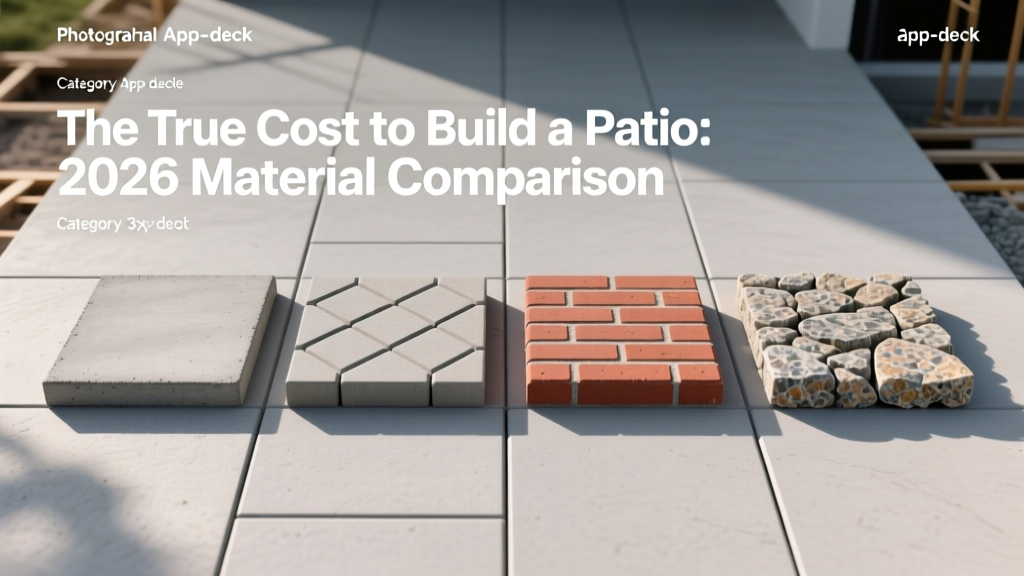
The True Cost to Build a Patio: 2026 Material Comparison
Compare the 2026 cost to build a patio using concrete, pavers, brick, and natural stone. Includes per-square-foot pricing, lifespan, and hidden expenses.
The Baseline: Average Cost to Build a Patio by Material
Calculating the exact cost to build a patio requires moving beyond national averages and examining the specific material science, base preparation, and regional labor rates that dictate your final invoice. In 2026, the national average for a standard 200-square-foot patio ranges from $1,600 for basic poured concrete to over $10,000 for premium natural stone installations. The variance is driven by substrate requirements, material weight, and finishing techniques.
Quick Cost Snapshot (Per Square Foot Installed)
- Poured Concrete (Broom Finish): $8 – $12
- Stamped/Colored Concrete: $14 – $22
- Interlocking Concrete Pavers: $16 – $30
- Clay Brick Pavers: $18 – $35
- Natural Stone (Flagstone/Bluestone): $25 – $50+
Deep Dive: Material Cost Breakdown & Performance
To understand where your budget is actually going, we must evaluate the structural requirements and long-term performance of the four primary patio materials.
Poured and Stamped Concrete
Concrete remains the most cost-effective patio material due to rapid installation and lower material costs. However, the cost to build a patio with concrete fluctuates based on the finish. A standard 4-inch slab with a broom finish costs between $8 and $12 per square foot. Upgrading to stamped concrete with integral color and release agents pushes the price to $14–$22 per square foot.
From an engineering perspective, exterior concrete must meet specific American Concrete Institute (ACI) standards. In climates with freeze-thaw cycles, the mix must include 4% to 6% air-entrainment to prevent surface scaling and achieve a minimum compressive strength of 3,500 to 4,000 psi. The slab requires a 4-to-6-inch compacted aggregate base and control joints spaced every 10 feet to manage inevitable shrinkage cracking.
Interlocking Concrete Pavers
The cost to build a patio using concrete pavers (such as those from Belgard or Unilock) ranges from $16 to $30 per square foot. The higher price reflects the intensive labor required for base preparation and the cost of the manufactured units. According to the Interlocking Concrete Pavement Institute (ICPI), a proper vehicular or heavy-use pedestrian base requires 6 to 8 inches of compacted crushed stone (ASTM D2940), followed by a 1-inch layer of coarse concrete sand (ASTM C33) for bedding.
Pavers offer a distinct structural advantage over concrete: flexibility. Because they are individual units locked together with polymeric sand, they shift slightly with frost heave and soil settlement without cracking. If a section settles, you can unzip the edge restraint, remove the pavers, re-grade the base, and reinstall them—a repair that is impossible with monolithic concrete.
Natural Stone (Flagstone and Bluestone)
Natural stone is the premium tier, with installed costs ranging from $25 to over $50 per square foot. The price variance depends heavily on the stone type and the installation method. Irregular, dry-laid flagstone over a sand base sits at the lower end of the spectrum. Conversely, thermal-cut bluestone set in a mortar bed over a reinforced concrete slab commands the highest prices due to the dual-layer construction and precise masonry labor required.
When budgeting for natural stone, factor in the waste factor. Unlike modular pavers, irregular flagstone generates 15% to 20% waste during cutting and fitting. Additionally, porous stones like sandstone and limestone require penetrating sealers every two to three years to prevent water absorption, staining, and winter spalling.
Clay Brick Pavers
Clay brick offers a classic aesthetic and exceptional color retention, as the pigment is fired into the clay body rather than applied to the surface. Installation costs range from $18 to $35 per square foot. True clay pavers (such as those from Pine Hall Brick) are significantly more expensive than concrete bricks due to the energy-intensive kiln-firing process.
The primary technical challenge with clay brick is efflorescence—a white, powdery salt deposit that migrates to the surface when moisture evaporates. While efflorescence is harmless and eventually weathers away, mitigating it requires using a permeable geotextile fabric in the base and ensuring the patio has a minimum slope of 1/8 inch per foot for positive drainage.
The Hidden Costs That Inflate Your Patio Budget
Contractor quotes often focus on the surface material, leaving homeowners blindsided by site-specific expenses. When calculating your total cost to build a patio, allocate an additional 15% to 30% for the following hidden variables:
- Excavation and Haul-Away: Removing existing sod, topsoil, or an old concrete slab costs $2 to $5 per square foot. Heavy clay soils require deeper excavation to reach stable subgrade, increasing dump fees.
- Retaining Walls and Step-Downs: If your yard is sloped, leveling the patio requires a retaining wall. Modular segmental retaining wall blocks cost $25 to $50 per linear foot installed, which can easily add $2,000 to $4,000 to the project.
- Drainage Solutions: Patios that tie into existing roof downspouts or sit at the bottom of a slope require subsurface drainage. Installing a French drain or a linear channel drain along the patio edge adds $30 to $60 per linear foot.
- Permeability Requirements: Many municipalities now enforce strict impervious surface limits. If your lot is maxed out, you may be forced to use permeable pavers. While the pavers themselves cost 10% more, the open-graded base (requiring specialized, highly angular crushed stone without fine particles) increases base material and labor costs by up to 25%. For more on this, review the EPA guidelines on permeable pavement.
Material Decision Matrix: Matching Budget to Lifestyle
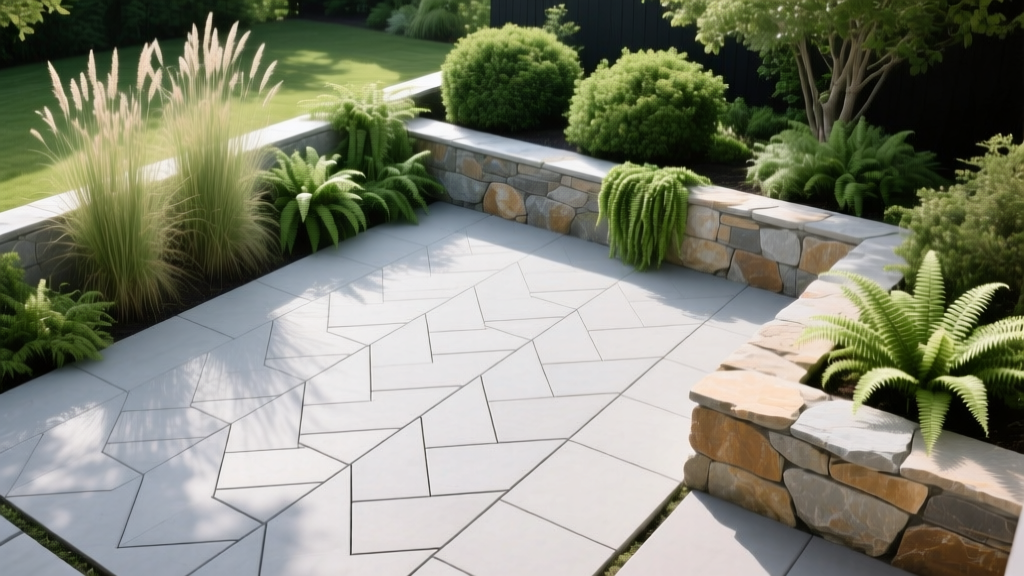
Use the following matrix to align your material choice with your specific site conditions, maintenance tolerance, and long-term expectations.
| Material | Cost per Sq Ft | Lifespan | Frost Heave Risk | Maintenance Level |
|---|---|---|---|---|
| Poured Concrete | $8 – $22 | 25 – 30 Years | High (Cracks) | Medium (Seal every 2 yrs) |
| Concrete Pavers | $16 – $30 | 50+ Years | Low (Flexible) | Low (Re-sand joints) |
| Natural Stone | $25 – $50+ | 50 – 100 Years | Medium (Depends on base) | High (Sealing, leveling) |
| Clay Brick | $18 – $35 | 50+ Years | Low (Flexible) | Medium (Efflorescence) |
Expert Verdict: Which Material Offers the Best ROI?
If your primary constraint is the initial cost to build a patio, a 4-inch broom-finished concrete slab is the undisputed winner. It provides immediate, usable outdoor space at the lowest barrier to entry. However, if you are evaluating the project through the lens of lifecycle cost and property value, interlocking concrete pavers offer the superior return on investment.
While pavers require a 40% to 60% higher upfront investment than basic concrete, their modular nature eliminates the catastrophic failure mode of a cracked slab. A tree root shifting beneath a concrete patio will destroy the slab, requiring a $3,000+ tear-out and replacement. That same root beneath a paver patio will simply lift a few units, which can be removed, the root excised, and the pavers reinstalled for under $200 in labor. For homeowners planning to stay in their homes for more than a decade, or those dealing with expansive clay soils and aggressive freeze-thaw cycles, the flexibility and repairability of pavers justify the premium in the initial cost to build a patio.
Written by
Elena RodriguezElena Rodriguez is a civil engineer and technical writer specializing in concrete technology, masonry systems, and ASTM/ACI compliance. She earned her B.S. in Civil Engineering from Texas A&M University and spent a decade at a materials testing laboratory, performing over 2,000 concrete compressive strength tests and masonry prism evaluations. Elena is an ACI-certified Field Testing Technician (Grade I) and a member of ASTM Committee C12 on Natural Building Stone. She currently consults on forensic engineering cases involving concrete failures and moisture intrusion. Based in San Antonio, TX, Elena is a proud member of the Society of Women Engineers (SWE) and coaches her daughter's FIRST Robotics team.
More from Elena Rodriguez
View all
Walls & Panels
Cost Analysis: Light Gauge Steel Framing Advantages and Disadvantages
Evaluate light gauge steel framing advantages and disadvantages through a strict cost analysis lens, comparing material, labor, and lifecycle expenses.
Aug 4, 2026

Walls & Panels
Gypsum Board Types: Exact Specifications, Thickness & Dimensions
Compare standard, Type X, and moisture-resistant gypsum board types. Get exact specifications, thicknesses, dimensions, and ASTM standards for your project.
Aug 4, 2026

Fire Resistance
Best Fire-Resistant Outdoor Decking Materials: 2026 Buyer Guide
Discover the best fire-resistant outdoor decking materials for 2026. Compare Class A PVC, aluminum, and hardwood options for WUI compliance and safety.
Aug 4, 2026