What Is Composite Decking Material? Core Types & Design Specs
Discover what composite decking material is, including WPC core anatomy, structural span limits, thermal expansion rules, and design planning costs.

The Polymer Matrix: What Composite Decking Material Actually Is
When architects and landscape designers ask, "what is composite decking material," the answer extends far beyond a simple wood alternative. Composite decking is an engineered Wood-Plastic Composite (WPC) designed to mitigate the moisture absorption, UV degradation, and biological decay inherent in natural timber. From a structural planning perspective, understanding its exact polymer matrix dictates everything from joist spacing to fastener selection and thermal tolerance.
Modern composite boards are manufactured through a co-extrusion process. The inner core typically consists of 50% to 60% fine wood flour (often reclaimed pine, bamboo, or rice hulls) blended with 40% to 50% recycled High-Density Polyethylene (HDPE) or Polyvinyl Chloride (PVC). This core provides the structural mass. During the final stage of extrusion, a protective outer layer—known as the cap—is fused to the core. This cap is usually formulated from Acrylonitrile Styrene Acrylate (ASA) or proprietary polymer blends, providing a non-porous shield against staining, mold, and UV fading.
Core Material Variations and Structural Implications
Not all composite decking shares the same structural profile. The specific polymer used in the core fundamentally alters the board's stiffness, weight, and maximum allowable span. When planning your deck framing, you must select the core type that aligns with your structural design.
| Core Type | Material Composition | Structural Characteristics | Best Design Application |
|---|---|---|---|
| Standard HDPE | Wood flour + High-Density Polyethylene | Heavier, more flexible. Prone to slight sagging over time if spans are maxed out. | Standard residential decks, ground-level patios, straight board layouts. |
| Advanced PVC | Cellular PVC core + Polymer cap | Lightweight, highly rigid. Allows for longer spans and complex bending. | Multi-level decks, curved fascia, rooftop terraces where weight is a concern. |
| Mineral-Based | Minerals + Polypropylene (Zero wood) | Extreme dimensional stability. Zero water absorption, highest strength-to-weight ratio. | Dock systems, ground-contact installations, high-moisture climates. |
According to the American Wood Council's DCA 6 Prescriptive Residential Deck Construction Guide, composite materials must be installed according to the manufacturer's specific span ratings, which often differ from natural lumber. While a 2x6 pressure-treated pine board can reliably span 24 inches on-center (OC), most 5.5-inch composite boards are strictly limited to 16 inches OC when laid perpendicular to joists.
Framing and Joist Span Requirements
Designing the substructure for composite decking requires stricter tolerances than traditional wood. Because WPC materials lack the sheer longitudinal strength of dense hardwoods like Ipe or Garapa, the framing must provide continuous, uniform support.
- Perpendicular Layouts: Maximum joist spacing is 16 inches OC for standard 1-inch thick boards. If using 2-inch thick composite (often used for commercial applications or heavy-duty stair treads), 24 inches OC may be permissible, but always verify with the specific brand's ICC-ES evaluation report.
- Diagonal Layouts (45-degree): If your design calls for a herringbone or diagonal pattern, you must reduce the joist spacing to 12 inches OC to prevent board deflection and bouncing.
- Cantilever Overhangs: Unlike wood, which can safely overhang a rim joist by up to 24 inches, composite decking is highly susceptible to sagging at the ends. Limit the overhang past the last joist to a maximum of 1 to 2 inches, depending on the manufacturer's specifications.
- Blocking Requirements: If you are utilizing hidden fastener systems that require a starting clip or end-gaps, solid wood blocking must be installed between joists at all board ends to provide a secure nailing surface for the starter clips.
Thermal Expansion and Fastener Selection
A critical failure point in composite deck planning is ignoring thermal dynamics. What is composite decking material in extreme heat? It is a thermoplastic that expands and contracts significantly along its length. While wood expands primarily across its width, composite expands longitudinally.
The standard engineering formula for WPC thermal expansion is approximately 1/16 inch per 10°F per 10 linear feet of board. If you install a 20-foot board on a 40°F autumn morning, and it reaches 120°F on the deck surface in mid-July, that single board will expand by roughly 1 inch. If both ends are rigidly screwed down, the board will buckle, warp, or tear the fasteners out of the joists.
Fastener Planning Rules:
- Never face-screw the field of the board. Use hidden clip systems (e.g., Trex Hideaway, TimberTech CONCEALoc) that grip the grooved edges and allow the board to slide longitudinally as temperatures fluctuate.
- End-gap calculations. When butting two boards end-to-end, calculate the gap based on the installation temperature. If installing at 70°F, leave a 1/8-inch gap. If installing at 40°F, leave a 3/16-inch to 1/4-inch gap to allow for summer expansion.
- Top-screwing perimeters. If you must face-screw for picture-framing or fascia, pre-drill oversized holes (1/4 inch) for a #8 or #10 stainless steel screw, and use a color-matched composite plug to hide the fastener while allowing the board to move beneath the screw head.
Heat Retention and Color Planning
Composite decking absorbs and retains more solar radiation than natural wood. In direct summer sunlight, dark composite colors (such as deep browns, charcoals, or mahogany tones) can reach surface temperatures of 140°F to 160°F, making them unusable for barefoot traffic.
When planning the deck's aesthetic, factor in the solar orientation of the site. For south- and west-facing decks with zero overhead shade, specify lighter color profiles (coastal grays, pale tans, or driftwood tones). Alternatively, specify mineral-based composite lines (such as Deckorators Voyage or MoistureShield Vantage), which utilize proprietary cooling technology and lighter core densities to run up to 30% cooler to the touch than traditional HDPE composites. For further material safety and performance standards, refer to the testing protocols published by the North American Decking and Railing Association (NADRA).
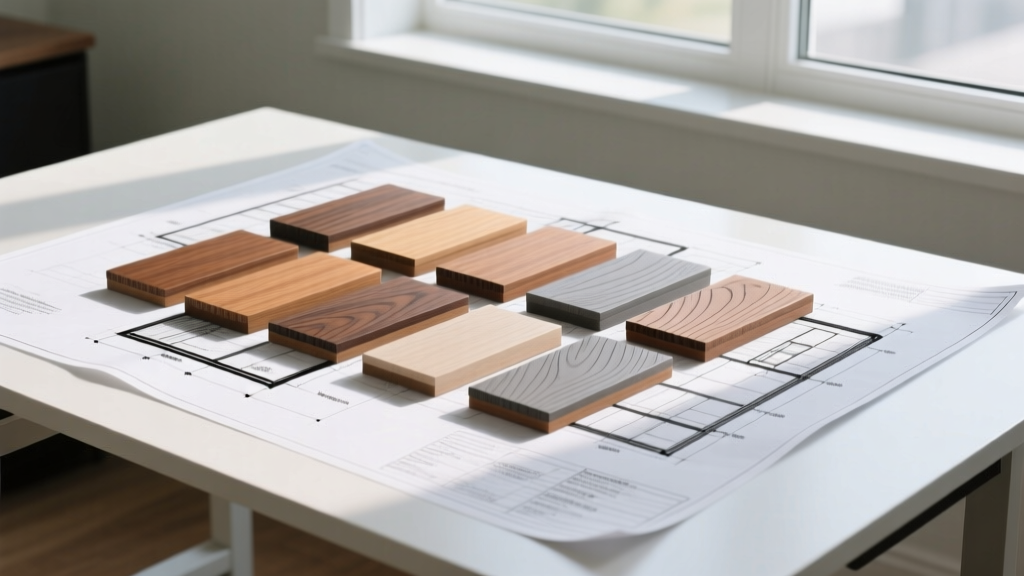
2026 Material Cost and Lifecycle Planning
Budgeting for composite decking requires looking past the initial material invoice. While the upfront cost is higher than pressure-treated pine, the elimination of annual sanding, staining, and sealing alters the 10-year lifecycle cost.
- Entry-Level Capped Composite: $7.00 - $9.00 per square foot (materials only). Features a thinner cap layer and repetitive wood-grain patterns. Best for budget-conscious flips or low-use areas.
- Mid-Tier Capped Composite: $9.50 - $12.50 per square foot. Includes deeper embossed grain textures, multi-tonal color streaking, and enhanced scratch resistance (e.g., Trex Select, Fiberon Paramount).
- Premium / Advanced PVC: $13.00 - $18.00+ per square foot. Features ultra-realistic wire-brushed textures, cathedral grain patterns, and superior rigidity for complex architectural designs (e.g., TimberTech Landmark, Trex Transcend Lineage).
Note: These figures represent the decking boards and hidden fasteners only. Substructure materials (joists, beams, footings) and labor will typically add an additional $15 to $25 per square foot to the total project cost.
Frequently Asked Design Questions
Can composite decking be used for structural framing or support posts?
No. Composite material lacks the compressive and shear strength required for structural loads. All load-bearing elements (posts, beams, joists) must be constructed from pressure-treated lumber, steel, or engineered structural composites specifically rated for load-bearing applications.
How do I handle transitions between composite decking and stone or concrete patios?
Is composite decking fire-rated for Wildland-Urban Interface (WUI) zones?
Standard HDPE composite is highly combustible. If you are building in a designated WUI zone (common in California and Colorado), you must specify specific fire-retardant treated composites or advanced PVC boards that have passed the ASTM E84 Class A flame spread rating and are listed on the state's approved WUI materials directory.
Written by
David NakamuraDavid Nakamura is a licensed architect (AIA) and construction technology writer focused on sustainable building methods, mass timber engineering, and high-performance building envelopes. He holds a Master of Architecture from the University of Washington and is a certified Passive House Consultant (CPHC). David spent eight years at the Seattle firm Mithun, where he led the design of three LEED Platinum projects, before founding his own practice specializing in net-zero residential design. He serves on the editorial advisory board of GreenBuilder Magazine and has authored peer-reviewed papers on cross-laminated timber (CLT) connections for the Journal of Structural Engineering. In his spare time, David teaches woodworking at Pratt Fine Arts Center and kayaks the Puget Sound.
More from David Nakamura
View all
Construction Cost
Labor Cost to Build a Deck Per Sq Ft: 2026 Installation Guide
Discover the exact labor cost to build a deck per sq ft in 2026. This installation guide breaks down contractor rates, complexity factors, and hidden fees.
Aug 4, 2026

Construction Cost
How Much Does It Cost to Build a 3 Bedroom House? Financing Guide
Learn exactly how much it costs to build a 3 bedroom house and explore 2026 financing options, construction loan types, and budget frameworks for your build.
Aug 4, 2026

Construction Cost
Cost to Build a Tennis Court: 2026 Guide
How much does it cost to build a tennis court in 2026? Breakdowns for asphalt, concrete, and synthetic surfaces plus fencing and lighting.
Jul 30, 2026