How to Choose the Most Durable Outside Decking Material for Your Climate
Compare the lifespan, failure modes, and climate suitability of every major outside decking material to build a deck that lasts decades.

The True Cost of Deck Degradation
Selecting an outside decking material is fundamentally a 25-year financial and structural decision. While initial installation costs dominate early research, the true expense lies in the material's degradation curve: the rate at which it succumbs to UV radiation, moisture intrusion, thermal cycling, and biological decay. A deck that requires annual sealing, board replacement, or early demolition completely negates any upfront savings.
To maximize your return on investment, you must match the material's specific failure modes to your local microclimate. What survives a decade in arid Nevada will rot in five years in coastal Florida. This guide breaks down the structural lifespan, exact degradation mechanisms, and climate-specific viability of the primary outside decking material categories available today.
The Lifespan Hierarchy: Data & Degradation Modes
The table below outlines the expected functional lifespan, primary failure vectors, and current 2026 market pricing for the most common outside decking material options. Pricing reflects material-only costs per square foot.
| Material Category | Expected Lifespan | Primary Failure Mode | Avg. Cost (Material/SqFt) |
|---|---|---|---|
| Pressure-Treated Pine | 10 - 15 Years | Checking, cupping, fungal decay | $4.50 - $6.50 |
| Cedar / Redwood | 15 - 20 Years | Surface erosion, UV graying, splintering | $7.00 - $11.00 |
| Capped Wood-Composite | 25 - 30 Years | Thermal expansion, mold in micro-scratches | $9.00 - $14.00 |
| Cellular PVC | 30 - 40 Years | UV chalking, extreme thermal movement | $12.00 - $18.00 |
| Tropical Hardwood (Ipe) | 40 - 50+ Years | End-grain checking, silvering (cosmetic) | $16.00 - $26.00 |
| Aluminum (Powder-Coated) | 50+ Years | Galvanic corrosion, coating fade | $19.00 - $28.00 |
Material Deep-Dive: Engineering & Edge Cases
Pressure-Treated Pine & Cedar (The Organic Decay Curve)
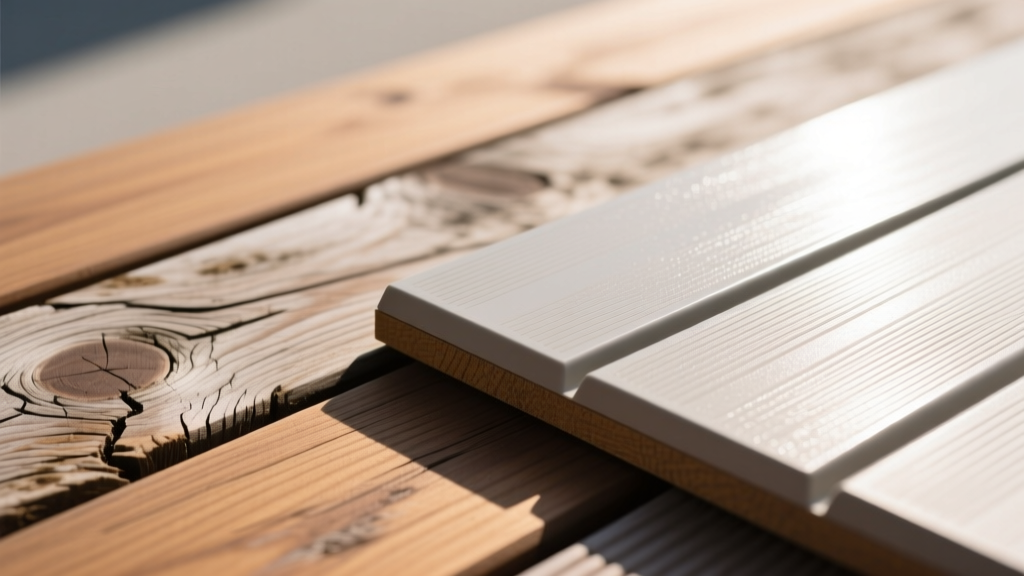
Wood is a hygroscopic material, meaning it constantly absorbs and releases moisture from the surrounding air. The primary enemy of pressure-treated southern yellow pine is not immediate rot, but dimensional instability. As the wood dries post-installation, it shrinks, leading to checking (deep cracks along the grain) and cupping.
To ensure longevity, you must verify the American Wood Protection Association (AWPA) Use Category stamped on the lumber. Decking boards should be rated UC4A (Above Ground), while structural posts embedded in or touching concrete must be rated UC4B (Ground Contact). Using UC4A lumber for posts is a critical edge-case failure that leads to substructural collapse within 7 to 10 years.
Capped Wood-Composite (Moisture & Thermal Dynamics)
First-generation composite decking (uncapped) is obsolete; it absorbed water and grew mold internally. Modern outside decking material in this category utilizes a co-extruded polymer cap (typically 2mm to 3mm thick) over a wood-flour and HDPE core. Brands like Trex Transcend Lineage and TimberTech Pro offer exceptional resistance to staining and fading.
The Hidden Flaw: Thermal expansion. Wood-plastic composites have a high coefficient of thermal expansion (CTE). A 16-foot composite board can expand or contract up to 1/4 inch across a 100°F temperature swing. If installers butt boards tightly together without leaving the manufacturer-mandated 1/8-inch to 3/16-inch gaps, the boards will buckle and pop fasteners during peak summer heat.
Cellular PVC (The Zero-Moisture Option)
Cellular PVC (such as AZEK Landmark) contains no wood fibers, making it entirely immune to rot, mold, and insect infestation. It is the premier outside decking material for high-moisture environments, including ground-level decks and docks. However, PVC is highly susceptible to UV degradation. Lower-tier PVC will "chalk" (develop a powdery white residue) as the UV stabilizers deplete. Always specify PVC with advanced capstock technology featuring integrated UV inhibitors and scratch-resistant matte finishes.
Tropical Hardwoods & Aluminum (The 50-Year Tier)
Ipe (Tabebuia spp.) boasts a Janka hardness rating of 3,680 lbf, making it virtually impervious to scratching and denting. Its natural oils and dense cell structure resist rot without chemical treatment. The mandatory maintenance for Ipe is applying a wax-based end-grain sealer (like Anchorseal) to every cut end during installation to prevent checking. If left untreated, Ipe will oxidize to a silvery-gray patina—this is a cosmetic change, not a structural failure.
Aluminum decking (extruded 6061-T6 alloy) is the ultimate fire-resistant and rot-proof option, heavily favored in Wildland-Urban Interface (WUI) zones. Ensure the aluminum features an AAMA 2604 certified powder-coat finish for maximum UV and salt-spray resistance.
Climate-Specific Decision Matrix
Use this framework to select the optimal outside decking material based on your primary environmental stressors.
| Climate Zone | Primary Stressor | Best Material Choice | Materials to Avoid |
|---|---|---|---|
| Coastal / Marine | Salt spray, high humidity, sand abrasion | Cellular PVC, Aluminum, Tropical Hardwood | Uncapped composite, standard steel fasteners |
| Arid / High Desert | Extreme UV, massive day/night temp swings | Aluminum, Capped Composite (light colors) | Dark PVC (heat retention), untreated Cedar |
| Humid / Subtropical | Constant moisture, moss, fungal spores | Cellular PVC, Aluminum | Pressure-treated pine, porous stone tile |
| Freeze-Thaw / Snow | Ice damming, snow load, de-icing salts | Capped Composite, Aluminum | Wood (traps water in grain, freezes and splits) |
Hidden Lifespan Killers: Fasteners and Substructure
The most durable outside decking material will fail prematurely if paired with incompatible hardware. Galvanic corrosion occurs when dissimilar metals interact in the presence of an electrolyte (rainwater or humidity).
- Coastal Zones (Within 1 mile of saltwater): You must use 316-grade stainless steel fasteners. 304-grade stainless will pit and rust in salt air. Brands like GRK and Simpson Strong-Tie offer specialized 316 marine-grade screws.
- ACQ and Copper Azole Treated Wood: Modern pressure-treated lumber contains high levels of copper, which rapidly corrodes standard galvanized nails and aluminum. Always use hot-dipped galvanized fasteners meeting ASTM A153 standards, or stainless steel.
- Composite/PVC Hidden Fasteners: Ensure the hidden clip system features a built-in gap-spacing guide and is constructed of glass-filled nylon or stainless steel to prevent snapping under thermal board movement.
Furthermore, the Federal Emergency Management Agency (FEMA) and local building codes increasingly mandate specific substructure protections in flood zones and high-wind areas. Applying a self-adhering butyl flashing tape (like Trex Protect or G-Tape) over every joist and ledger board seals the screw holes and prevents water from pooling on top of the wood framing, effectively doubling the life of your substructure.
Maintenance Schedules to Maximize Material Lifespan
Even "low-maintenance" materials require specific care to reach their maximum engineered lifespan. Adhere to these strict timelines:
Annual Requirements
- Composites & PVC: Wash with a mild soap and a soft-bristle brush in the spring. Do not use high-pressure power washers (keep PSI under 1,500 and maintain a 12-inch distance), as this will micro-scratch the polymer cap, creating pockets for mildew to embed.
- Wood Decking: Inspect for protruding nails/screws caused by winter freeze-thaw cycles. Re-drive or replace with coated deck screws.
Biennial (Every 2-3 Years) Requirements
- Pressure-Treated & Cedar: Clean with a specialized deck brightener (oxalic acid-based) to remove gray oxidized wood fibers, followed by a penetrating oil-based sealer. Film-forming finishes (like solid stains) will peel and require chemical stripping.
- Tropical Hardwoods: If you wish to maintain the original brown color, apply a UV-inhibiting hardwood oil (like Ipe Oil or Messmer's UV Plus). If you prefer the silver patina, simply scrub with a deck cleaner to remove organic debris and mildew.
Frequently Asked Questions
Does dark-colored composite decking warp faster than light-colored?
Yes. Darker colors absorb significantly more solar radiation, increasing the surface temperature of the board by up to 30°F compared to lighter shades. This accelerates thermal expansion and increases the risk of warping if the joist spacing exceeds the manufacturer's maximum (usually 16 inches on-center for straight lay, 12 inches on-center for diagonal lay).
Can I install aluminum decking over an existing wood frame?
You can, but you must isolate the aluminum from the pressure-treated wood. The copper in modern wood preservatives will cause galvanic corrosion of the aluminum. Install a continuous strip of butyl tape or a specialized PVC sleeper system between the wood joists and the aluminum decking boards to create a dielectric barrier.
Written by
David NakamuraDavid Nakamura is a licensed architect (AIA) and construction technology writer focused on sustainable building methods, mass timber engineering, and high-performance building envelopes. He holds a Master of Architecture from the University of Washington and is a certified Passive House Consultant (CPHC). David spent eight years at the Seattle firm Mithun, where he led the design of three LEED Platinum projects, before founding his own practice specializing in net-zero residential design. He serves on the editorial advisory board of GreenBuilder Magazine and has authored peer-reviewed papers on cross-laminated timber (CLT) connections for the Journal of Structural Engineering. In his spare time, David teaches woodworking at Pratt Fine Arts Center and kayaks the Puget Sound.
More from David Nakamura
View all
Construction Cost
Labor Cost to Build a Deck Per Sq Ft: 2026 Installation Guide
Discover the exact labor cost to build a deck per sq ft in 2026. This installation guide breaks down contractor rates, complexity factors, and hidden fees.
Aug 4, 2026

Construction Cost
How Much Does It Cost to Build a 3 Bedroom House? Financing Guide
Learn exactly how much it costs to build a 3 bedroom house and explore 2026 financing options, construction loan types, and budget frameworks for your build.
Aug 4, 2026

Construction Cost
Cost to Build a Tennis Court: 2026 Guide
How much does it cost to build a tennis court in 2026? Breakdowns for asphalt, concrete, and synthetic surfaces plus fencing and lighting.
Jul 30, 2026