The Ultimate Decking Material Selection Framework for Any Climate
Master our 4-variable decking material selection framework. Compare costs, joist spans, and climate performance for composite, PVC, and wood.
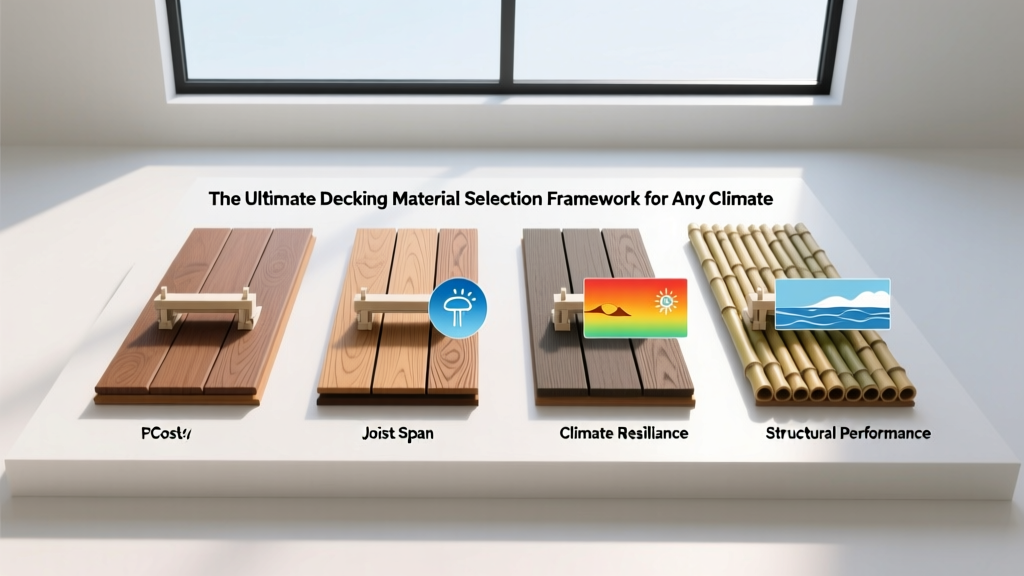
The 4-Variable Decking Material Decision Matrix
Choosing the right decking material requires moving beyond basic aesthetics and evaluating structural physics, microclimate data, and long-term lifecycle costs. Most selection guides rely on superficial pros and cons. As a structural framework, we evaluate every decking material across four non-negotiable variables: moisture absorption rates, thermal expansion coefficients, structural deflection limits, and localized fire codes. This matrix eliminates guesswork and aligns your material choice with the specific physical demands of your build site.
Variable 1: Microclimate & Moisture Exposure
Moisture dictates the lifespan of any outdoor structure. For ground-level decks or builds in high-humidity coastal zones, cellular PVC (such as TimberTech Advanced PVC Landmark Series) is mandatory. PVC features a closed-cell structure with a water absorption rate of less than 1%, compared to capped wood-plastic composites (WPC) which can absorb up to 3-5% moisture if the polymer cap is scratched or compromised during installation. In arid, high-UV environments, thermally modified woods (like Kebony or Thermory) outperform standard composites because the thermal modification process permanently alters the wood's cellular structure, reducing equilibrium moisture content (EMC) and preventing the severe cupping seen in untreated hardwoods.
Variable 2: Joist Span & Structural Deflection
A common catastrophic failure in DIY and contractor builds is ignoring the specific span requirements of synthetic decking materials. While pressure-treated Southern Yellow Pine can easily span 16 inches on-center (OC) at a 40 psf live load, many capped composite boards require 12-inch OC joist spacing if installed in a diagonal (45-degree) pattern to prevent mid-span sagging. Always cross-reference the manufacturer's specific span tables with the American Wood Council (AWC) span guidelines to ensure your framing substrate can support the dead load of heavier materials like Ipe, which weighs roughly 3.5 lbs per linear foot compared to 1.2 lbs for standard composite.
Material Deep-Dive: Performance vs. Cost Breakdown
The following matrix synthesizes 2026 market pricing, structural limitations, and maintenance realities for the five dominant decking categories. Costs reflect material-only pricing per square foot; framing and labor will add $12 to $25 per square foot depending on regional rates.
| Material Category | Avg Cost / Sq Ft (Material) | Maintenance Cycle | Max Joist Span (Straight) | Heat Retention & Expansion |
|---|---|---|---|---|
| Pressure-Treated Pine | $3.50 - $5.00 | Annual sealing/staining | 16' OC (12' OC diagonal) | Low heat, high warping/shrinking |
| Capped Composite (WPC) | $8.50 - $13.00 | Bi-annual soap wash | 16' OC (12' OC diagonal) | Moderate heat, low linear expansion |
| Cellular PVC | $12.00 - $18.50 | Occasional wash, stain removal | 16' OC (12' OC diagonal) | High heat reflection, high linear expansion |
| Thermally Modified Ash | $9.00 - $14.00 | Tri-annual UV oil (optional) | 16' OC | Low heat, exceptional dimensional stability |
| Tropical Hardwood (Ipe) | $16.00 - $24.00 | Annual oiling (if color retention desired) | 24' OC (due to density) | Low heat, virtually zero expansion |
Edge Cases: When Standard Recommendations Fail
Standard selection advice assumes a typical elevated deck with 24 inches of cross-ventilation. When your project deviates from this norm, material selection must pivot drastically.
Warning: Ground-Level & Sleeper Decks
If your deck framing sits directly on sleepers over concrete or features less than 18 inches of ground clearance, cross-ventilation is effectively zero. Capped composites and standard wood will trap moisture on the underside, leading to severe cupping, mold, and structural rot within 24 months. For low-clearance builds, you must use fully waterproof cellular PVC, marine-grade aluminum decking, or porcelain pavers on pedestal systems.
Pro-Tip: Wildland-Urban Interface (WUI) Fire Zones
If you are building in California, Colorado, or other regions with strict WUI fire codes, standard wood and many composites will fail inspection. You must select a decking material with a Class A flame spread rating. Products like Fiberon Promenade PVC or specific heavy-gauge aluminum decking systems are pre-approved for WUI zones. Always verify the specific product's ICC-ES evaluation report before purchasing.
The Hidden Cost Multipliers in 2026
When budgeting your decking material, the sticker price of the boards is only 60% of the actual material cost. The remaining 40% is consumed by the hidden hardware and specialized fasteners required to execute the build correctly.
- Hidden Fastener Systems: Standard top-down composite screws are outdated. Using a hidden clip system (like Trex Hideaway) adds roughly $1.50 per square foot. If you prefer top-down fastening for a cleaner look on PVC, color-matched structural plugs (like TimberTech Cortex) cost up to $2.50 per square foot and require a specialized setting tool.
- Joist Protection Tape: According to research on wood decay from the USDA Forest Products Laboratory, moisture trapped between composite boards and wooden joists accelerates joist rot. Applying butyl joist tape (e.g., Trex Protect) to all framing members adds $0.60 per linear foot of framing but doubles the lifespan of your substructure.
- Thermal Gapping Hardware: Cellular PVC expands and contracts significantly with temperature fluctuations (up to 1/8 inch per 10 degrees Fahrenheit per 10-foot board). Installing PVC requires specialized gap gauges and temperature-specific fastening schedules to prevent buckling in summer or massive gaps in winter.
Final Selection Flowchart
Use this deterministic logic flow to lock in your exact material specification:
- Step 1: Assess Clearance. Is the deck less than 18 inches off the ground?
- Yes: Stop. Choose Cellular PVC or Aluminum.
- No: Proceed to Step 2.
- Step 2: Assess Fire Codes. Are you in a designated WUI zone?
- Yes: Filter for Class-A rated PVC or Aluminum.
- No: Proceed to Step 3.
- Step 3: Define Maintenance Tolerance. Will you oil or seal the deck annually?
- Yes: Choose Ipe or Thermally Modified Wood for premium aesthetics.
- No: Proceed to Step 4.
- Step 4: Evaluate Budget & Heat. Is the deck facing South/West in a high-heat climate?
- Yes: Avoid dark-colored composites. Choose light-colored PVC, Thermally Modified Wood, or Aluminum to prevent barefoot burns.
- No: Capped Composite (WPC) offers the best balance of cost, aesthetics, and low maintenance.
By running your project parameters through this framework, you eliminate the risk of material failure, ensure code compliance, and accurately forecast the true lifecycle cost of your outdoor living space.
Written by
Marcus ChenMarcus Chen is a licensed structural engineer (PE) and building materials analyst with over 12 years of experience across residential, commercial, and industrial construction. He holds a Master of Science in Civil Engineering from UC Berkeley and spent six years at Thornton Tomasetti before transitioning to independent consulting and technical writing. Marcus specializes in material selection for seismic-prone regions, concrete reinforcement strategies, and lifecycle cost analysis. His work has been cited by the American Concrete Institute (ACI) and the Structural Engineers Association of California (SEAOC). When he is not on a job site or at his desk, you will find him hiking the Sierra Nevada or restoring a 1920s craftsman bungalow in Oakland, CA.
More from Marcus Chen
View all
Construction Cost
How Much Did the Eiffel Tower Cost to Build?
How much did the Eiffel Tower cost to build in 1889? We adjust for inflation and compare its budget to modern skyscraper construction.
Aug 4, 2026

Fire Resistance
What Is a Fire Resistant Material? Testing & Certification Guide
Discover what is a fire resistant material through ASTM and UL testing. Learn how fire ratings, certifications, and assemblies work in construction.
Aug 4, 2026

Construction Cost
How Much Did the Burj Khalifa Cost to Build?
How much did the Burj Khalifa cost to build? We break down the $1.5B project and extract 5 money-saving strategies for your next build.
Jul 30, 2026