Red on Deck: Redwood vs Composite Decking Selection
Compare redwood, tropical hardwoods, and red composite decking. Expert 2026 material taxonomy, pricing, and climate-specific selection frameworks.
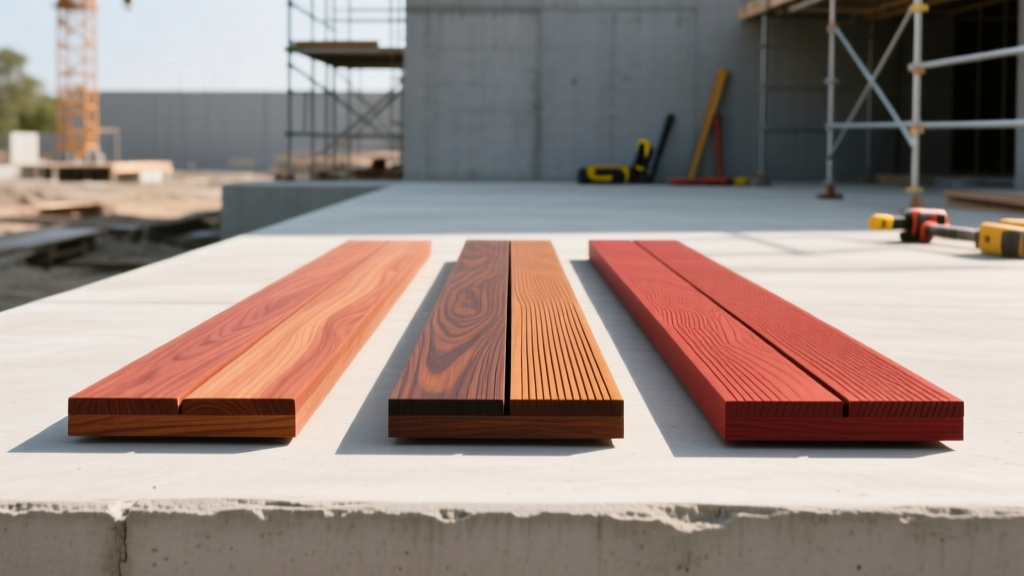
The Material Taxonomy of Red-Toned Decking
When homeowners and architects decide to bring red on deck, they are typically choosing between three distinct material categories: natural California redwood, tropical red hardwoods, and engineered red-hued composites. Each category possesses unique cellular structures, maintenance requirements, and thermal behaviors. Understanding this taxonomy is critical for selecting a material that will survive your specific microclimate without premature failure or aesthetic degradation.
California Redwood (Sequoia sempervirens)
Redwood remains the benchmark for natural red decking due to its high tannin and extractive content, which provides natural resistance to decay and insects without chemical treatment. However, not all redwood is equal. The California Redwood Association classifies decking boards into distinct grades that dictate both price and performance:
- Clear Heart: 100% heartwood, knot-free, and dimensionally stable. This is the premium tier, costing between $14.00 and $20.00 per linear foot in 2026. It is best for high-visibility, luxury applications.
- Select Heart (B Grade): Contains heartwood but allows tight, sound knots. Priced at $9.00 to $13.00 per linear foot, it offers the same rot resistance as Clear Heart but with a more rustic visual profile.
- Construction Heart: The most economical option ($5.00 to $8.00 per linear foot), featuring larger knots and some sapwood. Sapwood lacks the decay-resistant tannins of the heartwood, making it susceptible to rot if in direct ground contact.
Tropical Red Hardwoods (Red Balau & African Mahogany)
For structural density, tropical hardwoods outperform redwood significantly. Red Balau (often marketed as Batu) boasts a Janka hardness rating of 2,200 lbf, compared to redwood’s 420 lbf. This density makes it highly resistant to scratching and denting, but it also introduces installation challenges. Tropical hardwoods are prone to end-grain checking (splitting) when exposed to rapid moisture loss. Every cut end must be sealed immediately with a commercial wax emulsion like Anchorseal. Furthermore, sourcing requires strict adherence to Forest Stewardship Council (FSC) certification to ensure the timber is not linked to illegal deforestation.
Capped Polymer & Composite (Red Hues)
Modern composite and PVC decking achieve red tones through co-extruded polymer shells containing UV-inhibited pigments. Unlike early-generation composites that were dyed all the way through, 2026 capped composites feature a hard, impermeable outer layer (often 1/16th of an inch thick) over a recycled wood-plastic core. While they eliminate the need for sealing, deep red and brown composite boards absorb significant solar radiation. In direct, unshaded sunlight, dark red composite surfaces can reach 145°F to 155°F, necessitating the use of pergolas or lighter red-toned variants (like 'Spiced Rum' or 'Sienna') in barefoot traffic zones.
2026 Material Selection & Performance Matrix
The following matrix compares the physical and economic properties of the primary red decking materials available on the market.
| Material Type | Janka Hardness / Density | 2026 Material Cost (per sq. ft.) | Maintenance Cycle | Thermal Expansion |
|---|---|---|---|---|
| Clear Heart Redwood | 420 lbf | $12.50 - $16.00 | 12-18 months (Clean & Seal) | Moderate (Swells with moisture) |
| Red Balau (Batu) | 2,200 lbf | $11.00 - $14.50 | 24-36 months (UV Oil) | Low (Highly stable) |
| Capped Wood-Plastic Composite | N/A (Durometer 75D Shell) | $9.50 - $13.00 | None (Soap & Water only) | High (Expands/contracts with heat) |
| Capped Cellular PVC | N/A (Lightweight Core) | $13.00 - $17.50 | None | Very High (Requires specific gapping) |
The Hidden Chemistry: Tannins, Fasteners, and Staining
A common failure mode in natural red decking is improper fastener selection. Redwood and tropical hardwoods are rich in tannic acid. If you use standard galvanized steel or zinc-coated screws, a chemical reaction occurs between the zinc and the tannins, resulting in permanent, unsightly black streaks running down the board grain.
Never use electro-galvanized or hot-dipped galvanized fasteners on redwood. You must use Type 304 stainless steel for inland projects, and Type 316 marine-grade stainless steel for installations within 5 miles of a saltwater coast. Furthermore, redwood tannins will 'bleed' onto adjacent porous materials during the first few rainstorms. If your deck abuts light-colored stucco or concrete pavers, pre-weather the boards or apply a tannin-blocking barrier to the adjacent surfaces.
Composite decking bypasses this chemical reactivity, allowing for the use of standard stainless steel or specialized hidden composite fasteners. However, composite hidden clip systems require strict adherence to manufacturer-specified gapping (usually 1/8 inch side-to-side and 3/16 inch end-to-end) to accommodate thermal expansion. Failing to leave this gap in red-toned composites will result in board buckling during peak summer heat.
Lifecycle Cost Analysis: 25-Year Projection
While material acquisition costs are heavily scrutinized, the true cost of red decking is realized over its lifecycle. According to lifecycle analyses referenced by the North American Deck and Railing Association (NADRA), maintenance labor and consumables drastically alter the 25-year ROI.
- Redwood (25 Years): Initial material cost for a 400 sq. ft. deck (Select Heart) is ~$4,800. However, professional cleaning and penetrating oil sealing every 18 months costs roughly $800 per service. Over 25 years (approx. 16 services), maintenance totals $12,800. Total 25-year cost: $17,600.
- Capped Composite (25 Years): Initial material cost for a 400 sq. ft. deck is ~$5,200. Maintenance requires only bi-annual washing with a mild detergent, costing roughly $50 in supplies if done by the homeowner. Total 25-year cost: $5,450.
While redwood offers an unmatched natural aroma, tactile warmth, and authentic grain, it is fundamentally a high-maintenance luxury. If the homeowner lacks the time or budget for annual sealing, a red-hued capped composite is the mathematically superior choice.
Climate-Specific Decision Framework
Selecting the right red material requires aligning the wood's cellular properties with your regional climate data.
Arid & High-UV Environments (Southwest US)
In regions with intense UV exposure and low humidity, natural redwood will rapidly photo-degrade, turning a silvery-gray within six months unless shaded or sealed with heavy pigmented UV blockers. Tropical hardwoods like Red Balau perform better here due to their density, but they still require annual UV oil applications to maintain their red hue. Recommendation: Choose a lighter red-toned capped PVC, which reflects more solar energy and contains UV stabilizers molded directly into the polymer shell.
Moist & Temperate Environments (Pacific Northwest)
Constant moisture and shade promote moss and mildew growth. While redwood is naturally resistant to rot, it will hold moisture and become slippery if not kept clean. Recommendation: Capped composite decking is ideal here, as its non-porous polymer shell prevents moss from rooting into the material, allowing for easy removal with a simple pressure wash.
Coastal & Salt-Air Environments
Salt spray accelerates the corrosion of hardware and degrades wood fibers. Recommendation: Use Capped Cellular PVC with Type 316 stainless steel hidden fasteners. PVC absorbs zero moisture, eliminating the risk of saltwater wicking into the board core and causing freeze-thaw spalling in northern coastal regions.
Final Procurement Checklist
Before finalizing your material order, verify the following specifications with your supplier:
- For Redwood: Confirm the grade is 'Heart' (Select or Clear). Reject boards with more than 15% sapwood on the face. Ensure boards are kiln-dried after treatment (KDAT) to minimize initial shrinkage.
- For Tropical Hardwoods: Demand FSC-Certified documentation. Verify the supplier has pre-sealed the end grains or include a commercial end-sealer in your order.
- For Composites: Check the manufacturer's fade and stain warranty. Ensure you are ordering the correct hidden fastener clips specifically engineered for that brand's groove profile, as clip geometries are not universally interchangeable.