PVC Deck Materials Cost Breakdown & 2026 Pricing Guide
Discover the true cost of PVC deck materials in 2026. Get detailed pricing for AZEK, TimberTech, and Wolf, plus hidden installation expenses.
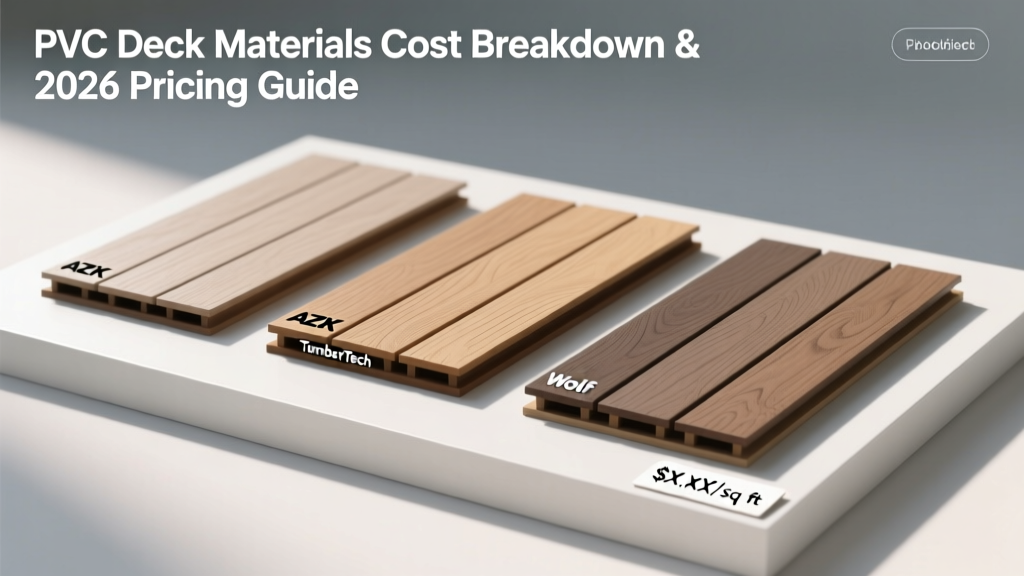
The Real Cost of PVC Decking in 2026
Polyvinyl chloride (PVC) decking represents the premium tier of the synthetic outdoor flooring market. Unlike wood-plastic composites that blend recycled wood fibers with plastics, 100% PVC deck materials contain zero organic matter. This molecular distinction makes PVC entirely impervious to moisture absorption, mold, and rot, but it also commands a higher upfront investment. For homeowners and contractors planning a build in 2026, understanding the exact financial outlay requires looking beyond the sticker price of the boards themselves.
The total cost of a PVC deck is influenced by material tiering, mandatory substructure reinforcements, specialized fasteners, and labor premiums associated with handling polymer boards. This comprehensive cost breakdown details the exact pricing, hidden expenses, and long-term financial implications of choosing PVC over traditional wood or composite alternatives.
Material Costs by Brand and Tier
PVC decking is not a monolith; pricing varies drastically based on the thickness of the polymer cap, the realism of the embossed wood grain, and whether the manufacturer offers multi-width board options. In 2026, top-tier manufacturers like AZEK and TimberTech dominate the premium segment, while brands like Wolf and Fiberon offer competitive mid-tier options.
| Brand / Product Line | Profile Type | Price per Linear Foot (6" Board) | Price per Sq Ft (Materials Only) |
|---|---|---|---|
| AZEK Landmark Series | Capped Polymer, Multi-Width | $7.80 - $9.50 | $12.50 - $15.00 |
| TimberTech Advanced PVC | Capped Polymer, Standard | $6.90 - $8.60 | $11.00 - $13.50 |
| Wolf Serenity | Capped Cellular PVC | $5.60 - $7.20 | $9.00 - $11.50 |
| Fiberon Promenade | Capped Polymer, Standard | $6.20 - $7.90 | $9.50 - $12.50 |
Why the Price Gap?
The delta between Wolf Serenity and AZEK Landmark comes down to manufacturing complexity. AZEK's Landmark series utilizes a proprietary alloy technology and multi-width boards (wide, narrow, and standard) that mimic the randomized look of real hardwood flooring. This aesthetic upgrade requires more complex extrusion dies and quality control, pushing the cost per square foot up by roughly 20% compared to standard-width, single-color PVC boards.
Hidden Costs: Substructure and Framing Requirements
One of the most frequently overlooked expenses in PVC deck construction is the substructure. Because PVC lacks the internal wood-fiber rigidity of composite or natural lumber, it is inherently more flexible. This physical characteristic dictates strict joist spacing requirements that directly increase framing costs.
Critical Framing Specifications for PVC
- Standard Install (Perpendicular): Joists must be spaced a maximum of 16 inches on center (OC).
- Diagonal Install (45-degree angle): Joists must be spaced a maximum of 12 inches on center (OC).
- Cost Impact: Upgrading from a standard 16" OC pressure-treated pine frame to a 12" OC frame increases lumber and labor costs for the substructure by approximately 18% to 22%.
Furthermore, because PVC is highly susceptible to thermal expansion and contraction, the framing must be perfectly level. Any variance in joist height will cause the flexible PVC boards to bounce or squeak. Contractors must spend additional time shimming and leveling the joists, or opt for a steel framing system like Trex Elevate, which adds $4.00 to $6.50 per square foot to the substructure budget but guarantees a perfectly flat, non-warping base.
Fasteners, Trims, and Accessories
You cannot use standard decking screws or generic composite hidden clips on PVC materials. The polymer surface requires specific fastening solutions to prevent surface dimpling, cracking, or visible rust stains. According to industry data tracked by Forbes Home Improvement, fastener and trim costs can account for up to 12% of the total material budget for premium synthetic decks.
- Color-Matched Screw and Plug Systems: The gold standard for PVC is the Cortex system. These kits include specialized torx-drive screws and matching PVC plugs. Expect to pay roughly $115 per 500-square-foot box. For a 400 sq ft deck, budget $100 just for face-fastening plugs.
- Hidden Fastener Clips: If using grooved PVC boards, manufacturer-specific stainless steel or polymer clips are required. These cost between $0.85 and $1.20 per clip. At one clip per joist intersection, a 400 sq ft deck requires roughly 450 clips, adding $380 to $540 to the budget.
- Fascia and Riser Boards: PVC expands significantly on its width. Installing PVC fascia requires specialized face-mounting techniques with oversized holes and cap washers to allow for lateral movement. PVC fascia boards are typically sold in 12-foot lengths and cost $45 to $65 per board.
Labor Premiums and Installation Nuances
Contractors routinely charge a labor premium for PVC deck materials, typically ranging from $18 to $32 per square foot, compared to $14 to $24 for standard composites. This premium is not arbitrary; it reflects the technical precision required to work with polymer boards.
Thermal Expansion Management
PVC expands and contracts linearly with temperature fluctuations. A 16-foot PVC board can expand up to 1/8 of an inch over a 40°F temperature swing. Installers must calculate the exact gapping requirements based on the ambient temperature on the day of installation. For example, if installing on a 50°F morning, a 1/16-inch gap is required at the butt joints; if installing on an 80°F afternoon, the boards must be placed tight. Failure to calculate this gap results in buckled boards in the summer or pulled fasteners in the winter.
Cutting and Fabrication
Standard 24-tooth framing blades will chip and melt the polymer cap on PVC boards. Installers must use 60-tooth or 80-tooth fine-finish carbide-tipped blades designed for plastics and aluminum. Additionally, cutting generates fine polymer dust that carries a static charge, clinging to the deck surface. Installers must clean the boards immediately after cutting to prevent the dust from baking into the surface under the sun, which adds time to the labor clock.
Long-Term ROI: The 10-Year Cost Reality
While the initial capital expenditure for PVC deck materials is undeniably high, the total cost of ownership over a decade tells a different story. When evaluating your budget, it is crucial to factor in the maintenance costs of alternative materials.
| Material Type | Initial Material Cost (400 sq ft) | 10-Year Maintenance Cost | Total 10-Year Cost |
|---|---|---|---|
| Pressure-Treated Wood | $1,600 - $2,400 | $1,800 - $2,500 (Staining, sealing, repairs) | $3,400 - $4,900 |
| Capped Wood-Plastic Composite | $3,200 - $4,800 | $400 - $600 (Specialized cleaning, mold treatment) | $3,600 - $5,400 |
| Premium PVC Decking | $4,400 - $6,000 | $50 - $150 (Basic soap and water washing) | $4,450 - $6,150 |
By year seven, the cumulative cost of maintaining a pressure-treated wood deck typically surpasses the initial investment of a PVC deck. Furthermore, PVC materials consistently retain 70% to 80% of their value in home appraisals, making them a highly defensible investment in high-moisture or coastal environments where wood rot is a primary concern.
Expert Strategies for Reducing PVC Decking Costs
If your budget is tight but you refuse to compromise on the moisture-resistant benefits of PVC, implement these professional cost-saving strategies:
- Utilize Square-Edge Boards for Perimeters: Grooved boards are necessary for hidden fasteners in the main field, but they cost roughly 10% more than square-edge boards. Use cheaper square-edge PVC boards for the outer fascia and picture-frame borders, face-fastening them with Cortex plugs. This creates a clean, finished edge while reducing the total number of expensive grooved boards and hidden clips required.
- Optimize Board Lengths to Minimize Waste: PVC boards are sold in 12-foot, 16-foot, and 20-foot lengths. Design your deck dimensions in multiples of these lengths. If your deck is 15 feet deep, you will have to cut down 16-foot boards, wasting 1 foot of expensive polymer per joist line. Designing the deck to be exactly 16 feet deep eliminates end-cuts and reduces material waste to near zero.
- Apply Joist Tape to Standard Framing: Instead of upgrading to a full steel substructure, use standard pressure-treated pine joists but apply a high-quality butyl joist tape (like Trex Protect) to the top of every joist. This costs roughly $0.40 per linear foot, seals the wood from moisture, and prevents the squeaking that occurs when PVC rubs against untreated wood.
- Time Your Material Purchase: Building material suppliers frequently implement peak-season surcharges between May and July. Purchasing your PVC materials in late February or early March often secures early-spring distributor discounts and locks in pricing before summer demand drives up the per-board cost.
Written by
Elena RodriguezElena Rodriguez is a civil engineer and technical writer specializing in concrete technology, masonry systems, and ASTM/ACI compliance. She earned her B.S. in Civil Engineering from Texas A&M University and spent a decade at a materials testing laboratory, performing over 2,000 concrete compressive strength tests and masonry prism evaluations. Elena is an ACI-certified Field Testing Technician (Grade I) and a member of ASTM Committee C12 on Natural Building Stone. She currently consults on forensic engineering cases involving concrete failures and moisture intrusion. Based in San Antonio, TX, Elena is a proud member of the Society of Women Engineers (SWE) and coaches her daughter's FIRST Robotics team.
More from Elena Rodriguez
View all
Walls & Panels
Cost Analysis: Light Gauge Steel Framing Advantages and Disadvantages
Evaluate light gauge steel framing advantages and disadvantages through a strict cost analysis lens, comparing material, labor, and lifecycle expenses.
Aug 4, 2026

Walls & Panels
Gypsum Board Types: Exact Specifications, Thickness & Dimensions
Compare standard, Type X, and moisture-resistant gypsum board types. Get exact specifications, thicknesses, dimensions, and ASTM standards for your project.
Aug 4, 2026

Fire Resistance
Best Fire-Resistant Outdoor Decking Materials: 2026 Buyer Guide
Discover the best fire-resistant outdoor decking materials for 2026. Compare Class A PVC, aluminum, and hardwood options for WUI compliance and safety.
Aug 4, 2026