How Much Would It Cost to Build a Small Deck in 2026?
Discover exactly how much it would cost to build a small deck in 2026. Get real pricing for materials, labor, permits, and hidden fees for 12x12 builds.
The Bottom Line for 2026
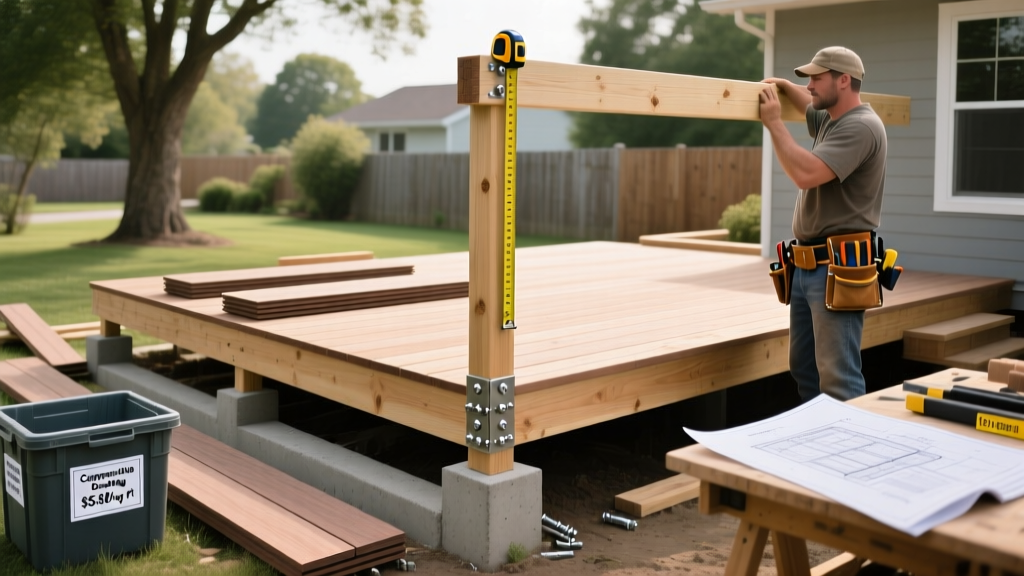
When homeowners ask how much would it cost to build a small deck, the answer for a standard 12x12 foot (144 square feet) attached platform ranges from $4,200 for basic pressure-treated pine to $12,800 for premium PVC. The national average sits at $7,450, assuming professional installation, standard concrete footings, and a 36-inch railing system on three exposed sides.
2026 Pricing Matrix: Small Deck Costs by Material
Material selection dictates 40% to 60% of your total budget. The table below breaks down the exact material and labor costs for a 144-square-foot (12x12) deck, excluding demolition of an existing structure or complex grading.
| Decking Material | Material Cost (per sq. ft.) | Total Material (144 sq. ft.) | Labor Cost (per sq. ft.) | Total Installed Cost |
|---|---|---|---|---|
| Pressure-Treated Pine (Southern Yellow) | $3.50 - $5.00 | $504 - $720 | $18.00 - $22.00 | $3,096 - $3,888 |
| Composite (e.g., Trex Enhance / Select) | $8.50 - $11.00 | $1,224 - $1,584 | $22.00 - $26.00 | $4,392 - $5,328 |
| Capped Polymer / PVC (e.g., Azek Landmark) | $13.00 - $17.00 | $1,872 - $2,448 | $25.00 - $30.00 | $5,472 - $6,768 |
| Hardwood (Ipe / Tigerwood) | $14.00 - $19.00 | $2,016 - $2,736 | $28.00 - $35.00 | $6,048 - $7,776 |
Note: These figures cover the decking boards, hidden fasteners, and substructure framing. Railings, stairs, and permits are calculated separately below.
Phase-by-Phase Installation Cost Breakdown
To understand where your money goes, we must look at the build sequence. According to Angi's comprehensive deck cost guide, labor and site preparation often surprise first-time builders. Here is the financial reality of each construction phase for a 12x12 build.
Phase 1: Site Prep, Layout, and Footings ($800 - $1,400)
A 12x12 deck requires a minimum of six to eight structural footings to comply with International Residential Code (IRC) Section R507. Contractors typically use 10-inch or 12-inch Sonotube forms filled with 4,000 PSI concrete. Each poured pier costs between $65 and $95 in materials and labor. If your soil has a high clay content or poor load-bearing capacity, the inspector may mandate helical piles, which cost $250 to $400 per pier installed, drastically increasing this phase's budget.
Phase 2: Framing and Ledger Attachment ($1,100 - $1,600)
The substructure is almost exclusively built from #2 grade pressure-treated Southern Yellow Pine. For a 12x12 deck, you will need approximately twenty-two 2x8x12 joists, spaced 16 inches on-center (OC). The critical expense here is structural hardware. Galvanized joist hangers, LedgerLOK structural screws for the ledger board, and butyl flashing tape (essential for preventing water intrusion against the house rim joist) add $350 to $500 in pure hardware costs.
Phase 3: Decking and Fasteners ($1,200 - $4,500)
This is where your material choice impacts the bottom line. If you choose composite decking, you must factor in the fastening system. Face-screwing composite boards with color-matched stainless steel screws is the cheapest route ($80 for the whole deck). However, most homeowners opt for hidden clip systems (like the Trex Hideaway or TimberTech CONCEALoc), which add $1.50 to $2.50 per square foot to the material cost but provide a clean, screw-free surface.
Phase 4: Railings and Stairs ($1,200 - $3,500)
A 12x12 deck typically features 36 linear feet of railing (assuming one 12-foot side is attached to the house). Standard pressure-treated wood railings cost $25 to $40 per linear foot installed. Upgrading to composite railings with black aluminum balusters pushes the cost to $75 to $110 per linear foot. Furthermore, a standard 4-foot wide staircase with three to four treads will add $800 to $1,500 to the project, as stair stringers and angled fascia require precision cutting and extra labor.
The 'Small Deck' Trap: Why Price-Per-Square-Foot Lies
When researching how much it would cost to build a small deck, you will frequently see national averages citing $30 to $45 per square foot. Do not apply this metric to a 10x10 or 12x12 deck.
The Economy of Scale Deficit
Small decks suffer from a lack of economies of scale. Fixed costs—such as the building permit ($150–$400), contractor mobilization, tool setup, and concrete delivery minimums—are amortized over a much smaller square footage. While a 500-square-foot deck might cost $40 per square foot to build, a 144-square-foot deck will often cost $65 to $85 per square foot because those fixed baseline costs represent a much larger percentage of the total budget.
Hidden Costs That Blow Up Small Deck Budgets
Budgeting strictly for wood, concrete, and labor leaves you vulnerable to secondary expenses. Factor these line items into your 2026 spreadsheet:
- Permitting and HOA Fees: Municipalities require structural plans and plot surveys. Expect to pay $150 to $450 for the permit. If you live in an HOA, architectural review applications may carry a $100 to $250 processing fee.
- Demolition and Haul-Away: If you are replacing an existing 12x12 deck, contractors charge $4 to $8 per square foot for tear-down and dumpster fees. Budget $600 to $900 for removal.
- Electrical and Gas Routing: Running a dedicated 20-amp GFCI circuit for outdoor lighting or a receptacle requires a licensed electrician, adding $600 to $1,200. If you are routing a gas line for a future fire pit, expect $800 to $1,500.
- Ground Slope and Retaining: If your backyard slopes downward more than 12 inches over the 12-foot span, you will need to either build a taller retaining wall under the deck or install engineered drop-beams and cross-bracing, adding $1,000 to $2,500.
DIY vs. Professional Installation: The Real Math
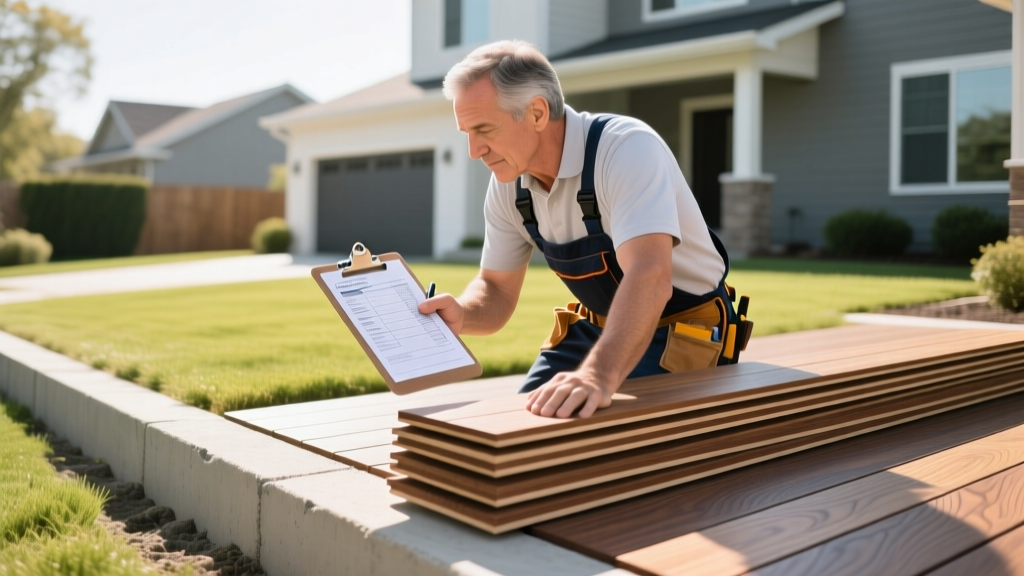
Building your own 12x12 deck saves the labor markup, which typically accounts for 50% to 60% of the total invoice. According to HomeGuide's deck building cost estimator, a DIY composite deck build will cost roughly $2,500 to $3,500 in materials and tool rentals. However, you must weigh this against the following realities:
- Tool Acquisition: You will need a miter saw, impact driver, hammer drill, auger for digging footings, and laser level. Renting an auger and buying specialized structural bits will eat up $300 to $500 of your 'savings'.
- Code Compliance: Failing a municipal inspection due to improper ledger board flashing or incorrect joist hanger nailing patterns will result in rework costs and delayed project completion.
- Warranty Voidance: Major composite manufacturers like Trex and TimberTech offer 25-year limited warranties, but these often require professional installation or strict adherence to their proprietary framing guidelines to remain valid.
Actionable Strategies to Cap Your Build Budget
If you need to keep your small deck build under $6,000 without sacrificing structural integrity, implement these optimization tactics:
1. Design to Standard Lumber Dimensions
Lumber and composite boards are sold in 12-foot, 16-foot, and 20-foot lengths. If you design a 14-foot wide deck, you will be forced to buy 16-foot boards and cut off 2 feet of waste per board. By sizing your deck to exactly 12x12 or 12x16, you utilize 100% of the material, eliminating 10% to 15% in offcut waste.
2. Opt for Skirting Instead of Custom Fascia
Instead of paying a carpenter to install custom composite fascia boards and ventilation lattice around the perimeter of the deck (which costs $15 to $25 per linear foot), use pressure-treated 1x6 skirting boards painted to match the house trim. This drops the perimeter finishing cost by 70%.
3. Utilize Post-Base Anchors for Grade-Level Decks
If your deck is less than 18 inches off the ground, you may be able to bypass deep frost-line concrete footings (depending on local frost depth codes) and use surface-mounted post bases anchored to concrete piers. This saves days of digging and hundreds of dollars in concrete and rebar.
Written by
Marcus ChenMarcus Chen is a licensed structural engineer (PE) and building materials analyst with over 12 years of experience across residential, commercial, and industrial construction. He holds a Master of Science in Civil Engineering from UC Berkeley and spent six years at Thornton Tomasetti before transitioning to independent consulting and technical writing. Marcus specializes in material selection for seismic-prone regions, concrete reinforcement strategies, and lifecycle cost analysis. His work has been cited by the American Concrete Institute (ACI) and the Structural Engineers Association of California (SEAOC). When he is not on a job site or at his desk, you will find him hiking the Sierra Nevada or restoring a 1920s craftsman bungalow in Oakland, CA.
More from Marcus Chen
View all
Construction Cost
How Much Did the Eiffel Tower Cost to Build?
How much did the Eiffel Tower cost to build in 1889? We adjust for inflation and compare its budget to modern skyscraper construction.
Aug 4, 2026

Fire Resistance
What Is a Fire Resistant Material? Testing & Certification Guide
Discover what is a fire resistant material through ASTM and UL testing. Learn how fire ratings, certifications, and assemblies work in construction.
Aug 4, 2026

Construction Cost
How Much Did the Burj Khalifa Cost to Build?
How much did the Burj Khalifa cost to build? We break down the $1.5B project and extract 5 money-saving strategies for your next build.
Jul 30, 2026