Cost to Build a 10x10 Deck: 2026 Pricing
How much would it cost to build a 10x10 deck in 2026? Compare wood, composite, and PVC pricing with our selection framework.

The 10x10 Deck Cost Matrix: A Selection Framework
When evaluating how much it would cost to build a 10x10 deck, the final price is entirely dependent on material tier, structural complexity, and labor execution. A 100-square-foot footprint is the industry baseline for a standard secondary outdoor space. In 2026, the total installed cost for a professional 10x10 deck ranges from $3,800 for basic pressure-treated pine to over $14,500 for premium cellular PVC with hidden fasteners and upgraded aluminum railings.
Rather than relying on national averages that obscure local variables, this selection framework breaks down the exact material, structural, and labor inputs required for a 10x10 build. This allows you to map your specific budget to the correct material tier and installation method.
Defining the 100 Square Foot Baseline
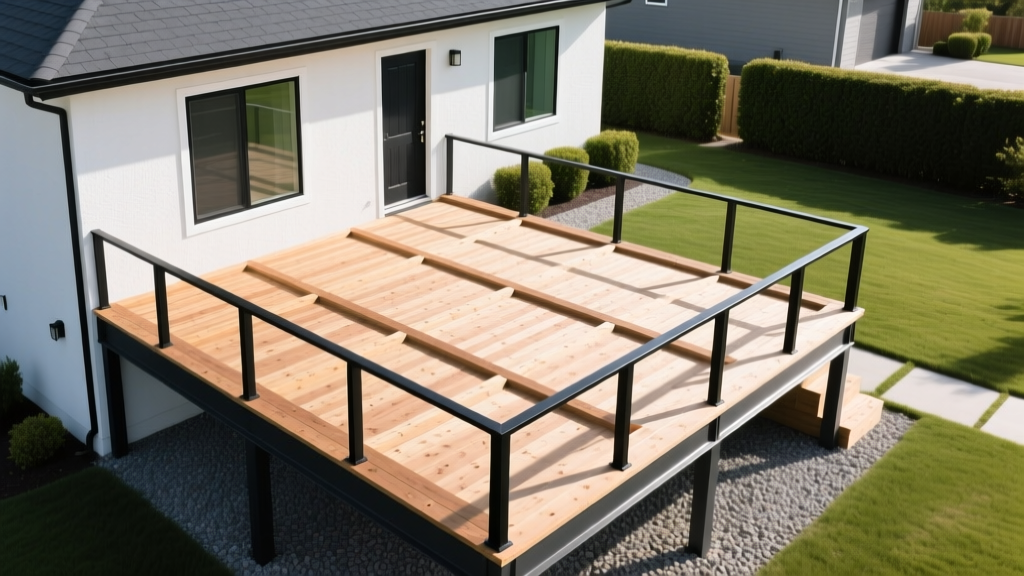
A 10x10 deck is not merely 100 square feet of surface decking. To accurately calculate costs, you must account for the complete structural assembly. A standard attached 10x10 deck requires:
- Foundation: 6 to 8 concrete footings (typically 12-inch diameter Sonotubes) extending below the local frost line.
- Framing: A pressure-treated ledger board, 2x8 or 2x10 joists spaced at 16 inches on-center (OC) for wood, or 12 inches OC for most composite brands.
- Surface: 105 square feet of decking material (accounting for 5% waste and cuts).
- Railing: Approximately 30 linear feet of railing (assuming the 10-foot side is attached to the house).
- Egress: One set of 3-step stair stringers with treads and risers.
Material Tier Selection & Cost Breakdown
The decking surface and railing system dictate 60% to 75% of your total material budget. Below is the 2026 cost matrix for a 10x10 deck, isolating material costs from professional labor.
| Material Tier | Surface & Railing Material Cost | Pro Labor Cost | Total Installed Cost (10x10) | Expected Lifespan |
|---|---|---|---|---|
| Pressure-Treated Pine (PT) | $1,200 - $1,800 | $2,500 - $3,500 | $3,800 - $5,300 | 15 - 20 Years |
| Capped Wood-Composite | $2,800 - $4,200 | $3,500 - $4,800 | $6,300 - $9,000 | 25 - 30 Years |
| Cellular PVC / Exotic Hardwood | $4,500 - $7,000 | $4,500 - $6,500 | $9,000 - $14,500+ | 30 - 50+ Years |
Tier 1: Pressure-Treated Southern Yellow Pine
PT lumber remains the most economical choice. For a 10x10 deck, you will need approximately 70 linear feet of 5/4x6 decking boards. While the upfront material cost is low (roughly $2.50 to $3.50 per linear foot in 2026), PT wood requires annual sealing and staining. Failure to maintain the boards leads to cupping, checking, and premature rot at the joist intersections.
Tier 2: Capped Wood-Composite
Composite decking, such as Trex Transcend or TimberTech Terrain, features a high-density polyethylene (HDPE) shell over a wood-flour core. Material costs range from $8.00 to $12.00 per linear foot. Crucially, composite boards require tighter joist spacing (12 inches OC for diagonal layouts or standard 16 inches OC for perpendicular), which increases your framing lumber and labor costs by approximately 15% compared to a wood deck.
Tier 3: Cellular PVC and Exotic Hardwoods
Cellular PVC (e.g., Azek Landmark) contains no wood fibers, making it entirely impervious to moisture and insects. Exotic hardwoods like Ipe or Cumaru offer extreme density (Janka hardness ratings over 3,500 lbf) but require specialized carbide-tipped saw blades and pre-drilling for every fastener. Both options push a 10x10 build into the luxury pricing tier, often exceeding $120 per square foot fully installed.
Labor Variables: DIY vs. Professional Installation
Labor typically accounts for 50% to 65% of the total project cost. According to HomeGuide's 2026 deck cost analysis, professional deck builders charge between $30 and $45 per square foot for labor, depending on regional wage differences and site accessibility.
Building a 10x10 deck DIY saves $3,000 to $5,000 in labor, but structural errors are costly. If your ledger board is improperly flashed or bolted with lag screws instead of 1/2-inch structural carriage bolts, the deck risks catastrophic detachment. Always consult the American Wood Council's DCA-6 Prescriptive Residential Wood Deck Construction Guide for exact fastening schedules and joist span tables before pouring concrete.
Hidden Cost Triggers in 10x10 Builds
When calculating how much it would cost to build a 10x10 deck, homeowners frequently overlook site-specific variables that inflate the final invoice:
- Demo and Haul-Away: Removing an existing 10x10 wood deck adds $600 to $1,200 in labor and dumpster fees.
- Grade Correction: If the soil slopes toward the house, you may need to excavate and install retaining blocks, adding $400 to $800.
- Permitting and Inspections: Municipal building permits for a 100-square-foot structural addition typically range from $150 to $450, requiring three separate inspections (footing, framing, and final).
- Electrical and Lighting: Adding low-voltage LED stair riser lights or post-cap lighting requires a licensed electrician to run a dedicated exterior circuit, adding $800 to $1,500.
The Decision Framework: Matching Budget to Material
Use this framework to select the right material tier based on your total available capital for the 10x10 project:
Scenario A: Strict Budget (Under $5,500)
Selection: Pressure-Treated Pine framing and decking with standard wood balusters.
Strategy: Execute the build DIY to eliminate labor costs. Purchase pre-cut stair stringers and use standard 4x4 wood posts with post-cap railings. Invest the saved capital into a high-quality penetrating oil sealer (e.g., TWP 1500 series) to maximize the wood's lifespan.
Scenario B: Balanced Longevity ($6,500 - $9,500)
Selection: Pressure-Treated framing with Capped Composite decking and aluminum railings.
Strategy: Hire a professional contractor for the framing and footing installation to guarantee structural integrity and code compliance. Upgrade to hidden fastener systems (like the CAMO Edge Deck Fastening System) to eliminate surface screws, which reduces future maintenance and provides a clean, modern aesthetic.
Scenario C: Zero-Maintenance Luxury ($10,000+)
Selection: Cellular PVC decking, steel deck framing (e.g., Trex Elevations), and glass or cable railings.
Strategy: Steel framing prevents the joist warping that can cause PVC boards to buckle over time. Pair this with a fully integrated lighting system and a custom-built bench or planter box to maximize the utility of the 100-square-foot footprint.
Structural & Fastener Specifications
The longevity of your 10x10 deck relies heavily on the hardware connecting the framing. Standard galvanized nails are no longer acceptable for structural connections. Modern building codes require hot-dip galvanized (HDG) or stainless steel structural screws and joist hangers.
For the ledger board connection, use Simpson Strong-Tie DTT2Z deck tension ties to resist the lateral load of the deck pulling away from the house. For joist hangers, use the specified 1.5-inch SD connector screws rather than generic nails. When fastening composite or PVC decking, always use color-matched, ceramic-coated composite deck screws (minimum #9 or #10 gauge, 2.5 inches long) to prevent mushrooming and ensure the fastener bites through the denser composite core into the joist.
Frequently Asked Questions
Do I need a permit for a 10x10 deck?
In most municipalities, any deck attached to a house or built more than 30 inches above grade requires a building permit. A 10x10 deck almost always requires footings that must be inspected before concrete is poured. Always check with your local building department, as unpermitted structures can result in fines and complicate future real estate transactions.
Can I use 4x4 posts for a 10x10 deck?
While older codes permitted 4x4 posts, recent International Residential Code (IRC) updates, along with most local 2026 amendments, strongly recommend or mandate 6x6 posts for all structural deck supports. 4x4 posts are prone to twisting and checking as they cure, which can compromise the structural integrity of the beam-to-post connection over time.
Written by
Marcus ChenMarcus Chen is a licensed structural engineer (PE) and building materials analyst with over 12 years of experience across residential, commercial, and industrial construction. He holds a Master of Science in Civil Engineering from UC Berkeley and spent six years at Thornton Tomasetti before transitioning to independent consulting and technical writing. Marcus specializes in material selection for seismic-prone regions, concrete reinforcement strategies, and lifecycle cost analysis. His work has been cited by the American Concrete Institute (ACI) and the Structural Engineers Association of California (SEAOC). When he is not on a job site or at his desk, you will find him hiking the Sierra Nevada or restoring a 1920s craftsman bungalow in Oakland, CA.
More from Marcus Chen
View all
Construction Cost
How Much Did the Eiffel Tower Cost to Build?
How much did the Eiffel Tower cost to build in 1889? We adjust for inflation and compare its budget to modern skyscraper construction.
Aug 4, 2026

Fire Resistance
What Is a Fire Resistant Material? Testing & Certification Guide
Discover what is a fire resistant material through ASTM and UL testing. Learn how fire ratings, certifications, and assemblies work in construction.
Aug 4, 2026

Construction Cost
How Much Did the Burj Khalifa Cost to Build?
How much did the Burj Khalifa cost to build? We break down the $1.5B project and extract 5 money-saving strategies for your next build.
Jul 30, 2026