Synthetic Deck Material Costs: 2026 Price Per Square Foot Guide
Discover the true cost of synthetic deck material in 2026. We break down pricing per square foot for composite, PVC, and mineral-based boards.
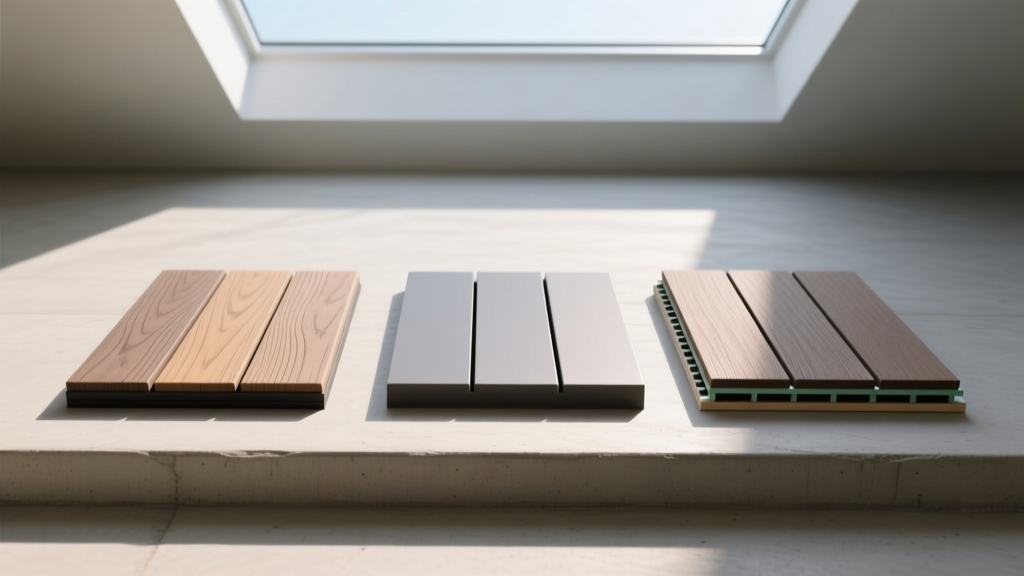
The True Cost of Synthetic Deck Material in 2026
Transitioning from pressure-treated lumber to a synthetic deck material requires a significant upfront investment, but the long-term elimination of staining, sealing, and board replacement shifts the financial calculus. In 2026, the national average for synthetic decking materials ranges from $7.50 to $16.00 per square foot, depending on the core composition and cap technology. When factoring in substructure upgrades, hidden fasteners, and specialized labor, total installed costs typically land between $35.00 and $65.00 per square foot.
- Material Only: $3,000 – $6,400
- Labor & Hardware: $8,000 – $16,000
- Total Installed: $11,000 – $22,400
Material Pricing Matrix by Core Technology
Not all synthetic boards are manufactured equally. The market is currently divided into three primary categories: capped wood-plastic composite (WPC), cellular PVC, and mineral-based composite (MBC). According to HomeGuide's composite decking cost data, cellular PVC commands the highest premium due to its zero wood-flour content, making it entirely immune to moisture absorption and fungal decay.
| Material Type | Top 2026 Product Lines | Material Cost / Sq. Ft. | Best Application |
|---|---|---|---|
| Capped WPC (Standard) | Trex Enhance, Fiberon Good Life | $7.50 – $9.50 | Budget-conscious upgrades, standard residential decks |
| Capped WPC (Premium) | Trex Transcend Lineage, TimberTech Legacy | $10.00 – $13.50 | High-traffic areas, deep wood-grain aesthetics |
| Cellular PVC | TimberTech AZEK Landmark, Wolf Serenity | $12.50 – $16.00 | Dockside, pool surrounds, high-moisture climates |
| Mineral-Based (MBC) | Deckorators Voyage, Vault | $9.00 – $12.00 | Ground-contact installations, extreme temperature swings |
The Hidden Budget Killers: Substructure and Hardware
Homeowners frequently calculate their budget based solely on the square footage of the deck surface. This leads to severe underfunding when the contractor presents the final invoice. The substructure and fastening systems represent 20% to 30% of your total material costs.
Joist Spacing and Framing Upgrades
Standard pressure-treated pine framing costs roughly $4.00 to $6.00 per square foot. However, synthetic deck material is heavier and more flexible than wood. While standard WPC boards require 16-inch on-center (OC) joist spacing for perpendicular installation, you must reduce the spacing to 12-inch OC if you plan to lay the boards diagonally at a 45-degree angle. This increases your framing lumber requirements by approximately 30%.
Furthermore, applying a butyl joist tape (such as Trex Protect or G-Tape) is mandatory to prevent the pressure-treated joists from rotting out before the 50-year synthetic decking warranty expires. Expect to pay $25 to $35 per 50-foot roll of butyl tape, adding roughly $0.75 per square foot to the project.
Hidden Fasteners vs. Face Screws
The method you choose to secure the boards drastically alters both the aesthetic and the budget:
- Hidden Clip Systems (e.g., Trex Hideaway, TimberTech CONCEALoc): Cost approximately $1.50 to $2.50 per square foot. These stainless steel or polymer clips screw into the joist and lock into the grooved edges of the boards. They require specialized installation tools and add roughly 15% to labor time.
- Color-Matched Face Screws (e.g., TimberTech Cortex): Cost roughly $110 per box (covers 300 sq. ft.). These screws drill directly through the face of the board and are concealed with a matching composite plug. This is the required method for stair treads, fascia boards, and picture-framing borders where grooved edges cannot be used.
- Top-Down Hidden Fasteners (e.g., CAMO Marksman): Cost around $70 for the tool and $80 per box of 1,750 screws. This system drives screws at an angle through the edge of solid (non-grooved) boards, leaving a nearly invisible entry point.
If your design includes a "picture frame" border (a single board running perpendicular around the perimeter to hide the end-cuts of the field boards), you will need to install additional blocking beneath the perimeter. This requires extra framing lumber, specialized fascia screws, and increases labor complexity, typically adding $3.00 to $5.00 per linear foot to the final cost.
Fascia, Stair Treads, and Trim: The Overlooked Expenses
Synthetic deck material pricing is almost always advertised based on standard 16-foot or 20-foot field boards. Trim components are priced entirely differently and carry massive markups.
Synthetic Fascia Boards
To cover the exposed rim joists, you must use synthetic fascia. These boards are typically 1/2-inch to 1-inch thick PVC or composite and cost between $45 and $85 per 12-foot length. A standard 400-square-foot deck requires roughly 80 linear feet of fascia, translating to $300 to $570 just for the perimeter trim material.
Stair Treads and Risers
Synthetic stair treads are not sold by the square foot; they are sold as individual, thick-profiled boards designed to handle concentrated foot traffic and span open stringers. Expect to pay $60 to $120 per tread. A standard staircase with 10 treads will add $600 to $1,200 to your material budget. If your local building code requires closed risers, you will also need to purchase synthetic riser boards, adding another $300 to $500 to the stair assembly.
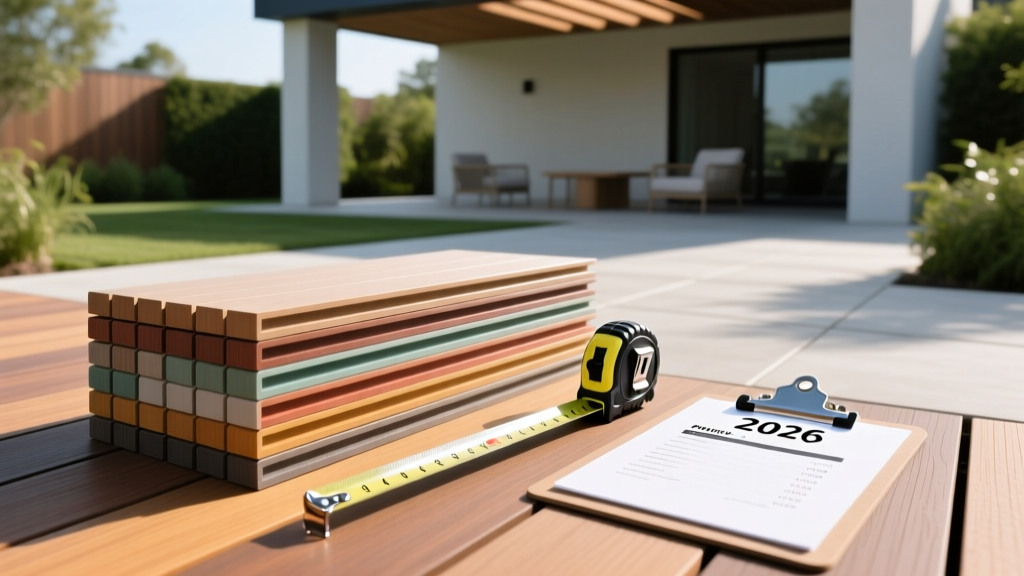
Labor Variables That Inflate Your Quote
According to Forbes Home Improvement's decking analysis, labor for synthetic installations is inherently more expensive than wood. Contractors charge a premium because synthetic boards require specific carbide-tipped blades to prevent melting the polymer caps, and the hidden fastening systems demand meticulous alignment.
- Standard Rectangular Deck (Ground Level): $18.00 – $25.00 per sq. ft. for labor.
- Elevated Deck (Second Story): $25.00 – $35.00 per sq. ft. due to scaffolding, material hoisting, and complex stair integration.
- Complex Patterns (Herringbone/Parquet): Add 30% to 50% to the base labor rate. Diagonal and geometric cuts increase the waste factor from the standard 10% up to 20%, and require significantly more blocking and precision cutting.
- Demolition and Haul-Away: Tearing down an existing wood deck and disposing of the debris typically costs $4.00 to $8.00 per square foot, depending on local landfill tipping fees.
Long-Term ROI: Synthetic vs. Pressure-Treated Wood
While the initial invoice for a synthetic deck material is roughly 2.5 to 3 times higher than pressure-treated pine, the 10-year total cost of ownership tells a different story. Pressure-treated wood requires annual cleaning, bi-annual sanding, and professional sealing every 2 to 3 years. Professional deck sealing costs an average of $2.50 to $4.00 per square foot. Over a decade, maintaining a 400-square-foot wood deck will cost between $3,000 and $5,500 in labor and materials.
"Homeowners often experience sticker shock at the point of sale for PVC or premium composite. However, when we map out the 15-year maintenance schedule of a wood deck—including the inevitable replacement of warped boards and popped nails—the synthetic option breaks even around year seven, assuming the homeowner values their own time at a standard hourly rate."
Pro Tips for Ordering and Minimizing Waste
- Calculate the Waste Factor Accurately: Order 10% extra material for standard perpendicular layouts. If you are installing diagonally or utilizing a herringbone pattern, increase your overage order to 18% to account for the off-cuts.
- Batch Your Dye Lots: Synthetic boards are manufactured in specific dye lots. If you under-order and have to request more material from a different production batch weeks later, you will likely see a noticeable color variance in direct sunlight. Always order all field boards, fascia, and treads in a single purchase order.
- Consider Steel Framing for Longevity: If you are investing in a premium PVC deck with a 50-year warranty, pairing it with pressure-treated pine joists (which typically last 15-20 years before structural degradation) creates a bottleneck. Upgrading to a steel framing system (like Trex Elevate or Fortress Evolution) adds $8.00 to $12.00 per square foot but ensures the substructure outlasts the decking itself.
Final Verdict: Budgeting for Success
When planning a build around synthetic deck material, base your initial budget on a minimum of $45.00 per square foot for a fully installed, turnkey project using mid-tier capped composite. If you opt for cellular PVC, complex multi-level designs, or steel framing, adjust your expectations to $65.00+ per square foot. By accounting for the hidden costs of fascia, stair treads, hidden fasteners, and joist tape upfront, you will avoid the change-orders that routinely derail outdoor living budgets.
Written by
Marcus ChenMarcus Chen is a licensed structural engineer (PE) and building materials analyst with over 12 years of experience across residential, commercial, and industrial construction. He holds a Master of Science in Civil Engineering from UC Berkeley and spent six years at Thornton Tomasetti before transitioning to independent consulting and technical writing. Marcus specializes in material selection for seismic-prone regions, concrete reinforcement strategies, and lifecycle cost analysis. His work has been cited by the American Concrete Institute (ACI) and the Structural Engineers Association of California (SEAOC). When he is not on a job site or at his desk, you will find him hiking the Sierra Nevada or restoring a 1920s craftsman bungalow in Oakland, CA.
More from Marcus Chen
View all
Construction Cost
How Much Did the Eiffel Tower Cost to Build?
How much did the Eiffel Tower cost to build in 1889? We adjust for inflation and compare its budget to modern skyscraper construction.
Aug 4, 2026

Fire Resistance
What Is a Fire Resistant Material? Testing & Certification Guide
Discover what is a fire resistant material through ASTM and UL testing. Learn how fire ratings, certifications, and assemblies work in construction.
Aug 4, 2026

Construction Cost
How Much Did the Burj Khalifa Cost to Build?
How much did the Burj Khalifa cost to build? We break down the $1.5B project and extract 5 money-saving strategies for your next build.
Jul 30, 2026