Proper Maintenance for Trex Deck Material: A Complete Guide
Learn the exact cleaning protocols, stain removal techniques, and seasonal care steps to protect your Trex deck material investment year-round.

Understanding the Polymer Cap: Why Trex Deck Material Requires Specific Care
Modern Trex deck material is engineered using a co-extrusion process that wraps a high-density polyethylene (HDPE) and wood-flour core in a durable, protective polymer shell. This 'capped' composite design is what gives lines like Trex Transcend, Trex Select, and Trex Enhance their superior resistance to fading, staining, and mold. However, a common misconception is that capped composite requires zero maintenance. In reality, it requires specific maintenance. Using the wrong chemicals or abrasive tools can compromise the UV inhibitors embedded in the polymer cap, leading to premature fading or micro-etching that traps dirt.
Furthermore, while the Trex deck material itself is impervious to rot, the pressure-treated pine or galvanized steel substructure beneath it is not. Failing to clear the 1/4-inch to 3/8-inch gaps between the deck boards allows organic matter to trap moisture against the joists, leading to substructure decay. Proper maintenance of your Trex deck material is as much about protecting the framing as it is about preserving the surface aesthetics.
The Routine Cleaning Protocol
For general dirt, pollen, and environmental grime, a semi-annual cleaning (spring and fall) is sufficient to maintain the appearance of your Trex deck material. Follow this exact sequence to avoid pushing dirt deeper into the embossed wood-grain texture.
- Clear the Gaps First: Use a stiff putty knife or a specialized deck gap tool to clear leaves, pine needles, and debris from between the boards. This ensures proper water drainage and protects your wooden joists from moisture retention.
- Pre-Rinse with a Garden Hose: Spray the deck with a standard garden hose to loosen surface dirt. Do not use a pressure washer for this initial step, as blasting dry dirt can scratch the polymer shell.
- Apply the Correct Cleaning Solution: Mix warm water with a mild, non-bleach dish soap (such as Dawn) or Murphy's Oil Soap. Avoid detergents containing sodium hypochlorite (bleach) or heavy industrial degreasers, which can strip the UV protectants from the cap.
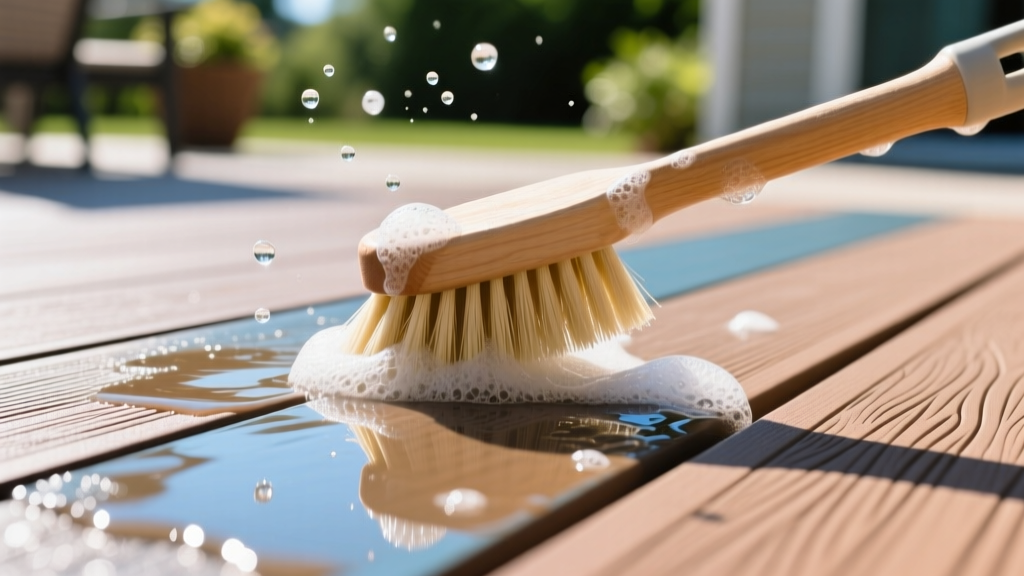
- Scrub with a Nylon Bristle Brush: Use a medium-soft nylon-bristle brush (approx. 0.015-inch bristle diameter). Scrub in the direction of the embossed wood grain to lift dirt out of the texture. Never use wire brushes or stiff bristle brooms, as they will leave permanent micro-scratches.
- Thorough Rinse: Rinse the deck completely with clean water before the soap dries. Dried soap residue will leave a hazy, streaky film that attracts more dirt over time.
Stain Removal Troubleshooting Matrix
Accidents happen, especially during summer barbecues. Because the polymer cap is non-porous, most stains sit on the surface, but they must be treated correctly to avoid chemical damage to the Trex deck material.
| Stain Type | Common Source | Recommended Solution | Prohibited Actions |
|---|---|---|---|
| Grease & Oil | Grill drippings, cooking oil | Hot water and heavy-duty dish soap (Dawn). Blot, do not rub. | Solvents like acetone or paint thinner (will melt the polymer cap). |
| Tannin Bleed | Wet oak leaves, pine needles, berries | Oxalic acid-based composite deck brightener. Apply, wait 10 mins, rinse. | Bleach or chlorine-based cleaners (will lighten the board color permanently). |
| Rust | Metal furniture, planters, nails | Commercial rust remover safe for composites (e.g., Whink). Spot test first. | Sanding or steel wool (will scratch the cap and expose the HDPE core). |
| Hard Water / Mineral | Sprinkler overspray, unsoftened hose water | White vinegar and water solution (50/50 mix). Wipe and rinse thoroughly. | Muriatic acid or harsh masonry cleaners. |
| Sunscreen / Bug Spray | Lotion spills, aerosol overspray | Mild soap and warm water. Wipe immediately to prevent oil absorption. | Allowing to bake in the sun; using abrasive scouring pads. |
Seasonal Care: Winter Snow and Ice Management
Winter maintenance is where many homeowners inadvertently destroy their Trex deck material. The polymer cap is highly resistant to cold temperatures, but the physical removal of snow and ice requires strict adherence to composite-safe practices.
Approved vs. Prohibited Snow Removal Tools
- APPROVED: Plastic-blade snow shovels with a rounded edge. Push the snow rather than lifting it to avoid catching the shovel edge on the board seams.
- APPROVED: Calcium chloride or rock salt (sodium chloride) to melt ice. According to the Trex Official Care and Cleaning Guide, these are safe for the polymer cap, but you must sweep away the salt residue and rinse the deck with warm water as soon as the ice melts to prevent white, chalky residue from settling into the wood-grain texture.
- PROHIBITED: Metal shovels, ice choppers, or steel scrapers. These will gouge the polymer shell instantly.
- PROHIBITED: Sand or kitty litter for traction. Sand contains silica and quartz, which are highly abrasive. Walking on sand scattered over a composite deck acts like sandpaper, permanently dulling the finish and creating micro-grooves that will trap dirt all summer.
- PROHIBITED: Ice melt products containing colorants or dyes, which can stain the lighter-colored Trex Select and Enhance boards.
Addressing Scratches, Scuffs, and Heat Damage
Unlike traditional wood decking, you cannot simply sand down a scratch on Trex deck material. Sanding a capped composite board will completely remove the protective polymer shell, exposing the porous HDPE and wood-flour core underneath. Once exposed, this core will rapidly fade, absorb stains, and become susceptible to mold.
For minor surface scuffs caused by dragging patio furniture, experts at This Old House recommend using a heat gun on a low setting. By gently warming the polymer cap (keeping the gun moving to avoid melting or warping the board), the polymers can slightly relax and blend the scuff mark back into the surrounding texture. For deeper scratches, your only viable option is to use a composite decking touch-up pencil matched to your specific board color (e.g., Spiced Rum, Rope Swings, or Foggy Wharf), or to flip the board over if the scratch is severe, as many Trex lines feature a usable, albeit less textured, reverse side.
Long-Term Cost Analysis: Trex vs. Pressure-Treated Wood
When evaluating the true cost of outdoor living spaces, the initial material price is only half the equation. The maintenance profile of Trex deck material offers a distinct financial advantage over time, primarily by eliminating the need for chemical sealants, stains, and intensive power washing.
Pressure-Treated Wood: Requires sanding and re-sealing every 2 years. At an average contractor rate of $2.50 per sq. ft., or $0.85 per sq. ft. for DIY materials, a 500 sq. ft. deck costs roughly $2,125 to $4,250 in maintenance over a decade.
Trex Deck Material: Requires only bi-annual soap-and-water cleaning. Cost of composite deck cleaner and soap averages $40 per year. Total 10-year maintenance cost: $400.
Net Savings: Up to $3,850 over 10 years, effectively offsetting the higher upfront premium of composite decking.
Ultimately, maintaining Trex deck material is about working with the engineered polymer cap rather than against it. By avoiding harsh abrasives, clearing the substructure gaps, and using targeted, composite-safe chemicals for stubborn stains, you will ensure your deck retains its structural integrity and visual appeal for its entire 25-year limited warranty lifespan. For further reading on composite material longevity, Bob Vila's Composite Decking Cleaning Guide provides excellent supplementary tips on managing high-traffic composite surfaces.
Written by
Marcus ChenMarcus Chen is a licensed structural engineer (PE) and building materials analyst with over 12 years of experience across residential, commercial, and industrial construction. He holds a Master of Science in Civil Engineering from UC Berkeley and spent six years at Thornton Tomasetti before transitioning to independent consulting and technical writing. Marcus specializes in material selection for seismic-prone regions, concrete reinforcement strategies, and lifecycle cost analysis. His work has been cited by the American Concrete Institute (ACI) and the Structural Engineers Association of California (SEAOC). When he is not on a job site or at his desk, you will find him hiking the Sierra Nevada or restoring a 1920s craftsman bungalow in Oakland, CA.
More from Marcus Chen
View all
Construction Cost
How Much Did the Eiffel Tower Cost to Build?
How much did the Eiffel Tower cost to build in 1889? We adjust for inflation and compare its budget to modern skyscraper construction.
Aug 4, 2026

Fire Resistance
What Is a Fire Resistant Material? Testing & Certification Guide
Discover what is a fire resistant material through ASTM and UL testing. Learn how fire ratings, certifications, and assemblies work in construction.
Aug 4, 2026

Construction Cost
How Much Did the Burj Khalifa Cost to Build?
How much did the Burj Khalifa cost to build? We break down the $1.5B project and extract 5 money-saving strategies for your next build.
Jul 30, 2026