True Trex Decking Cost: 2026 Lifespan and ROI Analysis
Analyze the true Trex decking cost in 2026. We break down material prices, 25-year lifespan durability, maintenance savings, and long-term ROI vs wood.
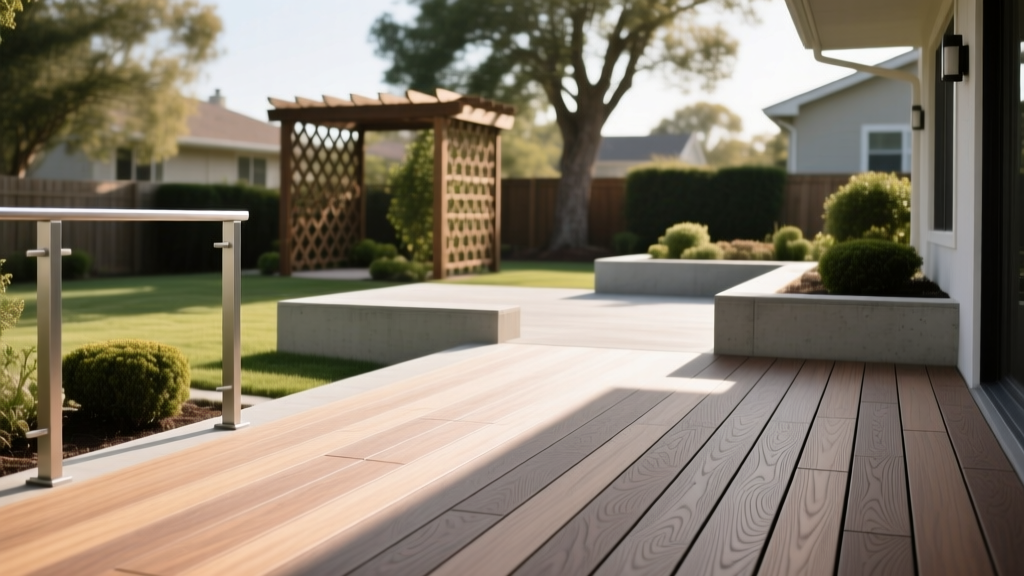
Calculating the true Trex decking cost requires looking past the initial material invoice. While pressure-treated pine demands $3.50 to $5.00 per square foot in raw materials, Trex composite boards command $9.00 to $18.50 per square foot. However, evaluating deck economics through a 25-year lifecycle lens fundamentally shifts the return on investment (ROI) calculation. When factoring in the elimination of annual sealing, the prevention of rot-related board replacements, and the structural integrity of the polymer cap, the long-term financial gap between composite and wood narrows significantly.
2026 Material Pricing by Trex Product Tier
Trex segments its composite lineup into three distinct tiers, each utilizing a different ratio of reclaimed wood fibers and recycled polyethylene plastic, topped with a protective polymer shell. Material costs below reflect 2026 market averages for 16-foot grooved-edge boards, excluding fasteners, framing, and labor.
| Product Line | Cap Technology | Material Cost (Per Sq. Ft.) | Durability Profile & Best Use |
|---|---|---|---|
| Trex Enhance | 3-Sided Architectural Cap | $9.00 - $11.50 | Entry-level composite. Susceptible to surface scratching. Best for low-traffic residential decks or budget-conscious upgrades. |
| Trex Select | 3-Sided Protective Cap | $12.00 - $14.50 | Mid-tier with enhanced stain resistance. Withstands moderate furniture dragging. Ideal for standard family decks and outdoor dining areas. |
| Trex Transcend | 3-Sided Premium Shell | $15.50 - $18.50 | Maximum fade, stain, and scratch resistance. Deep wood-grain embossing. Required for high-traffic zones, commercial spaces, and heavy grill use. |
Note: Installed costs (including pressure-treated joist framing, hidden fasteners, and skilled labor) typically add $18.00 to $28.00 per square foot, bringing the total turnkey Trex decking cost to between $27.00 and $46.50 per square foot.
The 25-Year Lifecycle Cost Analysis
To understand the actual financial impact of composite decking, we must model the 25-year cost of ownership. According to the Remodeling Magazine Cost vs. Value Report, composite deck additions consistently recoup a higher percentage of their initial cost at resale compared to wood decks, largely due to buyer aversion to immediate maintenance liabilities.
Trex Transcend vs. Pressure-Treated Pine (400 Sq. Ft. Deck)
- Initial Material & Labor: Trex Transcend (~$16,800) vs. PT Pine (~$8,400).
- Bi-Annual Maintenance (Wood Only): Professional cleaning, sanding, and sealing every 2 years costs roughly $1,200 per cycle. Over 24 years (12 cycles), this equals $14,400.
- Board Replacement (Wood Only): Expecting a 10% failure rate due to checking, splintering, or joist-rot over 25 years adds ~$850 in material and labor.
- Trex Maintenance: Bi-annual soap-and-water washing. Cost: $0 (assuming DIY).
- 25-Year Total Cost of Ownership: Trex Transcend ($16,800) vs. PT Pine ($23,650).
Structural Durability and Real-World Failure Modes
Trex boards themselves will easily outlast their 25-year limited residential fade and stain warranty period. However, the system's lifespan is dictated by installation precision. The most common cause of premature composite deck failure is not the board degrading, but the substructure failing or the boards warping due to ignored physics.
1. Joist Spacing and Sagging
Unlike 5/4x6 pressure-treated wood, which can span 24 inches on center (OC) without issue, composite decking is denser and more flexible. Critical Specification: Trex requires a maximum joist spacing of 16 inches OC for straight lay patterns, and 12 inches OC for diagonal patterns. Ignoring this results in visible sagging between joists, especially when the boards heat up and soften in direct summer sunlight.
2. Thermal Expansion and Contraction
Composite materials expand and contract at a higher rate than natural wood. If installed tightly end-to-end, boards will buckle when temperatures peak. The Rule of Thumb: Leave a 1/4-inch gap for every 10 feet of board length at the time of installation, assuming an ambient temperature of 70°F. If you are installing in 40°F weather, increase the gap to 3/8 inch to allow for summer expansion.
3. Moisture Trapping and Substructure Rot
Trex boards are highly resistant to moisture ingress, but they can trap water against the wooden joists below if debris is allowed to accumulate. In deep shade or heavily forested environments, organic matter (leaves, pine needles) can hold moisture against the uncapped bottom edge of the board, leading to mold growth on the surface and accelerated rot on the wooden joist beneath. Using joist tape (butyl flashing tape) over all framing members before laying the deck boards is a non-negotiable best practice to protect the wood substructure.
Heat Retention: The UV and Temperature Factor
A frequent critique of composite decking is heat retention. Early-generation composites (pre-2010) absorbed massive amounts of solar radiation. Modern Trex lines utilize advanced UV-inhibiting polymer caps that reflect more light, but color selection remains the primary variable for surface temperature.
- Dark Colors (e.g., Spiced Rum, Tiki Torch): Can reach surface temperatures of 140°F to 155°F in direct, 90°F summer sunlight. Barefoot traffic is uncomfortable or unsafe.
- Medium Tones (e.g., Lava Rock, Winchester Grey): Typically peak between 120°F and 135°F.
- Light Colors (e.g., Rope Swing, Island Mist): Remain 20°F to 30°F cooler than dark boards, generally staying below 115°F, making them the mandatory choice for south-facing decks in southern climates or areas with high barefoot traffic.
Expert Verdict: When the Premium is Justified
The decision to absorb the higher initial Trex decking cost should be based on your specific environmental conditions and long-term property plans.
| Scenario | Recommendation | Rationale |
|---|---|---|
| Primary Residence (10+ Year Hold) | Trex Transcend or Select | ROI is realized through eliminated maintenance and higher resale value. The 25-year warranty aligns with your ownership timeline. |
| Deep Shade / Heavy Tree Cover | Trex Select or PVC Alternative | While Trex resists rot, surface mold can grow on organic debris resting on the boards. Lighter colors and frequent sweeping are required. Pure PVC (like AZEK) may be better for perpetually damp, shaded environments. |
| Investment Property / Flip | Trex Enhance or PT Wood | Enhance provides the 'composite' marketing appeal for buyers without the Transcend premium. If flipping immediately, premium wood with a fresh coat of stain yields a faster, cheaper turnaround. |
| Ground-Level or Floating Decks | Avoid Standard Trex | Ground-level decks lack cross-ventilation. Moisture trapped beneath the boards will cause the wood-fiber core to swell and the boards to cup. Only use fully capped, 4-sided PVC composites for decks with less than 18 inches of ground clearance. |
Ultimately, the true Trex decking cost is an investment in time. By paying a premium upfront for the Transcend or Select lines, and strictly adhering to 16-inch joist spacing and thermal gap requirements, you secure a structurally sound, visually stable outdoor space that requires zero chemical sealants and zero splinter-removal over its multi-decade lifespan.