How the Labour Cost to Build a Deck Impacts Long-Term Durability
Discover how the labour cost to build a deck impacts its lifespan. Learn pricing for premium framing, flashing, and fasteners to ensure maximum durability.

The Hidden Link Between Installer Skill and Deck Degradation
When homeowners budget for a new outdoor living space, they typically fixate on the price of the decking boards themselves. However, the true determinant of a deck's lifespan is rarely the surface material; it is the structural integrity of the substructure and the precision of its assembly. The labour cost to build a deck is directly proportional to the installation techniques employed, which in turn dictate whether your deck will last 10 years or 40 years.
Premium composite and aluminum decking brands offer 25- to 50-year fade and stain warranties. Yet, these warranties are routinely voided by improper substructure ventilation, inadequate fastening, and missing moisture barriers. If a contractor cuts corners on the labour required to flash a ledger board or tape the joists, the underlying pressure-treated pine will rot long before the composite boards show any wear. Understanding how labour pricing correlates with technical execution is critical for maximizing your return on investment.
2026 Labour Cost to Build a Deck: Standard vs. Premium Tiers
Labour rates vary significantly based on the contractor's expertise, regional market conditions, and the complexity of the design. Below is a breakdown of what you can expect to pay in 2026, and more importantly, what that money actually buys in terms of structural longevity.
| Installation Tier | Average Labour Rate (per sq. ft.) | Framing & Flashing Methods | Expected Substructure Lifespan |
|---|---|---|---|
| Budget / Standard | $14 - $20 | Basic joist hangers, no joist tape, standard lag screws for ledger, minimal ground clearance. | 10 - 15 Years |
| Professional / Code-Plus | $22 - $32 | Structural screws, butyl joist tape, self-adhering ledger flashing, proper cross-ventilation. | 20 - 30 Years |
| Premium / Master-Built | $35 - $50+ | Steel or aluminum framing, hidden fastener systems, custom flashing integrations, engineered drainage. | 40 - 50+ Years |
While the budget tier might save you $3,000 to $5,000 on a 400-square-foot deck upfront, it introduces severe long-term risks. According to the American Wood Council's Prescriptive Residential Deck Construction Guide (DCA 6), the majority of catastrophic deck failures originate at the ledger board connection due to moisture intrusion and improper fastening—issues that are entirely dependent on the skill and thoroughness of the labour force.
4 Technical Details That Justify Higher Labour Rates
To evaluate if a contractor's quote is justified, you must look past the final number and scrutinize the line items. Premium labour costs are driven by the time required to execute the following critical durability details.
1. Ledger Board Flashing and Structural Connections
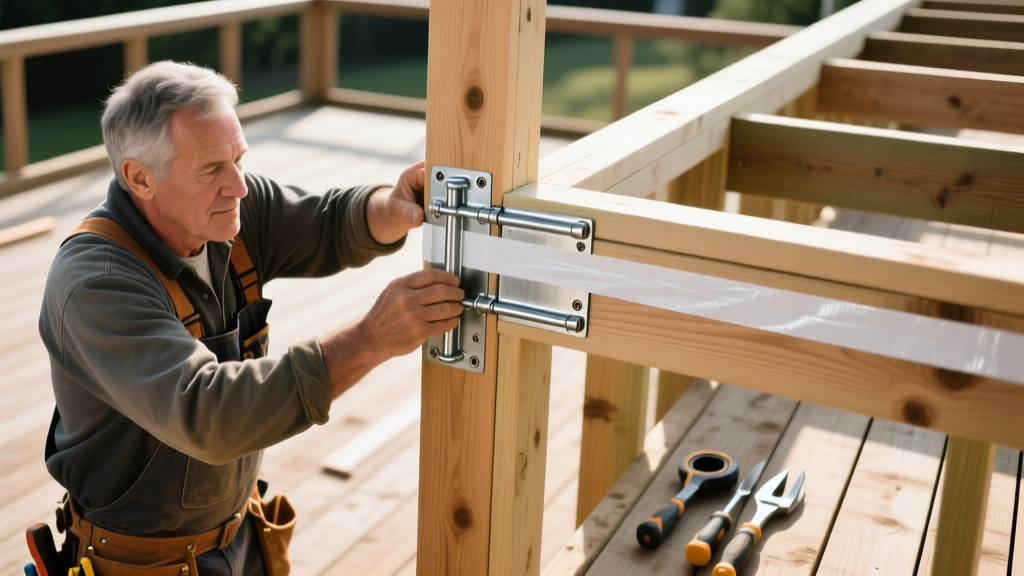
The ledger board is the single most critical structural component of an attached deck. Budget installers often rely on standard 1/2-inch galvanized lag screws and cheap metal Z-flashing. Premium installers invest the extra labour to apply a self-adhering waterproofing membrane (such as Grace Ice & Water Shield) behind the ledger, integrate it with the house wrap, and use specialized structural screws like the Simpson Strong-Tie SDWS. This meticulous layering prevents water from trapping against the home's rim joist, preventing structural rot that can compromise the house itself.
2. Joist Protection and Moisture Management
Pressure-treated lumber is resistant to decay, but it is not immune to it, especially when subjected to constant moisture from above. High-end labour includes applying a butyl-based joist tape (like G-Tape or Trex Protect) to the top of every joist and beam before the decking is laid. This tape seals around the fastener penetrations and prevents water from pooling on the horizontal wood surfaces. Skipping this step reduces the lifespan of the substructure by up to 40%, meaning you will eventually have to pay to remove and reinstall your expensive composite boards to replace rotted joists.
3. Fastener Selection and Hidden Systems
Driving top-down screws through composite or PVC boards creates entry points for moisture and leaves the surface vulnerable to splitting over time. The labour cost to build a deck increases when contractors use hidden fastener systems (such as CAMO or Trex Hideaway). These systems require precise alignment, pre-drilling in specific conditions, and specialized tools, adding 15% to 20% to the installation time. However, they eliminate surface water pooling and allow the boards to expand and contract thermally without tearing through the fastener heads.
4. Substructure Ventilation and Clearance
Composite decking requires specific airflow to prevent heat buildup and moisture trapping, which can cause the boards to warp or buckle. As outlined in Fine Homebuilding's code-compliant deck framing protocols, maintaining a minimum 12-inch clearance from the ground to the bottom of the joists is essential for unclosed decks. For low-clearance installations, premium contractors will excavate the soil, lay a heavy-duty weed barrier, and cover it with crushed gravel to eliminate ground moisture evaporation. This earthwork and site prep add significant labour hours but are non-negotiable for maximizing material lifespan.
"A deck is only as durable as its weakest connection. Investing in premium decking materials while utilizing budget-grade framing labour is the most common financial mistake homeowners make in outdoor construction."
Decision Framework: Allocating Your Labour Budget
Not every project requires the highest tier of labour. Use this framework to determine where to allocate your budget based on your specific site conditions and material choices.
- Choose Premium Labour ($35-$50/sq ft) When: You are installing high-end PVC or aluminum decking, building over living space (requiring complex under-deck drainage systems), or constructing in coastal environments where 316 stainless steel hardware and meticulous flashing are mandatory to prevent salt corrosion.
- Choose Professional Labour ($22-$32/sq ft) When: You are installing standard composite or high-grade pressure-treated wood on a standard-grade lot. Ensure the quote explicitly includes butyl joist tape, structural ledger screws, and proper cross-ventilation spacing.
- Choose Standard Labour ($14-$20/sq ft) When: You are building a ground-level, freestanding deck using basic pressure-treated pine, where substructure ventilation is naturally maximized and ledger board flashing is not required.
Red Flags in Low-Bid Labour Quotes
If a contractor's labour cost to build a deck is significantly lower than the regional average, scrutinize their proposal for these common omissions that sacrifice longevity:
- No mention of joist tape or flashing membranes: Indicates they plan to bare-back the composite directly onto the wood joists.
- Vague hardware specifications: If the quote just says "galvanized screws" rather than specifying hot-dipped galvanized or stainless steel structural screws, they are likely using cheap electroplated fasteners that will rust and streak your decking within two years.
- Omission of blocking and bracing: Proper lateral load bracing and solid blocking between joists take time but are essential for preventing the deck frame from racking and swaying over its lifespan.
Maximizing ROI on Your Labour Investment
Ultimately, the labour cost to build a deck should be viewed as an insurance policy for your material investment. Paying an extra $8 per square foot for a contractor who meticulously flashes every penetration, tapes every joist, and engineers proper drainage will extend the functional life of your outdoor space by decades. When reviewing bids, require contractors to detail their flashing, fastening, and ventilation methodologies in writing. The lowest bid is rarely the most cost-effective option when measured against the true lifespan of the structure.
Written by
Elena RodriguezElena Rodriguez is a civil engineer and technical writer specializing in concrete technology, masonry systems, and ASTM/ACI compliance. She earned her B.S. in Civil Engineering from Texas A&M University and spent a decade at a materials testing laboratory, performing over 2,000 concrete compressive strength tests and masonry prism evaluations. Elena is an ACI-certified Field Testing Technician (Grade I) and a member of ASTM Committee C12 on Natural Building Stone. She currently consults on forensic engineering cases involving concrete failures and moisture intrusion. Based in San Antonio, TX, Elena is a proud member of the Society of Women Engineers (SWE) and coaches her daughter's FIRST Robotics team.
More from Elena Rodriguez
View all
Walls & Panels
Cost Analysis: Light Gauge Steel Framing Advantages and Disadvantages
Evaluate light gauge steel framing advantages and disadvantages through a strict cost analysis lens, comparing material, labor, and lifecycle expenses.
Aug 4, 2026

Walls & Panels
Gypsum Board Types: Exact Specifications, Thickness & Dimensions
Compare standard, Type X, and moisture-resistant gypsum board types. Get exact specifications, thicknesses, dimensions, and ASTM standards for your project.
Aug 4, 2026

Fire Resistance
Best Fire-Resistant Outdoor Decking Materials: 2026 Buyer Guide
Discover the best fire-resistant outdoor decking materials for 2026. Compare Class A PVC, aluminum, and hardwood options for WUI compliance and safety.
Aug 4, 2026