Sourcing Wholesale Composite Decking Material: Contractor Guide
Learn how contractors source wholesale composite decking material. Compare direct vs. distributor pricing, MOQs, freight logistics, and warranty traps.

The Economics of Bulk: When to Buy Wholesale Composite Decking
Procuring wholesale composite decking material is not simply a matter of asking for a volume discount at a local big-box store. True wholesale pricing unlocks only when orders meet specific Minimum Order Quantities (MOQs), typically measured in full pallets or truckloads. For high-end capped composite and advanced PVC decking, a standard pallet contains between 400 and 600 linear feet of material, weighing anywhere from 2,200 to 3,000 pounds.
Contractors and custom home builders generally cross the threshold into wholesale viability when a project exceeds 1,500 square feet of deck space, or when a multi-family development requires identical SKU runs across multiple units. At this scale, bypassing retail markups yields a 20% to 35% reduction in material costs. However, accessing these tiers requires navigating a bifurcated supply chain and understanding the hidden logistical costs that can erase bulk savings if miscalculated.
Direct vs. Distributor: Navigating the Supply Chain
The route you take to source wholesale composite decking material depends entirely on your business volume and project timeline. The industry operates on a two-tier distribution model for bulk buyers.
Tier 1: Manufacturer Direct Programs
Manufacturers like Trex, TimberTech, and Fiberon operate dedicated commercial and high-volume residential divisions. Buying direct is reserved for large-scale commercial contractors, regional production builders, or distributors. According to Trex Commercial Programs, direct purchasing requires an established corporate account, proof of commercial insurance, and annual volume commitments that often exceed $250,000. The advantage is guaranteed allocation during supply shortages and direct access to engineering support for complex structural spans.
Tier 2: Specialty Pro-Desks and Lumber Distributors
For independent deck builders and mid-sized remodelers, national specialty distributors (such as Advantage Lumber, DeckWise, or regional building supply co-ops) are the primary gateway to wholesale composite decking material. These distributors hold master accounts with the manufacturers. By consolidating orders from dozens of smaller contractors, they secure truckload pricing and pass a portion of those savings down. TimberTech Commercial Solutions often routes mid-sized builders through these certified regional partners to ensure local code compliance and faster lead times.
2026 Pricing Matrix: Retail vs. Wholesale Composite Costs
Pricing fluctuates based on resin costs, freight surcharges, and seasonal demand. The table below outlines estimated Q1 2026 per-linear-foot costs for top-tier composite and PVC lines, contrasting standard retail pricing with verified wholesale tiers (assuming a minimum 3-pallet purchase).
| Brand & Product Line | Material Type | Retail Cost (Per LF) | Wholesale Cost (Per LF) | Approx. Pallet Coverage |
|---|---|---|---|---|
| Trex Enhance Basics | Scalloped Composite | $6.50 - $7.20 | $4.80 - $5.30 | 550 LF |
| Trex Transcend Lineage | Square-Edge Premium | $11.50 - $12.80 | $8.90 - $9.75 | 420 LF |
| TimberTech Prime+ | Scalloped Composite | $8.20 - $9.00 | $6.10 - $6.80 | 480 LF |
| TimberTech Landmark | Advanced PVC | $13.50 - $14.90 | $10.50 - $11.60 | 380 LF |
| Fiberon Promenade | Advanced PVC | $13.00 - $14.20 | $10.20 - $11.10 | 400 LF |
Hidden Costs and Logistics in Bulk Decking Orders
Securing a low per-linear-foot price on wholesale composite decking material is only half the battle. The physical movement of the product introduces logistical variables that must be priced into your initial estimate.
Freight Classifications and Liftgate Fees
Composite decking is exceptionally dense. A truckload of composite material easily maxes out the 45,000-pound weight limit of a standard tandem-axle trailer before it fills the physical volume of the box. When ordering Less Than Truckload (LTL) freight, composite decking is typically classified as Class 50 or 55 due to its high density and low liability for damage.
If your job site or staging warehouse lacks a commercial loading dock or a heavy-duty forklift, you must specify a liftgate service on the Bill of Lading (BOL). Failing to add a liftgate and curbside delivery designation will result in the freight carrier refusing delivery, triggering storage fees and redelivery charges that routinely exceed $350 per incident.
On-Site Storage and UV Degradation
Unlike pressure-treated lumber, which can be stickered and left to weather, uncapped composite ends and the protective polymer shells of premium boards are sensitive to prolonged, uneven UV exposure before installation.
- Stacking Limits: Never stack composite pallets more than two high. The bottom pallet will experience compression warping, leading to crowned boards that are impossible to secure flat against joists.
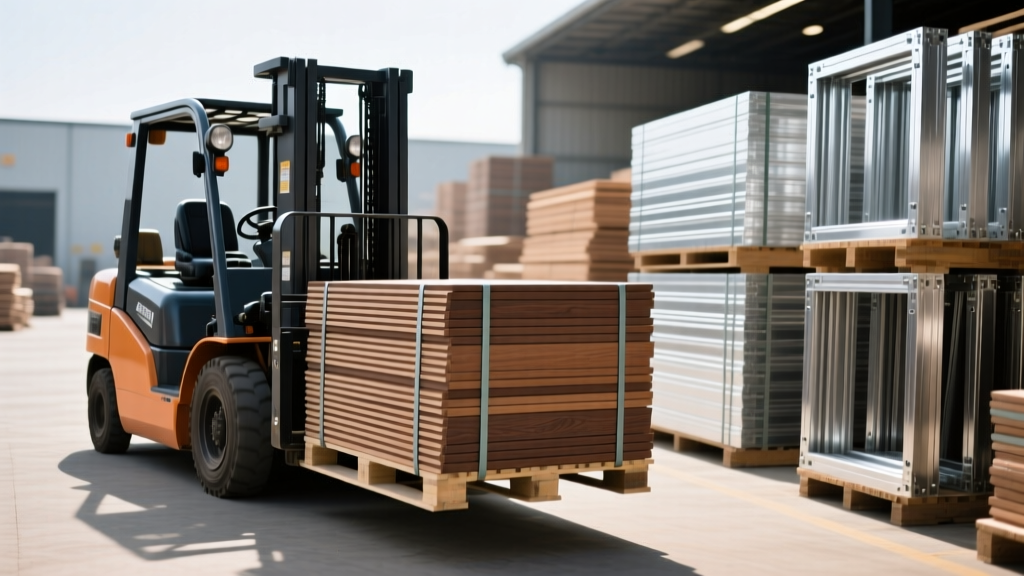
- Shrink Wrap Management: Leave the manufacturer’s UV-blocking shrink wrap intact until the exact day of installation. If the wrap is torn during forklift transit, cover the exposed bundles with opaque, breathable tarps. Trapping heat inside clear plastic wrap on a 90°F day can cause the polymer cap layer to soften and permanently deform.
The Warranty Trap: Commercial vs. Residential Applications
This is the most critical, yet frequently overlooked, aspect of sourcing wholesale composite decking material. The 25-year or 50-year fade, stain, and structural warranties advertised by major brands are strictly limited to single-family residential applications.
If you are purchasing wholesale composite decking for an apartment complex, a restaurant patio, a hotel boardwalk, or even a multi-family HOA common area, the standard residential warranty is instantly voided upon installation. You must register the project under the manufacturer’s commercial warranty program. Commercial warranties typically cap coverage at 5 to 10 years for fade and stain, and require stricter joist spacing (often 12 inches on-center instead of 16 inches) to maintain structural coverage. Always consult the NAHB Supply Chain Resources and manufacturer commercial guidelines before bidding multi-family projects.
Step-by-Step Procurement Checklist for Large Deck Builds
To execute a flawless wholesale purchase, follow this standardized procurement sequence to protect your margins and ensure material integrity.
- Calculate Exact Lineal Footage + Waste Factor: Standard straight-lay patterns require a 10% waste factor. Diagonal or complex herringbone patterns require 15% to 20%. Calculate total lineal footage, then divide by the specific product’s pallet coverage to determine full-pallet requirements.
- Request a Pro-Quote with Freight Included: Never accept a wholesale quote that lists materials and freight separately without a cap. Request a "delivered to site" (DDP) quote to shift the risk of transit damage and freight surcharges to the distributor.
- Verify Batch/Lot Numbers: Composite decking is manufactured in batches. Slight dye-lot variations can occur between production runs. Require your distributor to guarantee that all field boards ship from a single, identical lot number to prevent visible color banding on the finished deck.
- Inspect Upon Delivery (Before Signing the BOL): Break the shrink wrap on the top and bottom boards of every pallet immediately upon delivery. Check for edge cracks, polymer cap delamination, or severe crowning. Note any damage directly on the driver’s Bill of Lading and take timestamped photos. If you sign a clean BOL, the manufacturer will deny any subsequent freight damage claims.
- Acclimate the Material: Allow the composite boards to acclimate to the ambient site temperature for 48 hours before cutting and fastening. This prevents thermal expansion gaps from closing up and causing buckling if the boards were installed cold and subsequently exposed to peak summer heat.
Sourcing wholesale composite decking material requires shifting your mindset from a simple retail transaction to a complex logistics operation. By understanding the supply chain tiers, accurately forecasting freight requirements, and strictly adhering to commercial warranty parameters, contractors can significantly widen their profit margins while delivering a premium, long-lasting outdoor structure.
Written by
David NakamuraDavid Nakamura is a licensed architect (AIA) and construction technology writer focused on sustainable building methods, mass timber engineering, and high-performance building envelopes. He holds a Master of Architecture from the University of Washington and is a certified Passive House Consultant (CPHC). David spent eight years at the Seattle firm Mithun, where he led the design of three LEED Platinum projects, before founding his own practice specializing in net-zero residential design. He serves on the editorial advisory board of GreenBuilder Magazine and has authored peer-reviewed papers on cross-laminated timber (CLT) connections for the Journal of Structural Engineering. In his spare time, David teaches woodworking at Pratt Fine Arts Center and kayaks the Puget Sound.
More from David Nakamura
View all
Construction Cost
Labor Cost to Build a Deck Per Sq Ft: 2026 Installation Guide
Discover the exact labor cost to build a deck per sq ft in 2026. This installation guide breaks down contractor rates, complexity factors, and hidden fees.
Aug 4, 2026

Construction Cost
How Much Does It Cost to Build a 3 Bedroom House? Financing Guide
Learn exactly how much it costs to build a 3 bedroom house and explore 2026 financing options, construction loan types, and budget frameworks for your build.
Aug 4, 2026

Construction Cost
Cost to Build a Tennis Court: 2026 Guide
How much does it cost to build a tennis court in 2026? Breakdowns for asphalt, concrete, and synthetic surfaces plus fencing and lighting.
Jul 30, 2026